Image source: wikiart.org
Introduction
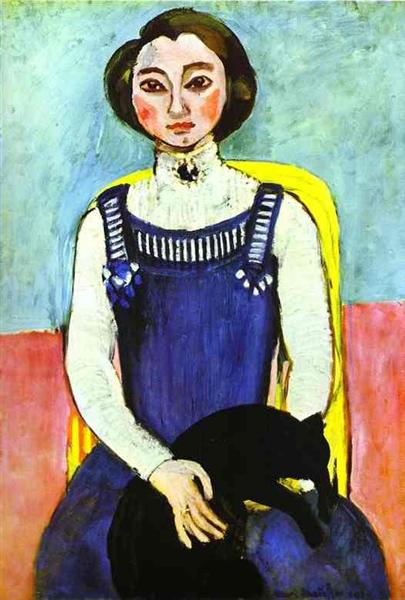
Henri Matisse’s “Girl with a Black Cat” (1910) distills portraiture to a lucid grammar of color, contour, and rhythm. A young seated figure faces us directly, framed by a high back chair. Her dark-blue pinafore dominates the center like a vertical banner; a pale blouse gathers at the throat; her cheeks glow with compressed reds; and a compact black cat settles across her lap like a curved accent. Behind her, the world is simplified into two broad bands—rose below and cool aqua-gray above—so the sitter and cat read with emblematic clarity. The painting is at once intimate and architectonic: a domestic scene turned into a modern icon where every mark has structural work to do.
Historical Moment and Matisse’s 1910 Clarity
Painted in 1910, the portrait belongs to Matisse’s pivotal years after Fauvism’s blaze and before the luxuriant interiors of Nice. By this time he had learned to harness high color into an orderly system. Rather than the riotous contrasts of 1905, his palette here is limited and balanced: cobalt and ultramarine for the dress, lemon-yellow for the chair, chalky aquas and mauves for the wall, coral for the lower register, and dense black for the cat and contour. The composition is meticulously simple, closer to a decorative panel than a salon portrait. Matisse’s aim was to produce pictures that read instantly at a distance and unfold slowly up close; “Girl with a Black Cat” does both.
Composition: A Stable Scaffold with Living Accents
Matisse organizes the rectangle around strong verticals and anchored symmetry. The figure’s head sits near the top third, the shoulders broadening into the rectangle of the pinafore, and the forearms falling to the lap where the cat forms a rounded bar. The high chair back, a lemon-yellow curve, encloses the figure like a halo and pins her to the background plane. The upper wall is a single, cool field; the lower is a warm rose band that touches the figure at the hips, giving the composition a gentle horizon. Because the background is so spare, the smallest deviations from symmetry—the tilt of the head, the droop of the cat’s paw, the slight angle of the right arm—become expressive events.
The Cat as Counterform and Anchor
The black cat is far more than a charming accessory. As a dense, simplified curve it anchors the composition’s lower half and acts as a counterform to the girl’s blue dress. Where the dress descends in long, vertical notes, the cat rounds horizontally, creating a cross of movements that keeps the eye circling rather than falling through. Its matte, featureless darkness absorbs the surrounding brightness and stabilizes the picture’s temperature. Because its head and paw are only lightly indicated, the animal becomes a living silhouette—felt first as shape, then as companion. The girl’s left hand, gently nested in the cat’s fur, is one of the painting’s tender pivots: it binds human and animal, form and counterform.
Color Architecture and Temperature
The portrait’s climate arises from two chord families. The first is cool: blue dress, aqua wall, neutral grays; the second is warm: coral floor band, yellow chair, rouge on the cheeks and lips. Matisse keeps these families in dynamic balance. The blue of the dress is deep enough to command the center but varied enough—darker at the pleats, lighter near the bodice—to keep it from reading as a flat slab. The yellow chair is a bright echo that vibrates against the blue without clashing. The coral band at the bottom lifts the composition’s weight, warming the cat’s darkness so it feels plush rather than heavy. Because there are so few hues, each relationship counts; the painting’s serenity lies in the exactness of those intervals.
Contour as Conductor of Rhythm
Matisse draws the figure with powerful brush-drawn contours that thicken and thin like a melodic line. A confident loop secures the cheek and jaw; the eyes are shaped with calligraphic strokes; the bodice seams are reinforced with vertical bars that behave as both drawing and pattern. Around the cat, a single, warm-black line clarifies the back’s arc and indicates the lifted paw with a minimal hook. These contours do not lock the color in place; they make it ring. By letting the line carry so much structural information, Matisse can keep the interior modeling spare and the surface clean.
The Face: Planes, Rosy Temperature, and Dignity
The girl’s face is built from a small number of planes, each a distinct temperature. A rosy oval lights the cheeks; cooler grays cool the forehead and the side of the nose; a delicate greenish tint—common in Matisse’s portraits—sets the shadow under the lower lip and at the neck. The eyes are slightly asymmetrical, with dark, almond lids and small, alert pupils. The mouth is closed and secure. The cumulative effect is dignity rather than cuteness. Matisse refuses theatrical expression, letting posture and planes do the expressive work.
Dress and Ornament as Structural Devices
The blue pinafore, with its square neckline and striping, behaves like architecture. The white ladder-like marks across the collarbone and straps are not decorative frills; they are rhythmic measures that stabilize the picture’s center. They turn the bodice into a small façade and let the darker blue fall like a curtain to the lap. On the sleeves, shortened dabs suggest fabric gathers and catch light without fussy description. The sense is of a well-made garment in which a child sits upright—a combination of presence and restraint that sets the painting’s tone.
Background as Active Field
The two-part background is a masterclass in economy. The upper field is a cool, modulated bluish gray brushed thinly so the canvas tooth breathes. The lower coral band is laid in broader, warmer strokes. The seam between them is not a hard horizon but a low shelf that the chair and figure cross, connecting room and sitter. On the right side, small, faint verticals imply a wall and perhaps a shadow fall, just enough to keep the rectangle from feeling vacant. These backgrounds are not “behind” the figure; they are partners in the rhythm, establishing temperature and interval so the figure’s silhouette can read.
Light Constructed by Adjacency
There are few cast shadows. Instead, light is constructed by the adjacency of planes. The blouse appears luminous because its creams and pale grays sit between the blue dress and yellow chair; the face glows because rose cheeks meet cool forehead and dark hair; the cat’s body feels rich because dense black is bordered by warm coral and cool blue. A few flicks—at the cuff, on the neck ruff, along the fingers—complete the sense of sheen. The painting’s light, like all of Matisse’s mature work, is a structural outcome rather than an illusionistic effect.
Space, Scale, and the Shallow Stage
Depth is shallow by design. The chair’s back rises like a single, curving plane; the seat is barely implied; the floor band is a flat stripe. The figure sits not in a fully described room but on a pictorial stage where color and silhouette carry the sense of presence. This shallowness keeps attention on relations—the way blue presses against yellow, the way black settles into rose—without the distraction of perspective. Scale is intimate but commanding: the figure is large enough to make the blue dress a genuine field while preserving the delicacy of facial planes and fingers.
Brushwork and the Living Surface
The surface holds visible strokes that declare the painting’s hand-made truth. In the wall, long, vertical pulls sink into the weave; in the dress, more loaded, directional marks describe pleats and weight; in the cat, strokes move with fur’s curvature yet remain generalized. Along many edges, tiny haloes persist where one color nudged another and was left unblended. These traces of process keep the image alive, proof that the portrait’s clarity was discovered, not manufactured.
Psychological Reading: Poise and Companionship
The girl’s pose is formal—spine straight, hands collected, gaze direct—but the cat softens the formality into companionship. There is a quiet exchange between the sitter’s left hand and the animal’s settling mass, a loop of comfort that humanizes the icon. The portrait’s mood becomes one of poised intimacy: the sitter is not performing for us; she is present with her animal, tolerating our look with calm gravity. In a time when many portraits leaned on worldly props, Matisse chooses a child and a pet, and elevates them through structure rather than anecdote.
Decorative Order Without Excess
To call the painting “decorative” is to note its even distribution of interest. No passage is neglected, yet none clamors for attention. The dress’s stripes, the chair’s yellow halo, the coral band, and the cat’s curve each contribute a repeating rhythm that holds the surface together. Ornament has purpose. It guides the eye and affirms the painting’s flatness while still allowing a sense of living volume at the core.
Dialogue with Sister Works
This canvas is kin to earlier portraits like “The Girl with Green Eyes” (1908) and to the stabilizing order of 1909 works. Compared with the heightened chromatic clashes of 1905, “Girl with a Black Cat” shows Matisse’s mature restraint: red is contained to cheeks and floor, blue centralized in the dress, black reserved for decisive accents. The strategy anticipates the Nice interiors of the 1920s where figures, textiles, and animals share rooms of controlled color climate. Here, the compositional simplicity—frontality, high-back chair, two-part background—prefigures that later serenity.
Material Presence and the Ethics of Simplification
Matisse’s economy is ethical as much as stylistic. By refusing storytelling clutter and showy modeling, he grants the sitter dignity and the viewer clarity. The child is not a vehicle for virtuoso description; she is the anchor of a balanced order. The black cat is not a sentimental flourish; it is a structural partner. Simplification here is respect—for subject, for viewer, and for the picture’s own truth as an object of color on canvas.
Lessons for Seeing and Making
The painting quietly proposes a method useful far beyond portraiture. Choose a limited palette and let each hue function as a structural player. Use contour to conduct rhythm instead of piling on description. Divide space into large, legible fields that support the central form. Allow one or two accents—a cat’s curve, a band of floor—to stabilize the whole. And let brushwork remain visible so the viewer can sense the picture’s making. The result is an image that is both immediate and durable.
Why the Painting Endures
“Girl with a Black Cat” remains fresh because it trusts essentials: a human presence, an animal companion, a handful of colors tuned to harmony, and lines that declare form without fuss. It offers the restorative calm Matisse prized while keeping the eye alert to subtle shifts—cool against warm, curve against vertical, mass against void. It is a portrait that reads like a poem: spare, exact, and generous.
Conclusion
Matisse turns a quiet meeting of child and cat into a modern icon. A blue dress becomes architecture; a black silhouette becomes anchor; a yellow chair becomes halo; and a room reduces to two planes of color that let the figure breathe. He demonstrates how a portrait can be fully human without descriptive excess and how color can build dignity and warmth at once. “Girl with a Black Cat” stands as a lesson in the power of clarity: with few elements, placed exactly, a painting can feel complete, intimate, and alive.