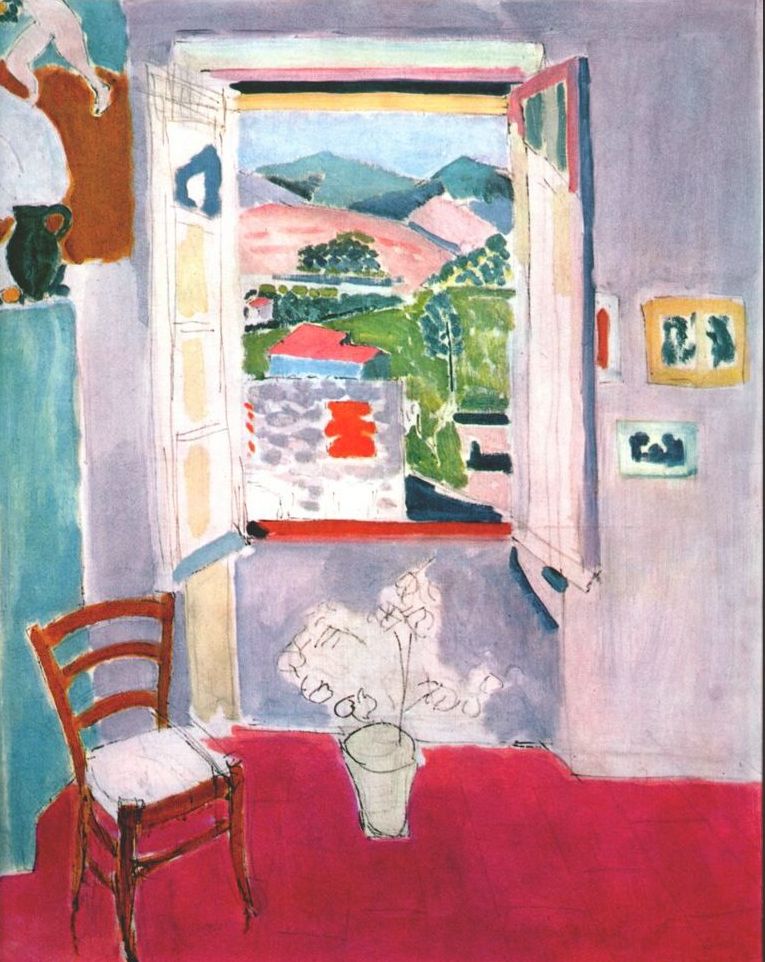
Image source: wikiart.org
Introduction
Henri Matisse’s “Open Window at Collioure” (1910) stages one of modern painting’s most durable dramas: the meeting of an interior and an exterior, the intimate space of a room and the boundless light beyond. A simple wooden chair, a thin-stemmed plant in a pail, violet-gray walls, and a radiant red floor compose the interior. At the center, white shutters swing open to reveal a layered view of hills, orchards, and tiled roofs fractured into confident planes of blue, green, pink, and yellow. Matisse does not treat the window as a mere dutiful aperture. He treats it as a second picture living inside the first, a colored pulse that recharges the quiet room. The whole canvas becomes a meditation on how color builds space, how line conducts attention, and how a few everyday elements can be tuned into a lasting harmony.
The Setting and Motif
Collioure, the Mediterranean fishing town that changed Matisse’s sense of light in 1905, remained a recurrent motif for years. By 1910 the raw shock of Fauvism had softened into a clearer order. The motif here—an open window—permits a double register: the measured calm of domestic space and the quick, sun-struck shorthand of landscape. Without a figure present, the room still feels inhabited. The chair is pulled slightly askew, the shutters left ajar, the plant quietly taking light. The scene is not a “view” illustrated from life; it is a construction where every shape has been weighed for its job in the composition.
Composition: The Stage of the Room
Matisse organizes the interior like a shallow proscenium. A strong vertical axis runs through the window’s jambs; lateral walls press inward as lavender planes; the red floor tilts forward in a bold trapezoid, inviting the viewer to step in. The chair anchors the left foreground, its bent ladder-back repeating the window’s bars in a softer rhythm. A pot of pale flowers stands below the sill like a low echo of the mountains outside. To the right, two small framed pictures introduce a secondary cadence of rectangles and remind us that this is a painter’s room—a space that already holds images within images. Nothing crowds. Negative space is allowed to breathe, and the eye is given a clear path from chair to plant to window and out across the hilltops.
Color Architecture and Climatic Chords
The picture rests on a few large chords. Inside the room, mauve walls and a blue-green flank breathe coolness, while the floor’s crimson-madder saturates the lower half with warmth. The window view introduces a fresh register: pale turquoise sky, mint and viridian trees, straw-yellow fields, and the punch of a coral roof. Matisse binds these climates together by repeating tints on both sides of the sill. The cools of the interior whisper in the distant mountains; the terracotta notes of the roofs answer the floor; a thin band of lemon just above the frame repeats itself as a quiet halo where the wall meets the ceiling. Nothing is neutral or filler. Every plane belongs to a family, and the families converse.
The Red Floor as Emotional Engine
The floor is a daring slab of color that sets the painting’s emotional temperature. Its crimson mass is not monotonous. Wide, diagonal strokes brighten then deepen, and the pigment thins near edges so that the canvas breathes through. The floor’s heat acts like an invisible hearth: it warms the chair’s ochre wood, lifts the white of the flowers, and makes the outdoor blues feel even cooler. Because the floor tilts forward beyond plausible perspective, it also performs a structural job—pulling the viewer into the room and then launching the gaze toward the window.
The Window as a Picture within the Picture
Matisse treats the landscape beyond the shutter as a second painting nested inside the first. The shutters and inner frame operate like a mat and molding. Within this inset picture, he shortens and flattens the vista: mountains are crisp, scalloped planes; fields occur as color blocks; trees knot into rounded, rhythmic bushes rather than botanical description. A small rectangle at the center of the balcony picks up red-orange accents, bridging inside and out. The nested picture contrasts with the broad, calm planes of the room, making the view feel sparkling and quick—exactly how a flood of outdoor light can register when you’ve been indoors.
Drawing with the Brush: Contour and Reserve
Line here is not graphite—it’s paint. Matisse draws with the brush, letting contours thicken and taper in response to form. Window bars are defined by single strokes and the whites they enclose; the chair’s rungs are laid in elastic arcs; the plant’s stems are scribbled with a swiftness that preserves their fragility. He often leaves reserves—narrow unpainted lanes—between abutting colors, which act as quiet separators and give the surface a candid, handmade vitality. These slight halos—around the chair’s legs, along the shutters, at the flower pot—are the painter’s heartbeat left visible.
Pattern, Ornament, and Decorative Order
Matisse’s “decorative” is a principle of equilibrium: the surface must distribute interest evenly without becoming busy. In this canvas, ornament is restrained but decisive. The tiled floor is implied rather than counted; the chair’s wood grain is suggested by warm strokes; the walls carry faint vertical drifts that keep them from sitting lifeless. Inside the window, fields and orchards form a natural pattern of stripes and blobs, echoing the interior’s gentle repetitions. The result is a room that feels both designed and casual, a place where a person could sit and a painting could hang with equal ease.
Space: Shallow Depth and Tilted Planes
Perspective is real but obedient to color. The red floor’s exaggerated tilt displays more of its surface, behaving like the tilted tabletops in Matisse’s still lifes. The window recess is believable but flattened just enough that the outdoor picture aligns with the plane of the wall. This shallow staging eliminates the tunnel of conventional depth and keeps the eye engaged with the surface. The viewer never “falls through” the window; instead, the gaze glides across stacked planes of color, tasting distance without leaving the room.
Light Built by Adjacency
There is no theatrical spotlight, no cast shadows mapped with academic rigor. Light in this painting is constructed through adjacency: the chair reads sunlit because white seat meets magenta floor; the wall glows because lapis and lilac overlap with the slightest value shift; the window dazzles because the pale shutters frame a view of higher chroma. Matisse places highlights sparingly—a thin edge on the chair, a chalky bloom on the pail, a bright lip on the sill—trusting the eye to complete the effect. The sensation is of midday, when light is everywhere and objects announce themselves by color more than by shadow.
The Role of the Chair and the Flower Pot
The empty chair is a classic Matisse surrogate for the human figure—upright, warm, and inviting—and here it acts as a conversational partner for the open window. Its back slats echo the panes; its angled legs mirror the floor’s diagonal thrust; and the white seat rests like a cloud of light that has drifted in from outside. The flimsy plant does the opposite job: it keeps the center low and light, a scribbled counterweight that prevents the heavy red floor from closing the composition. Together the chair and the potted stalk mark two scales of presence—sturdy and delicate—that make the room feel lived in without adding any anecdote.
The Balcony, Shutters, and Framing Devices
Notice how many frames Matisse provides. The outer picture frame is implied, the room’s walls form another, the window’s casing another, and the inner panel of landscape another still. Even the small pictures on the right wall add frame-within-frame repetitions. These nested borders do not hem the image in; they make the viewing experience rhythmic. Each border promises a new climate—cool wall, warm floor, bright window—and then delivers that change with color. Architecture becomes choreography.
Rhythm and Movement Across the Surface
Though no figure moves, the painting pulses with slow motion. The chair’s slanted legs lean forward; the floor tugs diagonally; the shutters swing out; hills roll in shallow waves; tree clusters bob; and even the marks that indicate mortar on the balcony form a little cadence of rectangles. The eye travels without hurry: from the chair’s ochre to the plant’s white, up the cool lavender wall to the pale shutters, through the window into the broken color of fields and mountains, and back again along the right wall’s framed images. The movement is circular, the kind of pacing you do when you walk a room while thinking or waiting for someone you love.
Materiality and Evidence of Process
Matisse lets the painting show its making. In the walls, pigment is pulled thin so the canvas weave peeks through; in the floor, thicker strokes lie on top like new plaster; in the view, brisk touches stack without blending, preserving the freshness of first statement. There are small pentimenti where an edge shifted—a shutter widened, a roofline nudged—and these traces read as confidence rather than indecision. The surface says: this harmony was discovered, not diagrammed.
Comparison with the 1905 Collioure Window
The famed 1905 “Open Window” explodes with Fauvist intensity—pure pinks, viridian sea, boats like cut-outs. The 1910 window keeps the motif but modulates the temperature. Chromas are still lively, yet the whole is gentler, with lavender, coral, and mint replacing the earlier shock chords. The composition becomes more architectural: chair, framed pictures, and clear wall planes create a scaffold that the view fills rather than overwhelms. The later painting shows Matisse turning from fireworks toward balance, from discovery to understanding.
Transition Toward the Nice Interiors
A few years later in Nice, Matisse would paint long sequences of interiors with open shutters, patterned screens, and deeply colored floors. “Open Window at Collioure” anticipates that mature language: the shallow stage, the nested frames, the orchestration of a few furniture motifs, and the primacy of color as space. You can feel the artist learning how to let a room carry a mood without over-describing it, and how to make outside light seem to pour in using only measured contrasts.
Human Presence Without Figures
No person is pictured, yet the room is intimate. The pulled chair implies a sitter; the plant suggests caretaking; the small pictures whisper of a habitual gaze; the open shutters mean someone wanted air. Matisse often said he wanted art that provides a restorative “armchair” comfort. This room enacts that promise: it is breathable, orderly, quietly joyful. Rather than force a narrative, he allows materials—wood, fabric, wall, air—to speak as companions.
Psychological Temperature: Calm Through Color
The painting’s mood is restorative rather than ecstatic. The red floor’s warmth is tempered by the cool surrounding grays; the outdoor greens feel watered by blue; the overall violet tint of the interior steadies the eye. Even the most saturated notes—coral roof, lemon band, crimson floor—are balanced by neutrals or complements nearby. The effect is a composed happiness, the feeling of standing in shade while looking into sun.
Lessons for Seeing and Making
The canvas offers a practical grammar. Start with a few strong planes and keep their edges legible. Let one field—here, the floor—set the emotional key. Use the window not as an excuse for distance but as a second painting with its own tempo. Draw with the brush so that contour carries character. Build light through adjacency, not laborious shading. Leave traces of process to keep the surface honest. And repeat simple forms—frames, slats, rectangles—to create rhythm without clutter.
Why the Painting Endures
“Open Window at Collioure” remains fresh because it trusts essentials. It asks you to feel heat and breeze through color alone, to sense space through rectangles and tilts, to accept flowers as a handful of airy lines and hills as a few planes. Every decision helps the whole, yet nothing feels constricted. The painting breathes. It can live in a domestic room because it models domestic grace; it can hang in a museum because its order is robust enough to stand beside the most ambitious experiments of its time.
Conclusion
Matisse transforms a simple window into an instrument that tunes an entire room. The chair, the plant, the red floor, the pale walls, and the banded landscape beyond form a single chord that is at once modern and humane. The painting rejects spectacle and pursues clarity. It teaches that a few colors, a few shapes, and a truthful surface can hold both the quiet of an interior and the exhilaration of sunshine on hills. In “Open Window at Collioure,” the world outside does not eclipse the room; it completes it, and the viewer, standing between, is invited to breathe both atmospheres at once.