Image source: wikiart.org
Introduction
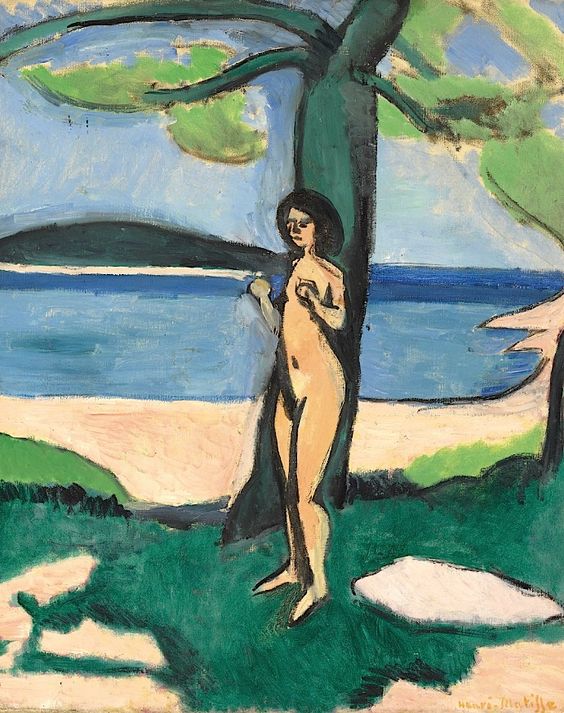
Henri Matisse’s “Naked by the Sea” (1909) distills the timeless bather into a clear, musical arrangement of planes and colors. A single nude stands beside a tree on a Mediterranean shore, a blue band of water stretching behind her and green turf at her feet. The forms are pared to essentials, bounded by dark contours and filled with broad, confident tones. More than a scene, the painting is an argument: color can build space, line can conduct movement, and simplicity—when exact—can feel monumental.
A Mediterranean Turning Point
Painted in 1909, the canvas belongs to Matisse’s pivotal post-Fauvist phase. The blazing chromatic clashes of 1905–1906 had taught him that color could be liberated from descriptive duty. Now he sought equilibrium. In works from this year, including “Dance I” and a suite of bathers, he transforms shock into structure—anchoring high color to a steady architecture of bands, arcs, and contours. “Naked by the Sea” is a prime specimen of that turn: bold yet serene, modern yet classical in its poise.
Composition as Architecture
The composition is built on a few decisive elements. A vertical pine tree rises almost to the top edge, becoming a central mast. Its trunk divides the horizon of sea and sky, while its canopy arcs left and right like a protective vault. The figure stands just off center, close to the trunk’s shadow, which doubles as a dark foil that clarifies her contour. Long, horizontal bands—shoreline, surf, horizon—stabilize the composition and counter the tree’s lift. Foreground greens gather in triangular mats that direct the eye inward. Nothing is incidental: every shape is positioned to balance another, creating a stable scaffold on which color can sing.
Color Architecture and a Coastal Chord
Matisse organizes the painting as a chord of five dominant tones. The sea is a saturated ultramarine, the sky a paler, cooler blue; sand reads as pale peach; grass and pine are richly green; the body glows in warm ochres and pinks. Dark blue-black lines seal the edges, intensifying each color’s presence. Because these hues are cleanly separated and carefully tuned, the canvas reads instantly from afar. Up close, small modulations—cool shadows in the grass, warmer notes along the shoreline, slightly deeper flesh tones where the body turns—keep the surfaces alive without breaking their monumental calm.
The Nude as a Column of Light
Matisse presents the figure as a vertical, luminous element set against the tree’s darker spine. The contour is frank and unembellished, the interior modeling minimal. Where the body needs to turn—a thigh, a rib—he places a warm or cool adjustment, never a cosmetic blend. The pose is modest and frontal-in-profile: one arm lifted with a small, spherical object, the other near the torso. The stance registers as a slow contrapposto, a gentle shift of weight that softens the verticality into an arabesque. Absent are the descriptive details of face and hair; what remains is presence constructed from intervals.
Between Eden and Arcadia
The figure’s gesture—holding a round fruit beside a tree—invites a faint biblical echo of Eve. Yet the mood is secular and Mediterranean rather than moralizing. Matisse borrows the archetype to fold mythic time into a modern shore: a human body in clear light among simple elements—tree, water, land. The allusion enriches without explaining. As in much of his work, the classical enters not through quotation but through clarity and measure.
Tree, Canopy, and the Geometry of Shelter
The tree performs several tasks at once. As a vertical axis, it anchors the composition. As a patch of dense green, it provides chromatic ballast to the sea’s blue. As a canopy drawn in sweeping arcs, it establishes a protective zone around the figure—a visual roof that converts open beach into an intimate grove. The broad, flattened foliage reinforces Matisse’s decorative logic: leaves become planes; their edges, musical lines; their shadows, cool counterweights to the body’s warm tones.
Sea, Sky, and the Logic of Bands
Matisse renders distance with horizontal strata. A narrow white band suggests surf; a deep blue band signifies water; lighter blue opens into sky. The order is emphatic and legible, preserving the canvas’s flat integrity while giving the scene air and breadth. There is no fussy perspective, no atmospheric haze. Depth is created by stacking and by the relative pressure of colors: cooler tones recede; warmer and darker shapes advance; overlaps confirm position. The viewer experiences space as a calm rhythm of belts rather than as a tunneled recession.
Drawing With the Brush
The dark contour—part ink, part paint—is the conductor. It defines the curve of a thigh with a single continuous stroke, marks the shoulder with a confident hook, and braces the tree’s trunk with steadier pressure. These lines neither decorate nor hedge; they describe decisions. Because the contour is so authoritative, Matisse can leave large fields unmodeled. The eye accepts a flat sand plane or a simplified leaf because the drawing has told it where each belongs.
Brushwork and the Living Surface
Although the forms are simplified, the surface is lively. In the sky, long, slanting strokes carry cool blues across warmer undercolor, evoking breezy air without descriptive cloud. In the grass, more granular marks scumble over darker ground, the dry brush leaving flecks that read as sunstruck texture. The flesh is creamy and opaque in the light, thinner along the edges where a warmer ground glows faintly through. These micro-rhythms keep the canvas speaking at close range even as the big architecture holds at a distance.
Light Without Chiaroscuro
Matisse creates luminosity by adjacency, not by theatrical shadow. The figure shines because warm flesh sits against the cool trunk and sea. The tree reads as solid because its darker interior is bounded by a lighter rim and lighter sky. The beach glows where pale peach meets blue; the grass breathes because green temperatures shift from yellow-green in light to blue-green in shade. Light here is relational and constructed, not imitated—one of the core innovations of Matisse’s mature style.
Space as Shallow Stage
The scene holds to a shallow stage that suits the decorative order. The foreground greens, mid-ground beach, and background sea form three steps, each articulated by a band and a contour. The figure occupies the foremost step without floating because shadows—economical but sufficient—touch her feet and the tree’s base. This controlled shallowness protects the surface from illusionistic tunneling and keeps the viewer focused on the painting’s real subject: the measured meeting of colors and shapes.
Economy, Ethics, and the Human Scale
A striking refusal of detail runs through the work. There are no pebbles, no ripples, no anatomical brag. The face is reduced to an oval within a darker halo of hair. Such economy is an ethic as much as an aesthetic. By removing sensational incident, Matisse protects the dignity of the subject and emphasizes the universal over the anecdotal. The nude is not a display; she is a human presence measured in color and rhythm.
Conversing With Sister Works
“Naked by the Sea” speaks directly to contemporaneous canvases. The long, unbroken arcs anticipate the monumental chain of bodies in “Dance I.” The shallow banded space and simplified figure recall the bathers of 1908–1910 and the Arcadian scene of “Le bonheur de vivre,” but with a new restraint. Compared to the incendiary “Blue Nude” (1907), this painting is calmer, less sculptural thrust than melodic line. It charts the path from Fauvist fireworks to the classic balance that would define Matisse’s later decades.
The Decorative Order, Reimagined
Matisse often insisted that “decorative” was not trivial but a principle of coherence. Here, the decorative arises from the even distribution of interest: the tree’s canopy echoes the shoreline’s curve; white beach shapes rhyme with white rock slabs in the foreground; the figure’s warm vertical plays against a cool vertical trunk. This web of repetitions and counterpoints allows the eye to roam without encountering dead zones. The painting behaves like a woven cloth of large motifs—sea, sand, tree, figure—held together by a dark, resilient thread.
Material Evidence and the Trace of Process
Look close and you can see where decisions changed. A contour nudges outward at the calf; a halo of blue meets the arm where the sea was trimmed; a leaf’s edge shows the ghost of an earlier placement. Matisse leaves these traces in place, letting the painting keep its own archaeology. The final calm is not the polish of erasure but the poise that comes from resolving choices in plain view.
Sensory Atmosphere and Emotional Tone
The painting’s mood is clear and unagitated. The blues cool, the greens refresh, the sand warms without glare. The figure’s slight tilt and contained gesture suggest inwardness rather than spectacle. The tree’s canopy shelters without enclosing. The overall effect is restorative—a quiet hour by the water translated into color. This is the “balance, purity, and serenity” Matisse famously sought, achieved not by sweetness but by exactness.
Why It Still Feels Modern
The image remains modern because it commits to a few strong relationships and refuses the rest. Contemporary viewers, saturated with detail, find in it a lesson in attention: simplify to essentials; let color carry structure; use line only to conduct; allow flatness to be beautiful. The painting’s clarity reads as an act of confidence—one that continues to inform painters, designers, and photographers who build with bands, silhouettes, and bold complements.
Conclusion
“Naked by the Sea” compresses Matisse’s 1909 program into a bright, durable image: a vertical body beside a tree, bands of shore and water, a canopy of wide leaves, and a limited palette tuned to harmony. Line establishes order; color constructs space; brushwork keeps air in the picture; simplification safeguards dignity. In this modestly scaled canvas, Matisse offers a model of how the ordinary facts of a beach—the trunk’s shade, the sea’s belt of blue, warm sand underfoot—can be reorganized into a timeless language of forms. It is both Arcadia and the afternoon; both myth and moment; both decorative and profoundly humane.