Image source: wikiart.org
Introduction
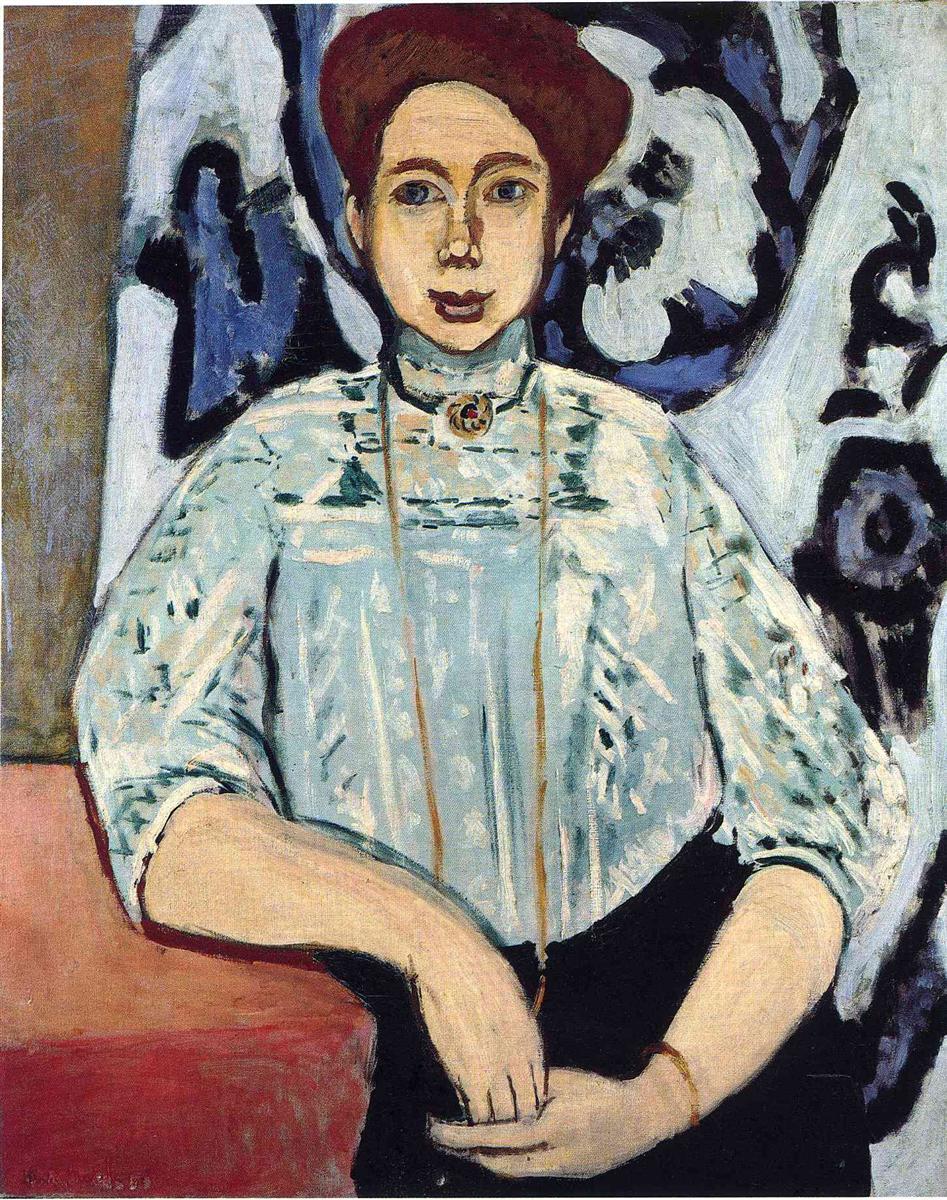
Henri Matisse’s “Greta Moll” (1908) is a landmark portrait from a pivotal year, when the painter consolidated the blazing discoveries of Fauvism into a calmer, more architectonic language. The picture shows a young woman seated in three-quarter length, her hands quietly aligned at her lap, her blouse a pale field of choppy whites and cool blues, her hair massed in a reddish crown. Behind her, broad abstract swirls of blue, black, and white rise like a stylized tapestry. Nothing in the canvas is fussy or anecdotal. Contours are firm, planes are simplified, and brushstrokes speak clearly. The result is an image that combines likeness with design, interior life with decorative order. It reads as a manifesto for the modern portrait: a face seen not only as a subject but as a structure of color and line able to hold the entire painting together.
Who Was Greta Moll
Greta Moll was part of Matisse’s circle in Paris and closely connected to the painter Oskar Moll. She was young, cosmopolitan, and fully attuned to the avant-garde. The portrait captures this sense of modern poise. The sitter’s clothes are fashionable yet understated, her jewelry sparse but decisive, her expression open and self-possessed. Matisse is less interested in social signals than in the intelligence of presence. Greta is presented not as a type but as a precise individual, whose clear gaze meets the viewer without coyness. The painting honors that presence while filtering it through Matisse’s evolving pictorial grammar, so that personality and pattern feel inseparable.
A Pivotal Moment in 1908
The year 1908 sits at the hinge between the shock of early Fauvism and Matisse’s march toward the classical serenity of his later work. He had already produced the incendiary portraits that made critics gasp—faces described by green bars, hats painted like banners, backgrounds that refused conventional depth. In “Greta Moll,” the heat of that experimentation cools into balance. The palette is still bold, but harmonized. The drawing is economical, but disciplined. The background acknowledges the flattened space of the decorative arts, yet grants the sitter room to breathe. The painting announces Matisse’s conviction that intensity can coexist with calm, and that reduction can deepen rather than diminish a portrait’s truth.
Composition and Framing
The composition is constructed with a clarity that approaches architecture. Greta’s head sits near the upper third, secured by the oval haloed shape of the hair. The shoulders widen into a broad horizontal that stabilizes the top of the torso. From there, the blouse drops in a gentle triangle, converging toward the clasped hands that lock the lower center of the canvas. Those hands, placed just above the red tabletop or armrest at left, form the painting’s keystone. Their pale geometry counters the strong vertical seam of the blouse and anchors the otherwise lively surface.
The edges are active. At left, the red form pushes inward like a block, while to the right the dark, patterned background swells and recedes. These asymmetries keep the portrait from sinking into symmetry; Greta is centered without feeling static. Space is shallow, but not airless. The sitter sits forward from the backdrop, set apart by contour and by the low-slung plane of the seat. Everything important is legible from far away, a testament to Matisse’s belief that a picture should declare itself at first glance, then reward sustained looking.
Color Architecture and Harmonies
Matisse organizes color like a composer writing for a few instruments and extracting from them a full symphony. The blouse is a chilly orchestration of whites tinted by blue and green. These cools establish the painting’s dominant climate. Into that climate Matisse inserts warm counterweights: the soft ochre of the skin, the pink of the lips, the red mass of hair, the terra-cotta rectangle of the seat. The background’s deep blues register not as atmosphere but as a decorative bass line, their weight balancing the forward push of the warms.
Complementary relationships are kept under careful tension. Blue and orange trade places in hair and blouse, red and green whisper through small passages, and the black of the outlines quietly heightens saturation everywhere it appears. Nothing screams. Instead, each color measures another, so that the viewer perceives a single coordinated field rather than isolated accents. This is color not as description of light, but as an abstract structure supporting the presence of a person.
Line, Contour, and the Discipline of Drawing
Contour is Matisse’s great conductor. He draws with the brush in confident strokes that contain and energize the color. The line around the cheek and jaw is neither fussy nor timid; it is a single continuous arc that persuades us of the head’s volume while respecting the flatness of the canvas. The arms and hands are described with a few decisive outlines that do more work than an entire paragraph of hatching could accomplish. Even the features—the bridge of the nose, the lips, the light under the lower eyelids—are delivered with plain, unblended marks.
The discipline of line does not feel severe. It feels humane. In “Greta Moll,” the contour acts the way a good sentence acts in poetry: it limits in order to liberate. By refusing soft, dissolving edges, Matisse clarifies relationships and allows the viewer’s eye to dwell on proportion and rhythm. The portrait’s likeness arises not from minute detail but from the rightness of intervals: the distance between eyes, the placement of the mouth within the oval of the face, the measured length of the neck above the high collar.
Brushwork and Surface
The surface is alive. Matisse lays paint with a varied touch—dragging, scraping, and scumbling to create a skin of marks that speaks as clearly as the drawing. In the blouse, strokes move in different directions, creating the impression of a patterned fabric without ever painting a literal pattern. Flecks of ground show through; earlier decisions glimmer beneath later ones. The background, too, is not a flat sheet but a palimpsest of gestures, its dark arabesques riding atop patches of lighter paint. This layered facture keeps the wide fields from deadness and gives the picture air and life.
The sense of speed is palpable yet controlled. You see the painter arrive at a solution and stop. You also sense where he changed his mind—edges corrected, a hand repositioned, a contour fortified. These traces of process are not imperfections; they are part of the portrait’s candor. The painting declares how it was made, and that declaration becomes part of Greta’s presence.
The Decorative Background and the Idea of the Arabesque
Behind Greta rises one of Matisse’s essential inventions: the decorative ground that is neither scenery nor void, but an active participant in the portrait. The dark blue and black shapes sweep behind her like calligraphic waves. They are nonrepresentational but not arbitrary. Their curves echo the arcs of the arms and the oval of the face, making the figure and the field interlock. The background presses near the head, almost forming a halo that both crowns Greta and tests the contour of her hair. That pressure intensifies the focus on the face while keeping the whole surface engaged.
This approach reflects Matisse’s long dialogue with textiles, Islamic ornament, and Japanese prints—sources that showed him how pattern could structure space without resorting to Western perspective. In “Greta Moll,” the arabesque is not decoration pasted on; it is the rhythmic logic that knits the painting’s parts together. The portrait thus stands at the crossroads of representation and abstraction, demonstrating how a human likeness can live comfortably inside a decorative order.
Costume, Ornament, and Modern Identity
Greta’s clothing offers a lesson in how Matisse converts description into design. The high-necked blouse with its pendant clasp, the slim rope-like necklace falling in two verticals, the dark skirt, and the faint bracelet at the wrist are all observed particulars. But they are also structural tools. The small jewel at the throat functions like a fulcrum, gathering the forces of the face and channeling them down the torso. The necklace’s twin lines clarify the center axis and emphasize the length of the body. The bracelet introduces a tiny ring that echoes the collar’s roundness and the oval of the head.
These decisions are never merely formal. They shape how we read the sitter. She appears cultivated, minimal in ornament yet attentive to detail. The clothes speak to a modern confidence that refuses flourishes. The painting acknowledges fashion without being about fashion; its true subject is the kind of self-possession that modern life was beginning to value.
Hands, Gesture, and Character
The hands are small miracles of compression. Their position is slightly asymmetrical, one wrist crossing the other, fingers interlaced in a gentle twist. The gesture communicates repose with a hint of alertness. Nothing is tense, but nothing is slack. Matisse understood that hands carry character as eloquently as faces do. He emphasizes their structure with clean outlines and leaves their interiors largely unmodeled, asking the viewer to feel them as shapes before reading them as anatomy. This move keeps them from becoming fidgety and lets them act as the portrait’s calm anchor. Their pale planes also modulate the composition’s light, creating a bright pause between the red seat and the dark skirt.
Light, Space, and Depth Without Modeling
“Greta Moll” achieves a convincing sense of space without leaning on traditional shadow and highlight. Volume is suggested by proportion and slight tonal steps rather than by deep chiaroscuro. The face turns with the help of a few notes—the darker arc at the cheek, the touch at the side of the nose, the small shadow under the chin. The blouse reads as a body not because of gradations but because of the way its outer shape swells and narrows. Depth emerges through overlap—the arm before the torso, the head before the background—and through chromatic temperature shifts rather than tonal drama. This restraint keeps the picture unified, refusing the illusion of a hole in the wall and insisting on the canvas as a field of coordinated decisions.
Comparisons to Other Portraits
Placed alongside earlier portraits like “Woman with a Hat” or “The Green Stripe,” “Greta Moll” feels quieter, more collected. The color contrasts are still strong, but they no longer crash into each other. The drawing is less exploratory, more conclusive. Compared to the still more radical portraits of a few years later, “Greta Moll” holds to the human scale. It is intimate rather than monumental, yet it anticipates the monumental by clarifying a vocabulary of planes, contours, and patterned grounds that would support Matisse’s work for decades. Within the family of Matisse portraits, this one occupies a singular niche: fully modern, deeply affectionate, and architecturally lucid.
The Portrait as Collaboration
Every strong portrait involves a negotiation between painter and sitter. The direct gaze suggests that Greta allowed and perhaps encouraged Matisse’s radical simplifications. She submits to the flattening of pattern without losing individuality. Her expression is not pinned down to a single mood; it hovers between attentiveness and amusement, between self-awareness and ease. This ambiguity feels earned because it arises from the portrait’s structure. The simplified features, the steady axis of the necklace, the restrained gestures—all conspire to create a presence that is definite without being overdetermined. The collaboration honors the sitter’s dignity and the painter’s search for essence.
Emotional Tone and Psychological Reading
Despite the compositional control, the painting is not cold. Its emotional temperature is moderated by the warm skin tones that press gently against the cool blouse, by the red of the seat that rhymes with the hair, by the slight softness in the eyes. The background’s darker swell near the head gives the face a radiant push forward, a subtle halo effect that intensifies the sense of a centered, thinking person. The overall tone is serenity edged with alertness. You feel that a conversation is possible and that the sitter is ready for it, but the painting also preserves a respectful distance. This balance—contact without intrusion—is one of Matisse’s great gifts to portraiture.
Materiality, Scale, and Studio Practice
The canvas rewards close looking. You notice the different weights of paint: the leaner application in the face, the heavier, more broken strokes in the blouse, the buttery deposits of blue and black in the background. You notice where the brush carried just enough pigment to leave a dry, textured drag and where it released a rich, continuous band. Such variety suggests a painter who works wet-into-wet where necessary and returns with corrections when dry, never polishing the surface to uniform gloss. The choice of scale—large enough to grant the head and hands proper presence, small enough to invite intimacy—supports the portrait’s conversational tone. Everything about the material handling confirms Matisse’s belief that truth in painting is not a matter of illusion, but of honesty of means.
Legacy and Influence
“Greta Moll” continues to inform how artists think about representing people within flattened, patterned spaces. Designers borrow its lessons in organizing a field with a few strong shapes; painters study its economy of means; photographers and filmmakers learn from its balance between figure and decorative ground. Beyond technique, the painting models an ethic of looking. It shows how attention, restraint, and clarity can produce an image that feels inexhaustible without being busy. The portrait’s modernity remains fresh because it is tied not to fashion but to fundamentals: proportion, rhythm, and the deep respect for a person’s presence.
Conclusion
Henri Matisse’s “Greta Moll” takes place on the thin edge where likeness meets design. It asks how much can be removed while preserving character and how a human face can become the organizing principle of an entire surface. The answers it offers are clear and enduring. Contour carries the weight of drawing. Color is disciplined into harmony. Pattern becomes structure rather than ornament alone. Gesture is modest but eloquent. The sitter—intelligent, poised, modern—holds her own within this economy, and the portrait in turn honors her clarity. Painted in a year of turning points, the work stands as a compact manifesto for the humane modern portrait, a picture that remains as lucid and alive today as when it left the studio.