Image source: wikiart.org
Introduction
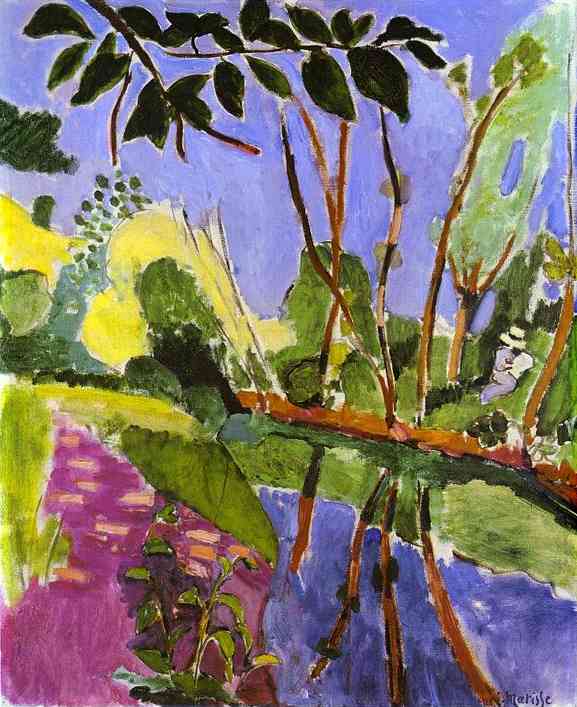
Henri Matisse’s The Riverbank (1907) is a compact explosion of color and structure that turns a simple waterside view into a modern orchestration of planes. At first glance, the scene is legible—trees lean over a stream, reflections shiver in the water, leaves silhouette the lavender sky—but the picture quickly declares a different ambition. Matisse treats nature as a set of interlocking shapes and tuned hues, binding them with firm accents of line. The diagonal of a fallen trunk slices the composition; saplings rise like reeds of music; violet, lemon, emerald, and ultramarine build a climate rather than a topographical record. Painted at a pivotal moment in 1907, the work condenses Matisse’s pursuit of equilibrium after the first blaze of Fauvism: color remains audacious, but composition is newly disciplined, and the brush speaks with confident economy.
Historical Context
By 1907, the shock of the 1905 Salon d’Automne had already fixed Matisse as a leader of the Fauves. Yet he was not content to repeat a formula of wild color. He sought a poise that would allow intensity without chaos, clarity without academic polish. The Riverbank belongs to this search. It keeps the Fauvist conviction that color can build space and emotion, while tightening the architecture of the picture through strong diagonals, clear silhouettes, and simplified forms. Across Europe that same year, painters were questioning the old depth-box of Renaissance perspective. Matisse’s answer here is a shallow, breathable space where near and far are woven across the surface by color relationships and echoes of shape.
Subject and Motif
The subject is modest: a bend of a stream bordered by plants and trees, with the sky seen through a canopy of leaves. A heavy branch tilts from left to right, as if storm-felled or pulled down by its own vigor. Saplings thrust upward, their reflections doubling in the water below. To the left, a violet-saturated channel gathers the colors of vegetation and sky; to the right, a deeper blue opens like a cool window into liquid depth. The upper register is lavender sky punctuated by dark leaves, a theatrical scrim that turns the scene into a stage. There are no figures, boats, or buildings to claim narrative attention. The drama is the river’s edge itself, the meeting between water, land, and air rendered as a living pattern.
Composition and Spatial Design
Matisse organizes the canvas around a set of dynamic diagonals. The ocher-orange trunk that cuts from lower left to upper right is the compositional keystone; it ties banks together and sets the dominant axis for the vertical saplings. These thinner trunks cross the diagonal like the strings of a musical instrument, while their reflections echo below, creating a second, inverted register. The scene’s horizontals—riverbank, sky line—are suppressed or broken, so that the eye keeps moving along slants, arcs, and mirrored angles. The silhouetted leaves at the top act like a proscenium, framing the action and supplying a stabilizing countershape to the diagonals. Depth is shallow, stacked like relief: a foreground of leaf clusters, a mid-ground of slanting trunks, a background of sky. The mirror of water complicates this stack, allowing far and near to trade places in the reflections.
Color Architecture
Color is the true architecture of The Riverbank. Matisse assigns each zone a dominant key and then tunes transitions where they meet. The sky is not a naturalistic blue but a lavender-violet that heightens the greens of the foliage. Lemon yellows flare behind dark shrubs, implying sunlight without a depicted sun. The water at left is a wine-purple, thick with reflected pigment from banks and sky; to the right, a cooler ultramarine opens into depth and steadies the painting’s temperature. Greens range from grassy light to near-black, shaped more by adjacency than by internal modeling. The orange of the fallen trunk injects warmth and binds the greens and violets in a complementary chord. Because the palette is saturated yet carefully parceled, the picture feels both exuberant and controlled.
Contour and the Role of Line
While color carries much of the structure, Matisse relies on assertive contour to articulate the key elements. Thick, dark strokes outline leaves overhead, the edges of trunks, and the seams between land and water. These lines are not fussy; they thicken, taper, and occasionally break, allowing color to breathe. Their effect is comparable to lead in stained glass: they keep the panes in tension and make the color sing brighter. In the reflections, contour loosens, letting paint trail and drag so the lines waver like ripples. This orchestration of line—tight above, liquid below—translates physical phenomena into a legible graphic rhythm.
Brushwork and Material Presence
The painting’s surface remains candid about how it was made. Sky and water are laid in with broad, unblended swathes that preserve the tooth of the canvas. Leaves and shrubs are dabbed and sliced with short, loaded strokes that deposit pigment in ridges, catching light like foliage in sun. The fallen trunk is brushed more opaquely, pushing forward in relief, while the reflected trunks are pulled in a single drag of darker paint, allowing the rough weave to fragment the stroke into watery tremors. This variety of touch keeps the image alive and communicates a sensation of looking in motion, as if painted during a walk that slowed at the bank.
Light Without Illusion
Light in The Riverbank is omnipresent but unspecific. There are no cast shadows, no careful modeling of forms toward a single source. Instead, brightness is rendered as higher-value, higher-chroma color—yellow where sun strikes through leaves, pale lavender where the sky is clear, lighter greens where grasses catch glare. Matisse substitutes optical description with chromatic agreements. The result is a sense of midday clarity without the apparatus of academic chiaroscuro. We feel the heat on the bank and the coolness over water through color temperature rather than through shaded gradations.
Reflection as a Second Composition
The river is not a passive mirror; it is a second composition embedded in the first. Trunks reappear as oscillating stripes, the sky as a deeper blue, and the banks as slipped wedges of purple and green. Because reflections flip and distort, they free Matisse to improvise—lines can bend where the “real” trunk remains straight, and patches can stretch or compress to suit the design. This doubled register allows the painter to balance the canvas like a musical canon, with one voice answering another at a delay and in a different key. It also thickens the surface, making water feel like paint’s cousin rather than merely a depicted element.
Nature as Pattern
Matisse treats vegetation not as botanical detail but as pattern. The leaf cluster across the top reads like a decorative border; the saplings repeat with slight variations; shrubs and grasses are reduced to notations—ovals, serrations, scalloped edges. This decorative sensibility does not flatten nature into ornament; rather, it reveals nature’s own underlying rhythms. The viewer recognizes the riverbank precisely because the patterns are true to the experience of seeing a tangle of growth at the edge of water, where repetition and variation rule more than linear perspective.
Rhythm, Movement, and Musical Analogy
The painting moves like a piece of chamber music. The diagonal trunk establishes tempo, the vertical saplings add counterpoint, and the reflections play a lower register in slower, wavier notes. Leaves overhead offer a recurring refrain that frames the variations below. The color scheme also behaves musically: purple and orange supply bold chords, while the many greens fill in the harmonies. This rhythmic construction explains why the picture feels eventful even though nothing “happens.” The riverbank itself becomes an action—growth, flow, and light interacting in time.
Space, Flatness, and the Modern Plane
One of the painting’s achievements is to reconcile a palpable sense of place with a modern assertion of flatness. The canvas reads as a woven field first and a window second. Matisse allows patches to butt against each other with minimal modeling; the viewer reads distance from the logic of overlaps and color contrasts rather than from diminishing scale or linear vanishing points. The result is a surface that stays present as an object while still evoking a breathable outdoors. It is a landscape at once tactile and atmospheric.
The 1907 Turn in Matisse’s Oeuvre
Compared with the riotous color combinations of 1905, The Riverbank feels tempered but not tamed. Its daring has migrated from hue to structure. The painter trusts fewer colors, places them more decisively, and lets drawing carry more weight. This turn anticipates the clarity of his later interiors and the large decorative panels where figures float on continuous grounds. At the same time, the picture reaches back to Cézanne’s idea that landscape can be built from planes—only here the planes are color-saturated and bounded by calligraphic line.
Atmosphere and Emotional Tone
Despite its compact scale, the canvas generates a strong emotional climate. The lavender sky reads as fresh and spacious; the dark greens as quiet and secret; the purple water as fecund and reflective. The diagonal thrust of the fallen trunk introduces a touch of drama, as if the scene had just been altered by wind or time. Yet the overall mood is unhurried. This is not sublime wilderness but a place we might reach in a brief walk, a pocket of nature where color presents itself with frankness and joy.
Material Economy and Visual Abundance
A striking feature of The Riverbank is how much it achieves with so little. There are no detailed leaves, no ripples painted one by one, no atmospheric haze. Instead, succinct marks stand for complex effects. A single lick of pale yellow suggests sun such as an entire paragraph of shading could not. A dark, meandering stroke conjures a bank’s shadow. The economy invites the viewer to participate, to complete forms and sensations from memory. Abundance arrives not from detail but from the interplay of simplified signs.
Comparisons and Lineage
Within Matisse’s body of work, this painting sits between earlier Fauvist landscapes with their fireworks of hue and later calm interiors in which color fields and contour are even more tightly controlled. It also belongs to a long French tradition of riverbank scenes, yet it denies the pastoral narrative typical of the genre. There are no fishermen, picnickers, or swans. The lineage that matters most is decorative art—the logic of textiles, wallpapers, and borders—translated into a high painting that refuses the hierarchy between “fine” and “applied” visual rhythms.
The Viewer’s Path Through the Picture
Matisse engineers a specific itinerary for the eye. We enter under the canopy at the top, then slide down the main diagonal toward the reflective pool. The purple left channel pulls us deeper, where we loop back up along the blue reflection and rejoin the saplings’ verticals. Each pass reveals a new junction where colors meet or lines cross, and the painting keeps us moving without fatigue. It is an optical walk that mirrors the real one the artist likely took along the bank, condensed into a single glanceable surface.
Legacy and Continuing Relevance
The Riverbank endures because it states a principle that remains fruitful for painters and viewers alike: color can do structural work, and nature seen as pattern can become more itself rather than less. The picture’s blend of audacity and restraint offers a model for transforming ordinary scenes into images that vibrate with order. Its lessons—limit the palette, stabilize with contour, let reflection double the theme—have echoed through a century of landscape painting and continue to feel fresh.
Conclusion
In The Riverbank, Matisse uses a handful of colors and a handful of lines to conjure a place where water, growth, and light braid into harmony. Diagonals and reflections structure the view; lavender, lemon, green, and blue supply its atmosphere; contour gives everything a crisp, modern edge. Painted in 1907, the work captures a turning point in the artist’s journey from raw Fauvist sensation to poised orchestration. It is both an outdoor note and a finished statement, a landscape that reads as music for the eyes and as proof that color, when composed with care, can create a world.