Image source: wikiart.org
Introduction
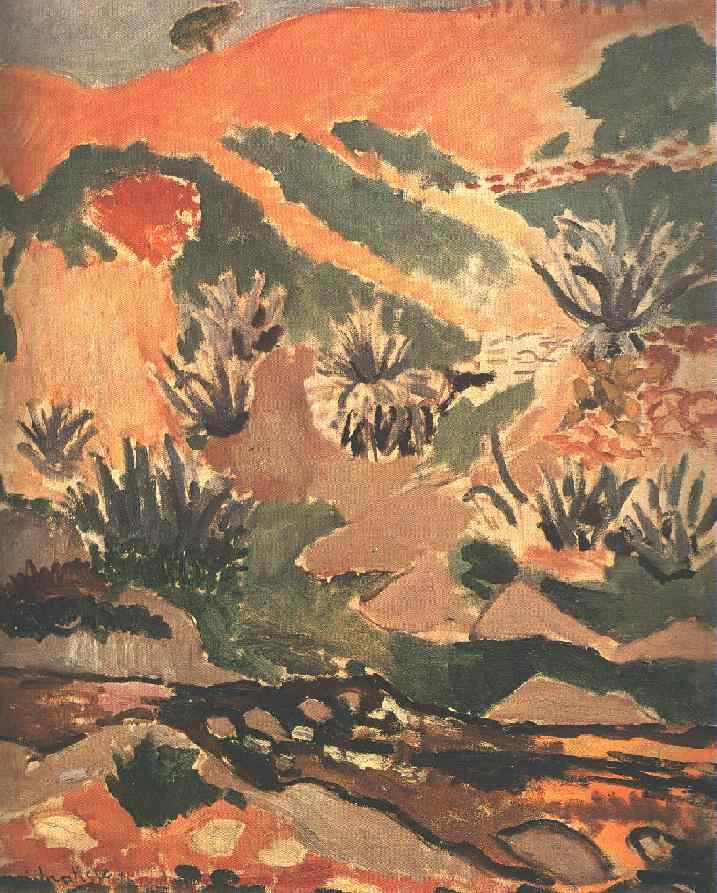
Henri Matisse’s Landscape with Brook (1907) encapsulates a pivotal moment in the artist’s search for equilibrium between Fauvist color and structural clarity. At first glance the painting appears to record a humble scene: a shallow stream threads its way through a scrubland of spiky plants and rough, ocher hills. Look longer and the canvas reveals itself as a tightly orchestrated experiment where color fields define space, where brushstrokes read like geological strata, and where vegetation becomes a set of rhythmic motifs. The brook, narrow but insistent, acts as both a map and a melody line, drawing the eye across a shallow stage of earth hues, greens, and blacks. This is not landscape as window; it is landscape as constructed harmony, a place where perception itself—organized through line, color, and tempo—becomes the subject.
Historical Context
The year 1907 is a hinge in French modernism. Two years after the debut of the Fauves, Matisse had moved past the sheer shock of non-naturalistic color toward a more considered architecture of the picture plane. He did not abandon the Fauvist credo; rather, he tempered it, seeking a poise that would let color sing without dissolving form. Landscape with Brook belongs to this search. It stands between the blazes of Collioure and the later interiors and odalisques, offering a landscape where energy is offset by restraint, and where the geometry of the composition holds the exuberant palette in a lucid armature. The painting also reflects a Mediterranean mindset central to Matisse’s art: sunlight that reduces values to flat planes, vegetation rendered as emblem rather than botanical study, and topographies whose essential curves can be read from a distance.
Subject and Motif
The subject is modest and grounded. A brook, barely a stream, cuts diagonally across the lower portion of the canvas, its banks mapped by dark strokes that suggest stones, roots, and wet soil. Clumps of vegetation stud the ground; they are often read as aloes or other hardy succulents, their fleshy, radiating leaves forming starbursts of bluish green. Behind them rise low hills in warm oranges and ochers, broken by patches of gray-green and by paths that zigzag upward. A lone treetop peeks over a ridge. There is no sky-dominated horizon; instead, the land almost fills the frame, as if the viewer were crouched close to the ground and scanning across it. The absence of human figures and built structures focuses attention on the terrain’s own rhythms. It is a landscape of proximities, where the eye navigates by touch and memory rather than by the vanishing point of classical perspective.
Composition and Spatial Design
Matisse devises a composition that is both layered and shallow. The brook, dark and sinuous, acts as a compositional spine that begins near the lower center and moves to the left edge in a diagonal drift. Above it, irregular shelves of earth step backward in shallow terraces, each shelf differentiated not by precise drawing but by shifts of color and brush direction. The plant clusters punctuate these shelves at measured intervals, like notes in a low register. The hills at top compress the depth further by meeting the picture’s upper edge, eliminating the sense of open sky. This orchestration produces an intimate space where the viewer’s gaze travels forward and back in short beats rather than making a single leap into depth. The composition’s logic is musical: alternating themes of curve and patch, warm and cool, dark and light.
Palette and Color Strategy
The palette is restrained by Fauvist standards but still emphatically non-naturalistic. Warm ochers, oranges, and pinked earth tones dominate, describing the sunstruck soil. These are tempered by olive and gray-greens, by the steely blue of the succulent leaves, and by zones of charcoal and black that articulate the brook and rocky shadows. The color fields are laid down broadly, with little blending, so that each hue functions as a plane. Rather than modeling forms with light and shadow, Matisse modulates temperature: a warm patch advances, a cool patch recedes, a black line arrests movement, a pale streak releases it again. The result is a landscape that feels simultaneously hot and breathable, as if the air itself were a thin glaze spread across the surface.
Brushwork and Materiality
Brushwork does the descriptive labor that drawing would perform in a more naturalistic image. Strokes tumble diagonally down the slopes, suggesting erosion and the path of water after rainfall. Elsewhere they cluster in short jabs to depict thickets of spines and leaves. In the brook, the brush moves laterally, dragging dark pigment that collects into stones and eddies. The paint is not thickly impastoed; it is laid with enough body to hold its edge and reveal direction, turning the surface into a record of tempo. Matisse frequently leaves slivers where ground shows through between strokes. These breathing spaces keep the eye alert and prevent the earthy palette from congealing.
The Brook as Pictorial Conductor
Although small, the brook conducts the entire orchestration. Its darkest notes create the strongest contrast and therefore the clearest path for the eye. It introduces a cool, reflective register into a field of warm earth, and it is where Matisse concentrates the densest drawing: stones like oval lozenges, black seams indicating water’s channel, flashes of orange that read as submerged gravel. Because it is both boundary and path, the brook organizes the foreground into zones—near bank, stream, far bank—and then connects them to the terraces beyond. It is a hinge between the horizontal and the diagonal, between stillness and movement. Without it the painting would be a patchwork; with it, the landscape breathes.
Vegetation as Calligraphy
The plant forms are stylized with a calligrapher’s economy. Each clump of aloes or scrub is reduced to radiating blades built from two or three swift strokes, typically with a darker core and a pale, dry-brushed fringe that suggests sun-burnished edges. Their repetition across the canvas is not botanical illustration but rhythmic punctuation. They mark the beat and elastic spacing of the terrain. Importantly, these forms also demonstrate Matisse’s interest in the decorative as a structural value. The plants are at once things in the world and motifs—ornaments that bind the surface. This doubleness allows the painting to oscillate between map and tapestry, between observation and pattern.
Drawing with Color and Line
Contour is used sparingly but decisively. Where an edge needs emphasis—the ridge of a hill, the seam of a path, the bank of the stream—Matisse reinforces it with a darker stroke. Elsewhere edges dissolve into adjacent patches, leaving color itself to carry the structure. This back-and-forth between drawn and painted edge becomes a source of energy. The viewer senses the painter deciding moment by moment which tool to use: line to lock a form, juxtaposition to let it breathe. The painting thus becomes a visible record of making, its structure coextensive with the actions that produced it.
Shallow Depth and the Modern Plane
Classical landscape depends on a deep vista, a ladder of planes stretching toward a far horizon. Landscape with Brook refuses that convention. The depth is shallow, stacked like relief. The upper ridge meets the canvas edge; the foreground spills toward us but is held back by the picture’s flatness. This is modern space, where the image is not a window but a woven surface. Matisse binds the near and far through color relationships rather than linear perspective. The ocher of a foreground terrace reappears, slightly cooled, in a distant slope; a gray-green patch echoes across levels; black seams tie the brook to high paths. The eye shuttles through these correspondences, constructing depth from analogy.
Atmosphere and Climate
The painting conveys heat without resorting to storytelling. There are no figures to signal toil or rest, no animals panting in shade. Instead, the warmth arrives through the dominance of orange and ocher, through the dryness of the brush, and through the scarcity of blue. Even the greens are heavy with yellow or brown. The plants are rendered not lush but tough, their blades stiff and thorny, the kind that thrive in Mediterranean aridity. The brook’s dark coolness therefore registers as relief, both visual and climatic. It is the painting’s small oasis, a place where the eye can rest before climbing the slopes again.
Rhythm, Pattern, and Musical Analogy
Matisse often likened painting to music, and the analogy is fruitful here. The brook supplies a bass line, repeating at intervals and setting the key in a darker register. The plant clusters are syncopated chords, repeating but never mechanically. The terraces are measures that advance the composition in steps. The palette operates like orchestration, assigning different instruments to different zones: warm strings in the hills, muted brass in the terraces, cool woodwinds in the vegetation, and percussion in the stones and black seams. Because of this musicality the painting can be read in time as well as space, a sequence of sensations rather than a static diagram.
From Fauvism to Structure
Compared to the riotous color of 1905, Landscape with Brook looks disciplined. Its daring lies not in chromatic shock but in the conviction that structure can be built with a limited set of elements. The simplifications are severe: trees are clumps, rocks are lozenges, paths are stripes. Yet the scene never collapses into abstraction because the cues of gravity, erosion, and growth are intact. The viewer recognizes the logic of a hillside etched by water, dotted by hardy plants, divided by goat tracks or footpaths. This is Matisse’s mature gamble in 1907: push representation to the brink of pattern while keeping the world legible.
The Ethics of Looking at Nature
There is a humility in the painting’s scale and attitude. The view is close, patient, and unspectacular. It refuses the grandiloquence of alpine peaks or storm-lashed coasts in favor of a small watershed and scrubland. In doing so it honors a kind of attention suited to modern life: the attentive walk, the pause by a ditch, the noticing of small networks that sustain a place. The painting invites the viewer to read landforms as living processes rather than backdrops for human heroism. It is a quiet ethic of regard, where the slightest change in color or brush direction becomes an event.
Material Surface and Craft
The tactile presence of the support remains visible through thinner passages of paint, especially in the lighter ochers where the weave of the canvas subtly asserts itself. This allows earth colors to feel literally grounded, as if pigment and support were of the same substance. Edges occasionally feather out, letting the tooth of the canvas nibble at the paint and produce dry, sandy textures. These craft choices matter because they align surface and subject: a scrubby place painted with a scrub of the brush, a stony brook recorded with dragging strokes that skip over the weave like water over pebbles.
Comparisons within Matisse’s Oeuvre
The canvas converses with other landscapes from these years in which Matisse tested how little information is necessary for recognition. It shares with his Collioure views the appetite for reduced forms and hot color, but it is more grounded and less celebratory than the bright harbor scenes. It also anticipates later works where pattern and subject fuse completely, such as interiors thick with textiles and plants. In those later pictures, the decorative often overwhelms landscape; here, landscape holds its own, asserting that the natural world can be decorative without becoming mere ornament.
Sensation, Memory, and Construction
The painting feels observed but also reconstructed from memory in the studio. This duality is key to its power. Observation supplies the logic of the watercourse and the habit of the plants; memory allows Matisse to rearrange terraces, compress distances, and tune color for maximum effect. He is not copying a view but building one that carries the essence of walking through such a place. The viewer senses this in the way paths appear and fade, in the way patches interlock like remembered fragments. The composition becomes a kind of mental map, one that privileges sensations—heat, roughness, prickliness, cool shade—over cartographic accuracy.
Light Without Illusion
Light is not modeled but inferred. Brightness is rendered as higher-value color and thinner paint; shadow is a matter of cooler, darker patches; glints on stones are simply left unpainted, the canvas peeking through. This approach maintains the flat integrity of the surface while still delivering the sense of an outdoor scene. The absence of cast shadows or cutout highlights keeps the painting calm, free of theatrical spotlighting. It is noon light, general and enveloping, the kind that reduces detail and clarifies silhouettes.
Legacy and Continuing Relevance
Landscape with Brook remains instructive because it shows how a painting can honor the specificity of place while operating as a disciplined abstract structure. It demonstrates that landscape need not rely on panoramic depth or anecdotal figures to be compelling. Its pleasures are those of rhythm, temperature, and touch—qualities that continue to engage viewers across styles and eras. For artists, the canvas offers a model of restraint: limit the palette, simplify the forms, let brushwork do the talking. For broader audiences, it offers a way of looking at the land where small systems matter and where the most modest watercourse can organize experience.
Conclusion
Henri Matisse’s Landscape with Brook transforms a quiet corner of terrain into a modernist meditation. The brook threads the scene with dark, cooling emphasis; spiky plants repeat like calligraphic signs; terraces of warm earth stack toward a compressed ridge. Color constructs space, brushwork describes process, and pattern binds the whole. The painting sits squarely in 1907, when Matisse sought a calm after Fauvism’s tempest, a harmony where sensation and structure could meet. What results is a landscape that feels both observed and composed, both tactile and abstract. It is less about the spectacle of nature than about the intelligence of seeing—how a few well-chosen strokes can make a world.