Image source: wikiart.org
Introduction
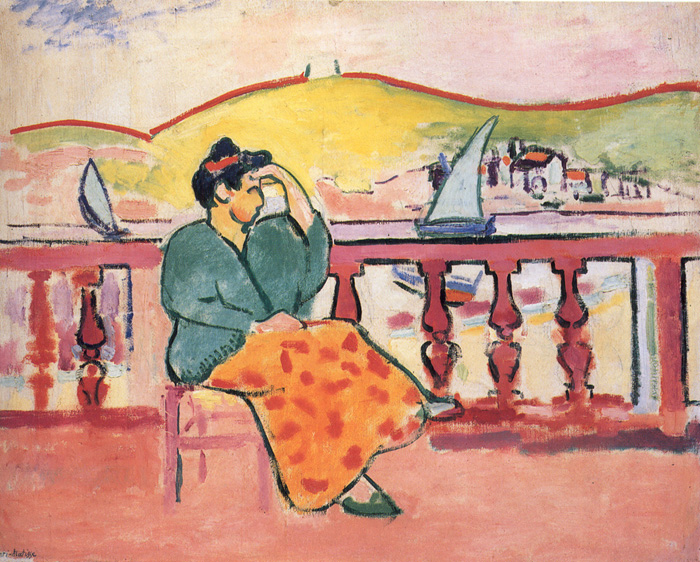
Henri Matisse’s Lady on a Terrace (1907) captures a moment of contemplative leisure at the water’s edge and transforms it into a laboratory for color, contour, and rhythm. A woman sits on a chair before a balustrade, one hand raised to shade her eyes as she gazes toward a bright harbor with sailboats and sunlit hills. The scene appears casual, yet every element—her dark hair and green blouse, the orange skirt dappled with red, the coral-pink terrace, the repeating balusters, the lemon-yellow hillside—has been orchestrated with the clarity of a musical score. The painting stands at a transitional point in Matisse’s development, when the blazing freedoms of Fauvism matured into a more balanced relationship between color harmonies and structural design. What seems like a seaside snapshot is, in fact, a carefully composed meditation on seeing, time, and the modern pleasure of simply looking.
Historical Context
By 1907, Matisse had already detonated expectations about naturalistic color. The 1905 Salon d’Automne had introduced his audacious palette to the public, and in the years that followed he tested how far pure color could carry a painting without collapsing into chaos. Lady on a Terrace emerges from this period of experimentation and consolidation. Rather than retreating from bold color, Matisse integrates it with firmer drawing and simplified architecture. The painting belongs to the broader story of the Mediterranean turn in his art—images of harbors, terraces, and sun-struck hills that offered a setting where color could be both heightened and calm. In 1907 European art was pivoting toward new structural propositions; Picasso was working through the implications of primitivism and fractured space, while Matisse responded with a counterproposal: build modernity from color and contour aligned with serenity rather than rupture.
Subject and Title
The title directs attention to ordinary modern life. This is not a mythological figure, nor a theatrical odalisque, but a woman pausing on a terrace. Her posture hints at a breeze and a squinting glance; the vessels on the water suggest a passing afternoon. The title’s simplicity underscores Matisse’s commitment to finding grandeur in the everyday. The terrace is both stage and threshold, a place between interior privacy and exterior spectacle. Within this liminal space, the act of looking becomes the subject: a woman looks out, and we look at her looking.
Composition and Spatial Design
The composition is anchored by three bands that march horizontally across the canvas: the pink-red terrace in the foreground, the balustrade running like a rhythmic barrier through the middle, and the sweep of water and yellow hills behind. The seated figure interrupts and enlivens these bands. Her dark hair and green blouse make a vertical mass that counterbalances the sailboats and the distant architecture. Matisse places her slightly left of center, allowing the remaining space to breathe with boats, reflections, and the distant shore.
The balustrade plays an essential role. Its columns repeat like beats in a measure, creating a cadence that leads the eye laterally while also marking the boundary between the viewer and the sea. Gaps in the balusters frame small views of water and sail, producing a cinematic effect of glimpses. This alternating opacity and openness makes the terrace feel at once enclosing and permissive, a perfect metaphor for the painting’s balance between structure and freedom.
The Role of Contour
Matisse outlines forms with decisive, unhesitating lines, often in black or dark maroon. These contours, thick enough to be felt, stabilize the simplified shapes they enclose. The woman’s profile is summed up in a few assertive arcs; the boats are triangles and curves; the terrace’s edge is a single confident stroke. Contour in this painting is not a timid border but an energetic partner to color. It compresses the drawing to essentials and allows the broad interior fields of pigment to declare themselves without fussy modeling. The effect is like stained glass, where lead lines and panes interlock to produce a vibrant whole.
Color as the Architecture of Feeling
The palette is both exuberant and controlled. The terrace reads as coral or pinkish red, the hills as warm yellow edged in red, the sea as pale mauve and blue, the sky as lavender drifting toward cream. Against these fields, the figure’s clothing creates the painting’s main chord: a deep green blouse with cool undertones and an orange skirt mottled with red marks. Matisse avoids conventional flesh tones and instead implies skin through warm ochres and light pinks.
These colors do more than describe. They assign emotional temperatures and establish spatial relationships. The terrace’s red advances; the yellow hills float forward even as they represent distance; the cool green blouse anchors the foreground; the orange skirt vibrates against the pink floor, forming a warm cluster around the seated figure. The sailboats are simple white and blue notes, high, clean sounds that punctuate the broader harmony. Everything is tuned to the sensation of strong sunlight washing forms into clarity.
Brushwork and Material Presence
Brushstrokes remain visible and directional. The hills show long, horizontal swaths that reinforce their rolling movement; the sky is brushed in loose, slightly diagonal sweeps that keep the air mobile; the skirt is worked with broad, scooping strokes that follow its weight across the woman’s lap. Paint is not smoothed to a photographic finish. Instead it retains the texture of decision, each stroke a record of placement and tempo. Matisse lets underlayers and canvas halo through at edges, leaving small breath-marks where line and plane do not quite meet. This keeps the image alive, preventing the flat color from feeling static.
Light Without Illusionism
Although the scene is bathed in bright daylight, Matisse refuses academic chiaroscuro. Light appears as color rather than as a system of shadows and highlights. The terrace is not shaded to indicate direction; the hills do not recede through atmospheric perspective; the figure’s face receives no modeling beyond the simplest planes. The cumulative effect still reads as sun and space because the relationships between colors are so well tuned. Pale tints near the horizon suggest glare on the water; saturated warm hues at the front suggest heat rising from stone. Light is not an external agent but an internal logic created by color contrasts.
The Psychology of the Figure
The woman’s posture conveys calm absorption. One leg crosses over the other in a compact, self-contained shape; her body leans back slightly, but her raised hand brings the head forward as if she is squinting into the brilliance beyond the balustrade. The gesture is ordinary yet expressive: she shields her eyes, creating a private visor that doubles as a frame within the frame. Her features are distilled to essential signs, a mask-like approach that eliminates anecdote and sends emotion across the whole body. Rather than a portrait of a specific person, she becomes an emblem of looking—someone whose stillness allows the scene to coalesce.
Terrace, Threshold, and Modern Leisure
Terraces have a special place in Matisse’s world. They bridge domestic comfort and public view, offering the modern subject a place to linger without obligation. The balustrade simultaneously protects and displays; it is an architectural necklace strung across the painting, ornament and barrier. In Lady on a Terrace, leisure acquires dignity. The woman’s relaxed pose and unhurried gaze affirm that doing nothing can be a richly modern act—time set aside for perception itself. The painting elevates the everyday ritual of sitting and looking into the central narrative.
The Sea and the Distant Shore
Beyond the balustrade, the sea carries small boats with triangular sails, their reflections simplified into quick vertical strokes between balusters. The distant shore is reduced to a few blocks and dots of color that hint at buildings, perhaps a harbor town, perhaps a row of houses climbing a slope. This simplification does not diminish the reality of the place; instead it distills it to sensory essentials: the curve of the coastline, the sparkle of sails, the hum of architecture against a hill. The yellow of the hillside, laid in a broad zone, is edged by a red contour that both defines the landmass and injects a warm pulse into the far distance.
Rhythm and Repetition
Repetition is the painting’s silent engine. The balusters repeat with slight variations, setting a march that steadies the scene. The red spots on the skirt answer the red outlines on the hills; the angular sail motif recurs at different scales; vertical strokes beneath the balustrade echo the woman’s legs. These repeats create a sense of rhythm that is almost musical, with the figure as the melodic line and the architecture providing the meter. The viewer’s eye moves left to right and back again, in sync with the terrace’s cadence and the breeze that seems to push the boats.
Comparisons within Matisse’s Oeuvre
Lady on a Terrace has kinship with other works from the mid-1900s in which Matisse navigates between Fauvist color and structural poise. It shares with earlier seaside scenes the exhilaration of daylight and the taste for simplified motifs—boats, hills, parapets—while anticipating the later interiors where pattern and figure interlock with even greater confidence. Compared to the tumultuous energy of his earliest Fauvist landscapes, this canvas displays a more settled equilibrium. The viewer senses the painter testing how far he can reduce and still keep the picture singing. The result is quieter than some of his shock-works but no less radical in its insistence that color, not illustration, carries the weight of meaning.
1907 and the Dialogue with Modernism
Across Europe in 1907, artists challenged the Renaissance inheritance of depth, shadow, and naturalistic flesh. Matisse’s answer was not to fracture forms but to flatten and clarify them. He draws on non-Western sources implicitly, particularly in the mask-like face and the decorative role of the balustrade, but he uses these reductions to generate calm rather than aggression. Where other modernists sought drama in dissonance, Matisse finds it in harmony: the tension between warm and cool, vertical and horizontal, solid and void. Lady on a Terrace exemplifies this stance, demonstrating that modernity can be built from pleasure rather than rupture.
Gender, Gaze, and Distance
Much has been written about how images of women in early twentieth-century art negotiate the gaze. In this painting, the seated woman’s attention flows outward to the harbor, not back toward the viewer. Her hand shields her eyes, creating both a literal shade and a symbolic boundary. We do not catch her in an intimate moment against her will; she remains absorbed in her own looking. The balustrade reinforces this respectful distance. It is a railing that separates us from her space, just as she is separated from the sea. This chain of thresholds—viewer to terrace, terrace to water—structures the ethics of viewing: we are permitted to observe, not to intrude.
Mediterranean Imaginary
Even without specifying a place, the painting conjures an unmistakably Mediterranean atmosphere: heat pooled in pale stone, bright sails gliding across calm water, hills the color of ripe fruit. For Matisse, the Mediterranean offered a vision of clarity, a landscape of essentials—light, air, color—where the complexities of urban modernity could be translated into primary sensations. Lady on a Terrace distills that ideal into a single figure bathed in color, living at the comfortable edge between domestic space and the open sea.
Time, Weather, and the Tempo of Looking
The painting proposes a tempo different from narrative time. Nothing happens in the dramatic sense; instead, there is duration. The woman’s stillness, the boats gliding, the sun saturating the terrace—these produce an experience of time that is elastic and contemplative. Even the brushwork participates: long strokes for the sky and hills, slower and broader gestures for the skirt, quick darts for sails and reflections. The viewer’s attention settles into this rhythm, lingering over repetitions and contrasts. The painting becomes a device for teaching the eye to rest.
Material Economy and Expressive Abundance
One of the marvels of the work is how much it achieves with so little. Details are omitted, but sensation is not. Architecture is suggested by a few right angles and verticals; the figure’s identity is suggested by a profile and a hand. The economy is not a lack but a decision—every mark must count. This restraint allows color to expand its role, to do what description once did. The orange skirt does not merely report fabric; it radiates warmth, weight, and even the softness of cloth. The green blouse does not simply indicate a garment; it anchors the figure and feeds cool calm into the palette.
Legacy and Continuing Relevance
Lady on a Terrace continues to resonate because it articulates a human truth: the deep satisfaction of unhurried looking in a beautiful place. At the same time, it offers an artistic truth: that painting can be built from color chords and structural rhythms instead of illusionistic depth. The work points forward to Matisse’s interiors of the 1910s and 1920s, his odalisques, and ultimately the paper cut-outs where color becomes pure shape. It also speaks to contemporary viewers who crave spaces of rest within the noise of modern life. The terrace is a metaphor for the painting itself—an area cleared for perception, a platform from which to watch the world without being overwhelmed by it.
Conclusion
In Lady on a Terrace, Henri Matisse composes an ode to leisure, looking, and the liberating discipline of color. A woman sits, shades her eyes, and gazes toward small boats and a radiant shore. Around that simple act, the painter constructs a world of measured repetitions and luminous contrasts: the marching balusters, the coral terrace, the lemon hills, the green blouse, the orange skirt, the white sails. The scene feels both immediate and considered, spontaneous in sensation and precise in design. Standing at a threshold year in modern art, Matisse declares that serenity can be as modern as shock, and that the pleasures of a Mediterranean afternoon can carry the full weight of artistic inquiry. The painting invites us to adopt its rhythm—to slow down, sit, and see.