Image source: wikiart.org
First Impressions: A Figure Built From Heat and Shadow
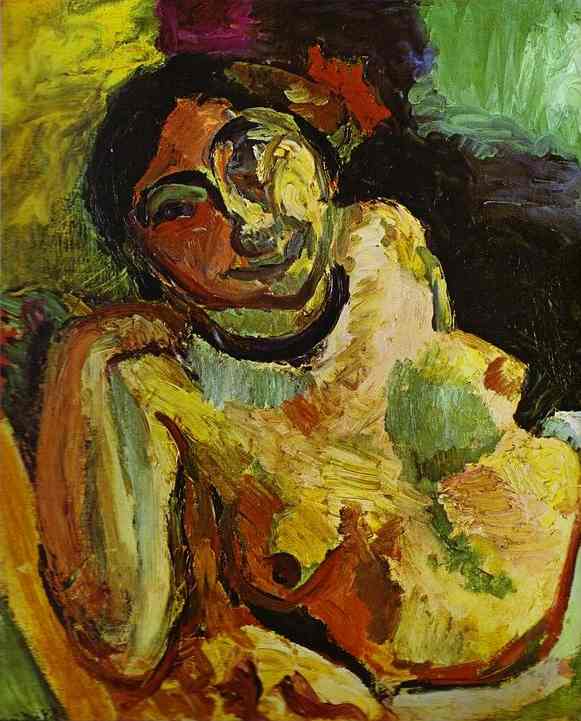
“Gypsy” (1906) is an arresting study in chromatic heat and sculptural paint. A reclining woman fills the frame at a steep diagonal. Her head tilts toward the viewer with a half-smile that wavers between invitation and introspection. The image is dominated by oranges, saffrons, bottle greens, and tar-black accents; thick strokes press into one another like plates of molten glass. The figure’s torso is modeled not by smooth gradations but by brisk, piled strokes that turn with the body’s planes. The background, reduced to fields of deep umber, acidic green, and a flare of purple at the top, works as a dramatic theater curtain that pushes the sitter forward. In a single glance, the canvas declares its allegiance to feeling over description and to paint as substance rather than mere coating.
1906: Consolidating the Fauvist Breakthrough
Created just after the explosive Fauvist season of 1905, this painting shows Matisse consolidating his discoveries. Color remains the primary agent of form, but the shriek of novelty has become a deeper, more physical register. Instead of organizing the picture with academic contouring and chiaroscuro, Matisse constructs it with high-contrast temperatures and assertive seams of dark. The result is bolder than naturalism yet more grounded than pure decorative flatness. “Gypsy” sits at the hinge between Fauvism’s chromatic liberation and the later, more architectonic Matisse who builds calm worlds from clarified relationships.
Subject, Naming, and Historical Distance
The title reflects a common early twentieth-century label for a Roma sitter—terminology that today is recognized as reductive. Acknowledging this context matters because Matisse’s choice of subject was part of a broader modern fascination with so-called “exotic” types. In this canvas, however, the rhetoric of otherness is muted by intimacy. The woman occupies the frame not as an ethnographic specimen or a costume study but as a living presence whose personality emerges through the movement of paint. The assertive, near-life-size crop resists the distancing that typology can induce. Whatever the title, the encounter is face-to-face.
Composition: Diagonals That Breathe
The figure lies at a diagonal from lower left to upper right, a sweep that generates both restful horizontality and kinetic tilt. The left forearm forms a ramp that lifts the head; the right shoulder rolls forward, creating a hollow at the sternum and a counter-slope at the hip. Matisse crops mercilessly so that the body exceeds the edges of the canvas, letting the viewer feel proximity instead of tableau distance. Triangles lock the design: one from elbow to head to breast; another from shoulder to navel to hip. These interlocking forms stabilize the painting while making it pulse like a lung. The eye cycles naturally—head to breast to hand to head again—so that looking reproduces the sitter’s slow breathing.
The Architecture of Color
Matisse’s color plan reads like a map of temperatures. Saffron and vermilion drive the warmest passages across cheek, chest, and belly; cooler pond-greens slip into the shadowed side of the torso and under the clavicle; a waxy, pale turquoise glazes transitional zones to soften the leaps. Jet-black seams—in the choker, hair, and key contours around nose and eyes—beam like armatures that hold the color masses together. The background’s acidic green at the upper right counterbalances the figure’s warm dominance, while dark umber in the upper left compacts space near the head and functions almost like a hush, giving the smile room to register.
Drawing With the Brush: Planes, Not Outlines
Look closely at the face. The nose is not modeled by a cautious gradient; it’s carved by a single, confident stroke that arcs from eyebrow to nostril. The orbit of the left eye becomes a crescent of shadow, while the right eye dissolves into a pair of parallel swipes. The mouth is a compact trapezoid whose corners are warmed just enough to read as flesh. This is drawing by planes: quick decisions that grasp how light meets form rather than how a pencil traces a silhouette. Across the torso, square-ended strokes stack like shingles, turning as the rib cage turns; where two temperatures meet—say, olive against apricot—the edge appears of its own accord.
Light Without Illusionism
Illumination here is not atmospheric effect but an ordering logic. The body glows because the painter sets warm notes against strategic cools, not because he simulates a measurable source. Highlights arrive as thick, pale, buttery strokes that sit high on the surface; shadows deepen abruptly into sap green or umber. The approach trades the subtle blending of academic light for decisive color events. Yet the anatomy reads, even persuades: collarbone, breast, rib, hip, and thigh are legible through this language of keyed contrasts.
Impasto and the Physicality of Seeing
The canvas’s surface is palpably worked. Paint is dragged, troweled, and pressed so that ridges catch light like little cliffs. This impasto does more than advertise energy; it makes the skin feel physically present. You sense the painter finding the form with his wrist and shoulder, not merely naming it with a thin brush. In places, a bristle’s rake reveals the underpainting in rhythmic striations, thick against thin, hot against cool. The body seems assembled from the very stuff that represents it—color as flesh.
The Psychology of a Half-Smile
The sitter’s expression is neither purely sensual nor purely aloof. The smile tilts, uncertain; the gaze does not pin the viewer but glances with a softness that complicates the frankness of the nude. This ambivalence is reinforced by the face’s asymmetry. The right side (our left) is warmly lit and relaxed; the left side is compressed by darker planes that narrow the eye and sharpen the cheekbone. The personality emerges in that tension: a person both present and protected, open and internally occupied. The black choker intensifies the effect by setting a crisp horizon under the chin—ornament that is also a shield.
Background As Emotional Weather
Rather than describing a room, Matisse floods the ground with emotional color. The acid green at top right feels like afternoon sun filtered through leaves; the deep umber and violet above the head suggest a recess of shadow, almost cave-like. These fields aren’t neutral backdrops. They operate like chords that tune the figure: the green cools the heat of the torso, the brown cautions the smile, the purple injects a flick of mystery. Because the background is kept planar and generalized, the figure comes forward as if surfacing from a warm pool of color.
Cropping and the Ethics of Nearness
By crowding the figure into the frame, Matisse eliminates the safe distance of voyeurism and substitutes proximity that demands regard. The nude becomes less a display and more a face-to-face encounter in which the viewer must negotiate eye level with the sitter’s tilted head. The diagonal cut across hip and thigh prevents the classical, reclining-odalisque silhouette; what remains is a frank body with the scale of real presence. The closeness does not force intimacy; it asks for responsibility.
Comparisons Within Matisse’s 1905–1907 Body of Work
Set beside “Woman with a Hat” (1905), “Gypsy” is earthier, closer to the model, less ornamented by costume and pattern. Compared with “Nude in a Wood” (1906) or the preparatory studies for “Le Bonheur de vivre” (1905–06), this painting compresses the landscape’s color storms into the human figure. It anticipates the frank corporeality of “Blue Nude” (1907), where planes turn even more geological. Yet it retains the tender, living warmth of 1906, a year in which Matisse balanced liberation with recognition—modern color that still keeps company with bodies we know.
Influence and Dialogues: Van Gogh, Cézanne, and Gauguin
The thick facture and saturated complements nod to Van Gogh’s material urgency. The constructive stacking of planes owes a debt to Cézanne’s method of building form as though masonry, each stroke a brick. The chromatic daring—the decision that the shadowed side of flesh can be green, the turning plane coral—echoes Gauguin’s synthetist license. But “Gypsy” is nobody’s pastiche. Where Van Gogh’s stroke often dramatizes distress, Matisse’s announces a confident equilibrium; where Cézanne’s planes strive for analytic permanence, Matisse’s pulse with sensual immediacy; where Gauguin flattens into decorative symbol, Matisse keeps the body tangible.
Edge Behavior: How the Figure Meets the World
Edges vary according to need. Around the jaw and nose, Matisse lays firm dark seams that snap the features into focus. The shoulder’s outer rim melts into green ground, trading hard outline for atmospheric bleed and giving the sense of skin absorbing light. At the breast, a rapid alternation—warm next to cool, thick next to thin—creates a vibrating contour that feels alive. These edge decisions choreograph the viewer’s attention: crisp where identity must hold, soft where breath should expand.
The Role of Black
Black is not merely shadow here; it is a structural color. In hair, choker, and key interior folds it sharpens neighboring hues, making oranges flare and greens deepen. Matisse was keenly aware that black, used sparingly and decisively, energizes the palette by contrast rather than deadening it. In “Gypsy,” a narrow black curve under the cheek sets off the smile; a dark hollow at the armpit anchors the torso as weight, not just shape. The picture depends on these small currents of darkness to keep brightness from floating away.
Flesh as a Field of Temperatures
The painting refuses the illusion that skin is a single tone. Instead it presents flesh as a climate, with hot gusts and cool pools. Notice the pale, buttery strokes across the sternum, the olive patch under the clavicle, the amber at the cheekbone, the terracotta in the shadow of the breast. These are not random experiments; they correspond to planes and to the way light and blood animate skin. The result is not anatomically literal but physiologically convincing, a portrait of how warmth circulates and how light grazes.
Time, Touch, and the Energy of Making
Because the surface remains open, we can reconstruct the order of decisions. A broad warm underpainting lies beneath; over it, Matisse sets cool counterstrokes to turn form; finally, selective dark lines and small highlight wedges lock the structure. That visibility of process gives the painting a time dimension. We experience not just a finished image but the energy of its becoming, a presence that feels contemporary because it keeps renewing itself as our eyes track the layers.
The Ethics of Looking at Nudes Today
Modern viewers bring a justifiable awareness to depictions of women as objects of the gaze, particularly when subjects have been historically exoticized. “Gypsy” complicates that history. The sitter’s face, so near and so particular, claims personhood rather than anonymity. The body is rendered with the same structural respect Matisse accords to landscapes and interiors, and the frankness is neither coy nor punitive. The painting asks us to see paint and person at once, neither canceling the other. Looking becomes a practice of attention rather than consumption.
Why the Painting Persuades
“Gypsy” convinces because every element performs more than one job. The diagonal composition rests and propels. Color both models flesh and sets emotional temperature. Black stabilizes drawing and intensifies hues. Thick paint makes surface and substance coincide. Background fields are nonliteral yet descriptive of mood. Nothing is filler; each decision contributes to a coherent visual logic in which sensation produces structure and structure deepens sensation.
Legacy: A Step Toward Matisse’s Mature Humanism
This canvas points toward Matisse’s later ability to reconcile daring color with serene order. Even while proclaiming freedom from academic decorum, it treats the sitter with a fundamental tenderness. The person is not lost in the experiment; the experiment serves the person. That humanism, rooted in attention and clarity, remains one of Matisse’s greatest gifts to twentieth-century painting.