Image source: wikiart.org
First Impressions: A Still Life That Glows From Within
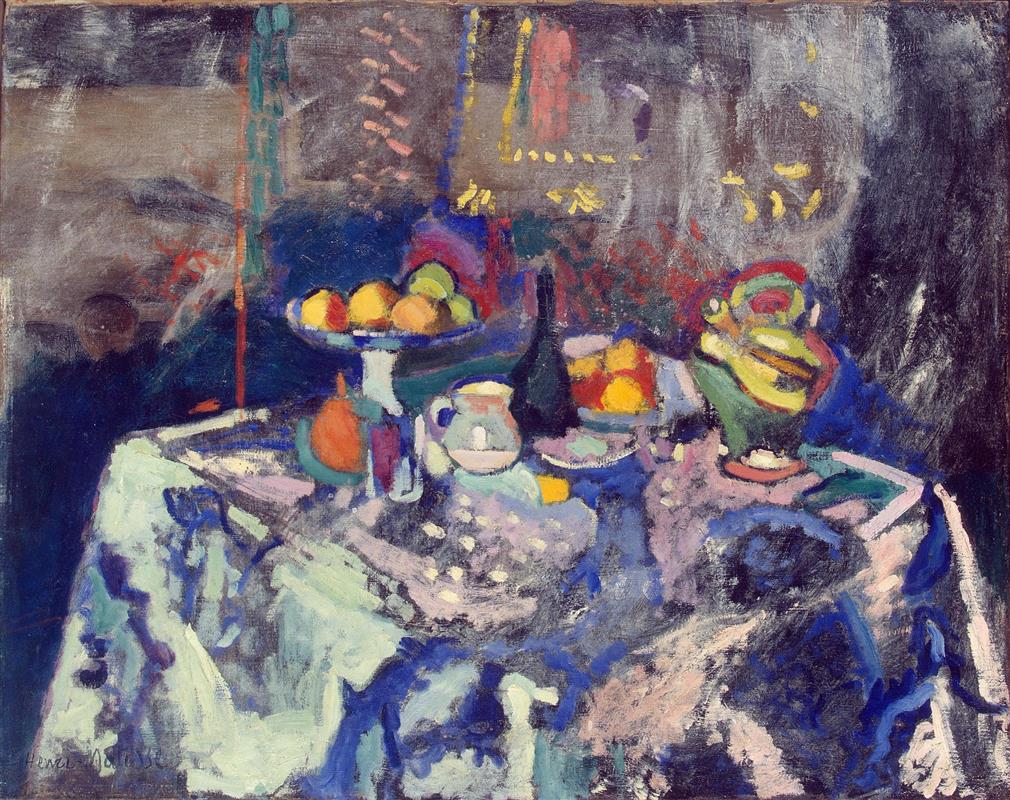
“Vase, Bottle and Fruit” arrests the eye with an atmosphere closer to a stage set than a kitchen table. A white pedestal compote heaped with citrus, a squat jug, a tall green bottle, a handled vase, and scattered fruit gather on a table draped in a pale, violet-shadowed cloth. Around them the room darkens to blue, plum, and charcoal, pricked by decorative sparks of yellow and pink that feel like reflections or wall ornaments glimpsed by lamplight. Rather than modeling each object with careful shading, Henri Matisse builds them from chords of saturated color—lemon and tangerine, emerald and ultramarine, rose and lilac—so that light seems to emanate from the pigments themselves. The effect is an intimate nocturne: a quiet interior where color is the true illumination.
The Moment: 1906 and the Indoor Turn of Fauvism
Painted the year after the explosive 1905 summer in Collioure, this canvas shows Matisse translating Fauvist discoveries from blazing seascapes to the low, reflective light of interiors. In 1905 he proved that unblended, complementary color could shoulder the structural work once handled by chiaroscuro. In 1906 he tests whether the same grammar can thrive away from Mediterranean glare. “Vase, Bottle and Fruit” answers yes. Here, saturated notes burn brighter for being surrounded by dusk; the tablecloth’s chill violet makes oranges flame; the bottle’s dark green deepens the radiance of the compote’s white stem. It is Fauvism recalibrated for evening.
Composition: A Tabletop as Proscenium
The composition is triangular and sure. The table’s front edge tilts toward us, its corners clipped by the frame so the surface thrusts into the viewer’s space. Atop it, the tall compote stands slightly left of center like a principal actor. The jug and fruit cluster to its right; the bottle and a cut citrus sit just behind; the lidded vase at far right counterbalances the compote’s height with bulbous volume. The drape falls over the table in angled planes that echo the geometry of the stage-like foreground, while the background recedes as a soft, dark wall—not a literal room but a climate that holds the lights of the objects. Everything is placed to keep the eye in play: verticals arrest and release, diagonals usher the gaze from one object to the next, and circular fruit interrupt the rectilinear thrust with pulses of roundness.
The Tablecloth: Light Made Material
Matisse’s tablecloth is more than support; it is the painting’s field of weather. A ground of cool blue-white is veiled with lilacs, slate blues, and brief violet shadows, all brushed loosely so the cloth breathes. The high-key light of the cloth pushes forward against the deep room, allowing darker objects to sit without heaviness. Where folds peak, the paint is left thin so the canvas or priming flickers through like glare; where folds drop, a single violet sweep suffices for shadow. The pattern is not stitched detail but a rhythm of tones that lends the whole stage a living pulse.
Color Architecture: Complements Doing the Drawing
The structure rests on deliberate complementary pairings. Oranges flare against blues, lemons gleam against violets, and greens steady the entire scheme as a cool, saturated foil. Matisse does not outline his fruit with black; he places a tangerine against a lilac fold so that the seam becomes edge. The green bottle is only partly described; its silhouette is completed by the surrounding night. The white of the compote pedestal is not pure white at all but a calibrated mixture of cool and warm lights—pale mint beside cream—so that it reads luminous without leaving the color world. Because pigments remain relatively unblended, each stroke retains chromatic identity and the entire scene vibrates with quiet intensity.
Objects as Characters: Compote, Bottle, Jug, and Vase
The pedestal compote is the anchor. Its bowl is a cool blue-violet that traps the heat of oranges and a green apple, a perfect microcosm of the canvas’s hot–cool logic. The high stem lends elegance, and its bright shaft punctures the tablecloth’s shadows like a column of moonlight. The green bottle, slim and vertical, is built from a single dark chord, its contour suggested where it interrupts surrounding tones. It is not diagrammed; it simply stands, gathering the room’s dimness into itself. The small jug to the right is handled with affectionate economy: a white body tinted by neighboring violets and blues, a mouth rimmed with a quick dark, a handle that swings with a single sure stroke. Finally, the handled vase at far right, with red collar and yellow-green belly, introduces a warmer echo of the bottle’s silhouette. Together, these forms create a rhythm—tall to squat, dark to light, warm to cool—that animates the tabletop.
Background as Active Space
The wall behind the table is no dead backdrop. It is a deep, modulating field where the brush never sleeps. Plush blues mingle with smoky umbers and plums; here and there, strokes of turquoise and orange descend like ribbons; small lozenges of yellow and pink suggest reflections or a decorative frieze glimpsed in low light. These signs are never descriptive enough to distract, but they enliven the dark so it feels like air rather than void. The background’s softness also protects the painting’s luminosity: because the wall is full of minor variations rather than flat black, the bright objects do not pop with vulgarity; they bloom.
Light Without Chiaroscuro
Conventional still lifes hinge on a single directional light that carves shadows, stamps reflections, and stages a clear time of day. Matisse arrives at illumination differently. He lets hue, not shadow, declare turning form. The lemon on the plate brightens where it leans toward blue and cools where it meets violet; the compote’s bowl turns through a dial of blues without ever dropping into brown; the jug’s body swells because a slightly cooler white sidles up to a warmer one. Even the dark bottle is volumetric not because it is shaded but because its edges trade temperatures with neighboring fields. This chromatic conception of light keeps the painting high-key, breathing, and remarkably clear even where values are close.
Brushwork and Facture: Evidence of Decision
The surface is a record of thinking in paint. Tablecloth strokes drag and scumble, suggesting both fabric and glare. Fruit are laid with compact, curving touches that follow their roundness. The bottle and background receive long, lateral sweeps that flatten and quiet them so the eye can rest before returning to the table. Small bursts—like the hot flare at the vase’s rim or the sparks of yellow on the wall—announce changes of tempo. This orchestration of touch differentiates substance without resorting to fussy description. You feel skin, glaze, linen, and air through the way paint behaves.
Rhythm and the Eye’s Path
The painting choreographs a loop for the gaze. You begin at the bright compote, slide to the jug, hop to the lemon and bottle, swing across to the green-and-yellow vase, then drop to the tablecloth’s heavy fold at lower right before gliding back along the cloth’s diagonal to the pedestal stem and the piled citrus. Each object borrows a hue or a directional stroke from the next, so the circuit repeats naturally. This self-renewing rhythm is part of the canvas’s quiet hospitality: it never traps the eye, and it never lets attention disperse.
Space and Depth Without Stage Tricks
“Vase, Bottle and Fruit” remains pleasantly shallow, as if we are leaning over the table rather than peering into a deep room. Depth arises from overlapping planes and value steps rather than from perspective grids. The plate wedges partly under fruit and bottle; the vase’s foot sits on a lighter patch that signals a nearby fold; the far wall darkens by degree, not by horizon line. The shallow space keeps the decorative unity intact while still allowing objects to occupy believable positions.
The Decorative Intelligence at Work
Matisse loved ornament—textiles, ceramics, Islamic tiles—and he often said that painting must be decorative in the noblest sense: an organization of relations that gives pleasure and calm. This still life manifests that ideal. Pattern is implicit rather than explicit: the cloth’s broken lights behave like a textile motif; the fruit repeat as color accents; the vertical bottle and pedestal stem function as stripes that steady the field. Nothing is symmetrical, yet everything is balanced. The composition feels inevitable without ever growing rigid.
Food and Vessel as Metaphor
Without narrative props, the picture still conveys meaning through its materials. Fruit are pure color and fleeting life; vessels hold, reflect, and stabilize; linen receives and distributes light. Matisse uses these roles to stage a small allegory of painting itself. Pigment, like fruit, is vivid and perishable unless given a stable form; containers and cloth stand for the format that receives and organizes that energy. The still life becomes a demonstration that color can be both wild and civilized when set inside a sensitive structure.
Kinships and Contrasts Within Matisse’s Oeuvre
Set beside the 1906 “Flowers,” this canvas shows a related nocturnal mood but with more architectural scaffolding. Compared with “The Geranium,” its color is lower-key, its darks thicker, its atmosphere denser. Later interiors in Nice will lighten again, with beach glare pouring through shutters, but the underlying logic—color as structure, pattern as rhythm, reserve as light—remains constant. Here we see the hinge where Matisse proves that Fauvist principles can organize a complex indoor harmony, not just a sunstruck landscape.
How to Look So the Picture Opens
Stand close to the compote’s stem and note how two nearly white notes—a cooler mint and a warmer cream—turn a cylinder. Step back and watch that modest contrast lift the entire table. Move to the green bottle’s right edge and feel how a faint halo of lilac air completes its contour; no line is necessary. Drift across the tablecloth’s fold at lower right and sense how a single, confident violet stroke describes depth that a page of crosshatching could not. Finally, rest your eyes on the small yellow dashes on the wall; notice how they keep the background alive without breaking its dusk. After a few circuits, the painting stops being a list of objects and becomes a single, resonant chord.
Why It Still Feels Modern
The canvas reads as contemporary because it relocates accuracy from descriptive detail to durable relations: warm against cool, saturated against muted, vertical against diagonal. It accepts incompletion where completion would deaden. It treats the background as active partner and shadow as colored air. And it trusts viewers to complete edges and volumes from hints—a faith that matches how the eye actually works. In an age of images that tell too much, “Vase, Bottle and Fruit” remains fresh because it says exactly enough.
Conclusion: A Night Table Where Color Thinks
“Vase, Bottle and Fruit” is a poised argument for color’s intelligence. With a handful of vessels, a mound of fruit, and a breathing cloth, Matisse constructs a world where light is born from hue, space is a negotiation of temperatures, and pleasure is the natural result of measured relations. The objects keep their everyday dignity, yet the scene rises beyond domestic anecdote into musical order. More than a century later, the still life remains what Matisse wanted art to be: a place of calm intensity, a good room for the eye.