Image source: wikiart.org
First Glance: A Harbor Built from Pure Color
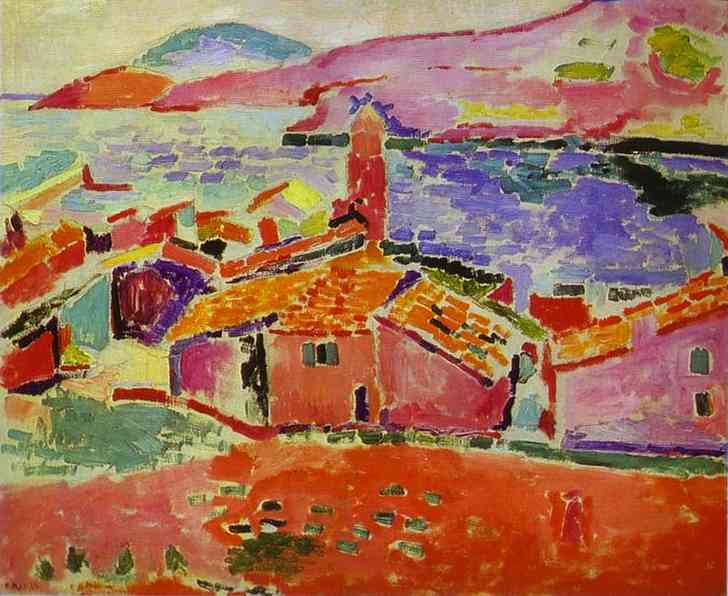
“View of Collioure” throws you into the heat and glitter of a Mediterranean town by turning rooftops, sea, and hills into blocks of saturated paint. Orange roof tiles flare like embers, pink façades breathe with warmth, and the harbor registers as a mosaic of lavenders and blues. Instead of shading buildings with gray shadow, Henri Matisse organizes the entire scene through temperature: hot reds and oranges advance; cool violets and aquas recede. Black appears only as a taut seam to lock pieces together. Even before you name a single object, the painting delivers a sensation—a sunstruck town alight with color.
Collioure 1905 and the Birth of a New Language
The canvas belongs to the summer when Matisse, working side by side with André Derain in the fishing town of Collioure, reinvented his method. He left behind the measured dots of Neo-Impressionism and let color operate with unprecedented independence. “View of Collioure” is not a postcard; it is a record of discovery. In it Matisse shows that color can carry the structural labor usually assigned to drawing and chiaroscuro. The painting is less a description of streets than an argument made visible: if the temperatures are right, a town coheres without a single careful shadow.
Composition as a Network of Rooflines and Water
The scene is seen from an elevated vantage, probably a hillside path or terrace above the harbor. Roofs knit together in a crisscross that points toward a central vertical tower. The lower third is an open, glowing forecourt of red that reads as the town’s sun-baked plaza; the middle third compacts into tilted roofs; the upper third releases into water and distant hills. This tiering keeps the eye moving. Diagonals pull you inward along ridge lines, then send you outward again toward the horizon. The tower, centered but slightly offset, stops the zigzag from running away and gives the painting a pulse.
Color Architecture and the Logic of Complements
Matisse builds the picture from complementary pairs. Red-orange roofs meet greenish doors and accents; pink façades lean into blue-violet shadows; lemon daubs flash against purple water. These complements do more than decorate. They create edges, so that forms are drawn where warm collides with cool. The roofs are not modeled with brown; they are stated by sequences of orange hit by cadmium yellow, edged by black or blue slivers. The sea is not a single blue; it is lavender pushed against lilac and ultramarine so that the surface appears to breathe.
The Sea as a Tiled Field of Light
Look into the harbor and you find a ledger of strokes placed like tesserae. Horizontal notes of violet and blue settle the plane, while lighter lilac patches open pockets of glare. Small, dark bars drift across the water like low craft or shadows; they act more as rhythm than as objects, disciplining the field and pacing the viewer’s travel. This method captures a truth about bright coastal light: the sea does not read as “blue” but as a quilt of reflections that never quite stop moving.
The Rooftops and Facades as Living Surfaces
The roofs carry thick, loaded strokes in alternating oranges and reds, sometimes crossed by short darker notes that stand for tiles. Walls are not flatly filled; they are planes of pink and rose interrupted by small, darker rectangles for windows and doors. A narrow band of black often runs where roof meets wall. Those seams work like the lead in stained glass, bracing the high-key palette and clarifying the angles of the buildings with minimal means. The town feels entire, yet nothing is overdrawn.
Brushwork, Impasto, and the Evidence of Decision
The surface keeps your awareness of paint intact. Matisse lays broad swipes on the roofs, scumbles thinner paint across the sea, and leaves places where the primed canvas peeks through. That reserve is not carelessness; it is light. It lets air circulate between strokes, prevents color from getting muddy, and reproduces the glare of the day more honestly than a blanket of pigment ever could. In several passages, especially along roof ridges, impasto ridges catch real light, doubling the painting’s internal luminosity with the gallery’s.
Light and Hour without Chiaroscuro
The high horizon, crisp contrasts, and absence of long cast shadows suggest strong midday light. Matisse does not paint highlights as brilliant white spots; he bakes light into every color choice. Reds are cleaned of brown; blues are allowed to stay vivid; pinks are lifted almost to coral. The result is not a theatrical spotlight but a chromatic climate—the sensation of heat pressed into your eyelids when you squint at a harbor at noon.
Space Constructed through Temperature and Overlap
Depth emerges without a plotted vanishing point. Warm foreground reds push toward you; cooler water slips back; the far hills thin to pastel notes. Overlap completes the effect: one roofline crosses another; the tower overlaps the harbor; the boats overlap the water as dark dashes. Because space is built from temperature and overlap, the picture remains agreeably shallow—a decorative stage on which the eye may travel without falling through.
Decorative Intelligence and the Pulse of a Town
Matisse loved textiles, tiles, and Islamic ornament. Their logic is present here, not as surface decoration, but as a way of ordering experience. Roofs become repeating motifs, windows become dark beats, and the water’s marks become a patterned ground. The town’s energy rises from these repetitions. There are no individualized figures, yet the scene teems with civic life translated into rhythm.
The Tower as Emblem and Anchor
The vertical tower at center-right is more than a landmark. It provides the necessary perpendicular against the painting’s many diagonals. The tower’s red core steps up through the roofs into the cool zone of the harbor and sky, knitting lower and upper halves together. Small shifts of color around it—violet on one side, blue on the other—bind architecture to water and prevent the structure from feeling pasted on.
Rhythm and the Eye’s Path
The painting composes a clear route for the viewer. You enter through the broad red field of the foreground, pick up the nearest roof’s bright orange line, and climb toward the tower. From its cap you cross to the lavender harbor, rise to the pale hills, and then return on the diagonal roofs to begin again. The circuit is smooth because each segment anticipates the next through echoing color and direction. Looking becomes a gentle loop that mimics walking a hillside and glancing down again and again at the water.
Comparison within the Collioure Cycle
Seen alongside Matisse’s “Open Window, Collioure,” this canvas broadens the view and toughens the geometry. Where the window painting frames the harbor through shutters and vines, “View of Collioure” uses rooftops themselves as framing devices. Compared with the seascapes of the same summer, this canvas privileges architecture and civic pattern rather than cliffs and surf. And compared with “View of Collioure (The Tower),” it leans harder into decorative flatness, using larger fields of single colors for maximum clarity.
The Role of Black as a Structural Tool
Black appears sparingly—window apertures, roof seams, a few outlining strokes—and its function is structural, not atmospheric. In a high-key palette, a handful of darks prevent color from drifting. They sharpen angles, reinforce perspective without geometry, and heighten saturation by contrast. Remove those black notes in your mind and the painting’s firmness softens immediately; restore them and the town snaps into focus.
Material Truths and a Sense of Place
The painting’s physical behavior echoes the Mediterranean site. Thick, warm strokes feel like sun on tile and stucco. Scrubbed passages of water recall reflections that thin as they approach the horizon. Small, exposed flecks of canvas read as salt glare. You sense that the place is not being copied so much as re-composed from the sensations it produces—heat, dazzle, rhythm, and the appetite to look.
Urban Modernity Expressed through Fauvist Means
Although the subject is a small town, the treatment is modern. Matisse declines anecdote—no crowds, no signage, no chimneys with careful smoke—and translates bustle into color rhythm. The harbor’s “traffic” occurs as dark marks on lavender water; the workday hum is a pattern of doors and windows punctuating pink walls. The painting proposes that a modern cityscape can be truthful and moving without descriptive detail, provided color relations ring true.
How to Look so the Picture Opens
Begin by letting your gaze float in the red foreground until edges appear. Climb a roofline to the tower, notice the thin black seam that acts as an armature, then push into the harbor’s violet field and watch how dark dashes keep you from sliding away. Drift to the distant hills, whose pastel softness releases your eyes, then drop back to the closest roof where oranges flare hottest. After a few circuits, the scene becomes less a map and more a continuous chord of temperature and tempo.
Anticipations of Matisse’s Later Rooms and Studios
Several devices here anticipate Matisse’s future milestones. The reliance on color to build space blossoms in “Harmony in Red” and “The Red Studio,” where hue becomes not only the light but the architecture itself. The use of repeated motifs as structural scaffolding returns in his Nice interiors, where shutters, textiles, and window frames create measured rhythms. Even the exposed ground visible between strokes foreshadows the paper cut-outs, where white is literal light rather than painted highlight.
Meaning and Mood without Narrative
What does the painting say, beyond reporting a view? It argues for a kind of clarity—visual and emotional—that the Mediterranean made tangible for Matisse. Orange against blue, pink against violet, black bracing color: these are not just scenic choices. They are statements about how to live and look with composure in a bright world. The mood is celebratory but calm, a balance Matisse pursued all his life.
Conclusion: A Harbor Held Together by Light
“View of Collioure” condenses the 1905 breakthrough into a single, persuasive scene. The town is a network of warm planes; the harbor is a field of cool vibration; the tower ties earth to water and the present to the timeless. With a handful of decisive strokes and a fearless palette, Matisse shows that when color is entrusted with structure, the world not only remains legible—it becomes newly vivid. That is why the canvas still feels fresh: it captures not the inventory of a place, but the experience of light that makes place unforgettable.