Image source: wikiart.org
An Icon Of Fauvism And A Portrait Of Amélie Matisse
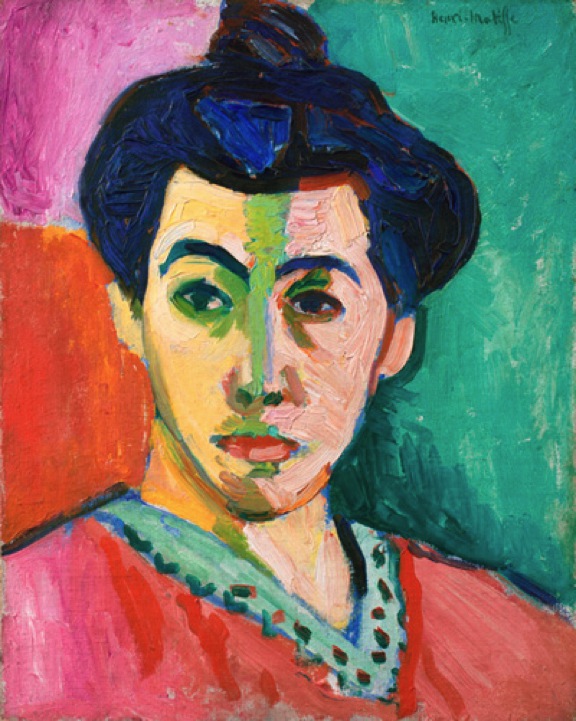
“The Green Line” (1905), often subtitled “Portrait of Madame Matisse,” is one of the defining images of Fauvism and of twentieth-century portraiture. Painted during the blazing breakthrough summer of 1905, it presents Amélie Matisse frontally, hair piled in a dark knot, shoulders wrapped in a coral garment. Across her face runs the painting’s most audacious event: a cool vertical band of green from hairline to chin. This single stripe reorganizes everything we think a portrait should do. Instead of modeling flesh with brown shadows and gentle transitions, Matisse builds form and character with temperature contrasts, complementary chords, and boldly visible brushwork. The result is both a likeness and a manifesto: a human presence expressed as a living structure of color.
First Impressions: A Face Built From Temperature
At first glance the picture reads as a set of radiant fields. The left background flares magenta and orange; the right recedes into sea-green. The face is parted by the famous green stripe; to the left of it, cool yellow-greens and turquoise dominate; to the right, warm salmon, shell pink, and apricot rise toward the ear. The dark blue-black of hair and brows locks these bright planes together, while the garment’s coral notes echo the left background to bind sitter and setting into one climate. Even before the eye parses features, the portrait communicates a precise sensation: coolness and warmth in poised equilibrium, clarity without fuss, intensity without noise.
Composition And The Famous Green Stripe
Formally, the painting is a symmetrical bust—head centered, shoulders cropped, no deep setting—but the symmetry is energized by asymmetrical color. The green stripe is both axis and hinge. Anatomically it abbreviates the shadow cast by the bridge of the nose; compositionally it divides the face into two temperature zones that act like interlocking wings. The stripe is not merely a special effect; it solves multiple problems at once. It states the turn of the head without a perspectival grid. It anchors the gaze, preventing the high-key palette from scattering. And it names the painting’s method: structure will be carried by color, not by tonal modeling.
Color Architecture: Complementaries Doing The Drawing
Matisse builds the portrait from a few decisive complementary relationships. Red meets green at nearly every boundary: the coral garment and magenta wall play against the sea-green background and the vertical stripe; small dots of greener paint bead the neckline like a necklace, converting ornament into structural punctuation. Blue meets orange along the cheek and jaw, where cool passages lie beside warm apricots to declare curvature. Violet and yellow hover around the mouth and chin, keeping the flesh luminous rather than muddy. Because these complements stay clean and largely unmixed, they create edges by adjacency, so that drawing happens where temperatures collide. The face holds together not through contour lines but through seams of hue.
Background As Active Space Rather Than Neutral Setting
The background is a pair of large, breathing planes rather than a neutral void. Magenta to the left is laid in broad, knitted strokes that reveal slivers of the ground; teal to the right is thicker, its direction angling back behind the head. These fields do the work walls would usually do. The warm left side pushes forward and enlivens the cheek of the same side; the cool right side recedes, letting the head turn without a single cast shadow. The background’s colors also echo the sitter’s costume and skin, welding person and room into one atmosphere—the quintessential Fauvist interior where color equals air.
Brushwork, Impasto, And The Speed Of Decision
The surface preserves the tempo of looking. Hair is constructed from dense, directional strokes of blue-black that leave ridges catching real light; the green band is a single sweep adjusted by small retouches at the brow and nose; flesh is a mosaic of angled patches, some laid thick, others scrubbed thin so the primed ground flickers through. Nowhere does Matisse polish the surface into anonymity. The painting insists that a portrait is made of acts—press, drag, lift—and that those acts are faithful to how perception works in strong light: we register planes, seams, and temperatures faster than we register micro-gradations.
Light Without Chiaroscuro
Traditional portraiture uses chiaroscuro—light against shadow—to model volume. “The Green Line” offers another path. Light here is not a spotlight casting hard shade; it is a climate defined by color relationships. The cooler left side of the face reads as the side exposed to bluish ambient light; the warmer right suggests light bouncing from garment and wall. The green stripe abbreviates the nose’s shadow but, more importantly, asserts the difference between the two light sources. Highlights are not white additions; they are lighter values of the prevailing hues. This approach makes the head feel lit from within, a quality that helps the painting avoid caricature despite its bold simplifications.
Features Reduced To Essentials And Intensified
Eyebrows are dark arcs that carry a great deal of psychology. The left brow, thicker and more angled, emphasizes the cool half’s alertness; the right brow softens slightly, harmonizing with the warm flesh below. The eyes are compact constructions—cool irises surrounded by warm lids—yet they lock attention immediately. The mouth, a chord of rose and plum with greenish notes at the corners, has weight without fussy drawing. The ear is a peach oval edged by blue, proof that a warm–cool seam can stand in for intricate anatomy. Each feature is strongly simplified and therefore needs to be placed exactly once; that exactness is part of why the portrait feels inevitable.
Psychology Conveyed Through Color And Posture
Amélie’s expression is steady and self-possessed. The centered head, direct gaze, and compact mouth suggest strength rather than softness. That quality is not achieved by descriptive detail but by the portrait’s tectonics: the dark architecture of hair and brows, the unflinching vertical of the stripe, the calm balance between hot and cool. The palette also rejects sentimental naturalism. Green face tones could have felt grotesque; here they read as ceremonial, like stage light clarifying character. Color is not a disguise but a revelation of temperament—clarity, reserve, and quiet intensity.
Costume, Pattern, And The Edge Of Decoration
Around the neckline small green beads punctuate a paler band that separates flesh from garment. These dots carry more than decorative charm. They echo the vertical stripe, reinforce the green–red complement, and set a measured rhythm at the threshold between body and clothing. The garment itself is a field of reds ranged from coral to crimson, its brushwork broader than that of the face so the latter remains the focus. Pattern and color thus become structural devices, not accessories—a lesson that will bloom in Matisse’s interiors and, decades later, in the paper cut-outs.
The Role Of Black As Armature
Few tones in the painting are truly dark, which gives the handful of black-blue accents extraordinary authority. Hair, brows, nostril, and a touch along the underlip act like the lead in stained glass, bracing saturated panes around them. These darks are not shadows but anchors. They stabilize the high key so it does not drift and they concentrate expression without resorting to descriptive hatching. The economy is remarkable: a short mark at the nostril can fix the tilt of the nose; a single sweep defines the upper contour of the hair and the bun at once.
Dialogues With Other Works And With Tradition
“The Green Line” converses with the other landmark portrait of 1905, “Woman with a Hat.” In that canvas Matisse scatters smaller strokes and a riot of hues to open the face like a kaleidoscope. In “The Green Line” he compresses the experiment into larger, cleaner planes and a commanding vertical, producing greater architectural clarity. The painting also answers earlier portrait traditions. Where Renaissance and Baroque masters used modeling to elevate the sitter, Matisse proposes that color relationships can carry equal dignity. There is an echo of Gauguin’s cloisonné outlines and daring palettes but without exotic costume; there is a debt to Cézanne’s construction by color planes but accelerated and intensified. The portrait keeps company with the past while speaking decisively in a new tongue.
From Collioure To The Paris Salon: Shock And Staying Power
When canvases from the Collioure summer appeared at the 1905 Salon d’Automne, their high-key palettes earned the group the nickname “les fauves”—the wild beasts. “The Green Line” encapsulated the provocation. A face articulated with a stripe of green looked to some like a prank; to others it announced a modern truth: that sensation, not convention, is the measure of pictorial accuracy. The painting’s staying power comes from its double success. It is radical enough to seem perpetually fresh and disciplined enough to remain convincing as a portrait. Many daring works lose force when their shock fades; this one gains force because its logic is so clear.
Why The Portrait Still Feels Modern
The portrait feels contemporary because it solves timeless problems with uncommon economy. It shows how to convey volume without heavy shading, character without fuss, and light without illusionism. It accepts the flatness of the canvas yet builds a fully inhabited space by means of temperature alone. It replaces anecdotal likeness with structural likeness, the sort that survives changes in fashion. In an age of digital images, its frank brushwork and clean seams read as honest craft, while its color architecture feels as crisp as a well-designed interface.
How To Look So The Picture Opens
Begin at the green stripe and let your eyes test its neighbors. On the left, note how a thin yellow band softens into cool green at the bridge of the nose; on the right, how warm pink presses back against it to push that side forward. Follow the hair’s midnight blue across the brow and feel how it braces the entire head. Drift to the background and sense the push-pull between magenta and teal—one advancing, one receding—without any drawn lines. Return to the mouth and watch the cooler notes at the corners stabilize the rose center. Finish at the beaded neckline where color becomes rhythm. After a few circuits, the face no longer seems divided; it reads as a single, breathing organism tuned by temperature.
Material Presence, Ground, And Paint Handling
Matisse exploits the primed ground as a source of light. In several passages a thin drag allows the white beneath to sparkle through, especially in the right background and along the cheek. This reserve keeps mixtures clean and replicates the effect of glare. Where he wants mass—hair, brows, the cap-like knot—paint thickens and ridges, creating a micro-relief that catches gallery light. The total effect is a tactile equivalence for the experience of strong Mediterranean illumination: some surfaces feel hot and dense, others airy and cool.
Influence And Afterlife Across Matisse’s Career
Seeds sown in “The Green Line” germinate throughout Matisse’s work. The confidence that color can act as architecture culminates in “Harmony in Red” and “The Red Studio,” where hue builds entire rooms. The use of pattern as structure resurfaces in Nice interiors, where curtains, textiles, and screens organize space. The habit of drawing with seams of color rather than with outline evolves into the paper cut-outs, in which color and edge are literally the same material. This portrait is thus both a pinnacle and a blueprint.
A Human Likeness Reimagined
At heart the painting redefines what a likeness is. Instead of cataloging features with naturalistic tones, it identifies the sitter through proportional clarity, temperature balance, and the cadence of a few dark accents. If we changed the colors arbitrarily, the portrait would collapse; if we kept their relations, the identity would persist. That is why the picture is so memorable. It captures not a momentary expression but a stable structure of presence—the way this person occupies light and space.
Conclusion: A Stripe That Divided And United Painting
“The Green Line” is remembered for its single audacious stroke, but its greatness lies in the harmony that stroke makes possible. With one vertical of green, Matisse clarifies the head’s turn, unites portrait and background, and declares a method in which color is the primary engine of form. Everything else follows: the complementary chords, the confident brushwork, the poised psychology, the room that seems to breathe. The painting does not ask viewers to abandon tradition; it asks them to trust their eyes—to feel how clean relations of hue can deliver truth with a candor unavailable to brown shadow. More than a century later, the stripe still parts the face and opens a path through modern art.