Image source: wikiart.org
Collioure, 1905: A Coastline Where Color Learns to Lead
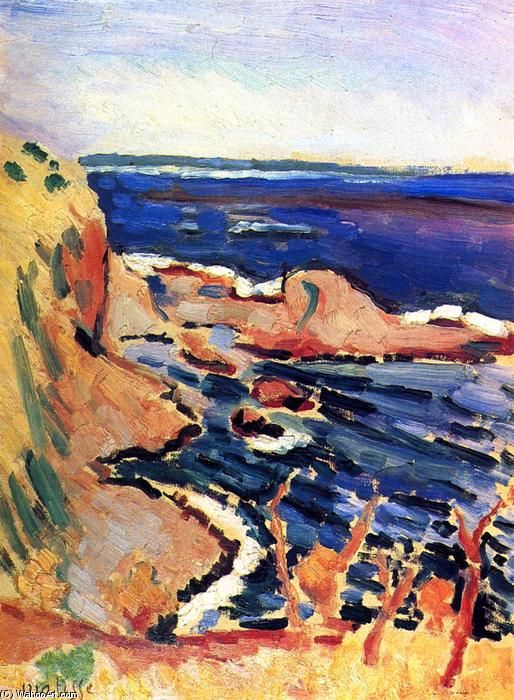
Henri Matisse painted “La Moulade” in the summer of 1905, the season in Collioure when he remapped what painting could do. On this rocky Mediterranean headland he stood above a small inlet and reimagined the scene as a set of saturated chords. Warm ochres and oranges shape the sandstone cliff at left; a band of dense ultramarine and Prussian blue composes the sea; ribbons of white snap like foam along the rocks; and a pale violet sky holds everything in a high key. The painting does not merely picture a cove—it stages the collision of hot land and cool water, translating heat, glare, and motion into a language of color and touch that would soon be called Fauvism.
The Motif and Its Name
“La Moulade” refers to a specific inlet on the Collioure coast, a bite taken out of the shoreline where the surf twists around reefs and shelves of rock. Matisse chooses a high vantage, looking down and across the cove so that the cliff plunges diagonally from the upper left toward the water, while the sea sweeps horizontally like a dark ribbon. In the immediate foreground a fringe of red-brown shrubs or pruned vines lifts their forked stems, echoing the surf’s rhythm. The motif is simple—cliff, water, sky—yet the treatment is radical. Instead of drawing every fracture in the rock or every ripple in the water, Matisse reduces the whole to essential pressures and lets color carry the weight of description.
Composition As a Triangular Engine
The picture is built on a strong triangular armature. Edge one is the plunging cliff that descends from top left. Edge two is the long horizontal of the dark bay that cuts the canvas in its upper half. Edge three is the diagonal of foam and current that winds through the middle ground, climbing from the lower right toward the center before losing itself at the cliff’s foot. These three vectors pin the eye in a revolving loop: down the cliff, across the sea, back through the surf—and repeat. The foreground shrubs act like metronomes, marking the tempo of that loop, while the bright wedge of sky at top keeps the whole design breathing.
Color As Structure Rather Than Ornament
Every major form in “La Moulade” is constructed from temperature contrasts more than from line. The cliff is a stack of warm notes—ochre, orange, coral—stabilized by cool intrusions of blue-green where vegetation clings to stone. The sea is a dense field of blues laid in horizontal passes, thickened and darkened toward the horizon to suggest depth. Along the seam where water meets rock, Matisse inserts narrow bands of white, lilac, and turquoise that do the job of drawing without a pencil. The complementary pairing of orange cliff and blue sea is the painting’s governing chord. Because these colors sit opposite on the spectrum, each intensifies the other: the sea looks deeper beside the hot cliff; the cliff glows hotter beside the cool sea.
The Expressive Use of Black and Deep Darks
Matisse’s daring in 1905 included the strategic deployment of black and near-black. Short bands of very dark blue-black carve the water’s interior currents and eddies; a few emphatic darks puncture the cliff, suggesting crevices or shadowed ledges; and the foreground shrubs are rimmed or filled with nearly black pigment that makes the surrounding yellows and oranges blaze. Rather than deaden the palette, these darks serve as ballast. They provide a bass line under the high-key melody and keep the composition from floating away.
Brushwork and the Physicality of Paint
The sea is woven from strokes laid like shingles, their direction following the swell. In places Matisse drags the brush lightly so that undercolor peeks through the blue; elsewhere he lays paint thick, building ridges that catch the light. Rocks and shoals are built from chunky, angular strokes of coral and violet, set down with the certainty of a mason placing stones. The cliff is handled more broadly, its planes swept with warm color that bends to the rock’s tilt. The sky is the loosest zone, a veil of pale violets and blues scumbled thinly so that the ground glows through. The variety of handling—thick against thin, dragged against loaded—does more than describe surfaces; it carries the wind and the heat of the day.
Light and the Hour of the Scene
Everything about the color and the brevity of shadows suggests bright early afternoon. The water is dark not with storm but with depth under steep sun. Whites are crisp, not milky. The cliff’s warm skin looks bleached by heat. And the sky, though pale at the horizon, rises to cooler violets higher up, implying the kind of intensity that simplifies vision into large zones. Matisse does not paint meteorology as clouds and wind; he paints it as temperature and glare. The viewer’s eyes squint sympathetically, as if standing with the painter on that headland.
Space Without Gridded Perspective
Depth in “La Moulade” arises from the choreography of temperature and from overlapping forms, not from vanishing points. Warm colors advance: the cliff and foreground shrubs leap toward us. Cools recede: the band of dark sea pushes back, and the pale sky recedes further still. Overlaps seal the illusion—foam running in front of rock, rock before water, water under sky. Yet the painting never abandons the flatness of its surface. Strokes remain declarative; edges are seams between colors, not outlines placed above them. We sense distance while staying aware of paint.
The Role of Reserve and the White Ground
Matisse allows primed canvas to participate in the picture. In the sky and along certain waterlines, thin scumbles and spaced strokes let the ground flash through as flecks of white light. These small reserves keep the palette clean, prevent overmixing, and admit literal brightness into the structure. In the surf, touches of white sit on top of blue like foam; elsewhere, white is simply what is not painted—and that ambiguity is part of the picture’s radiance.
Geological Truth Translated to Color
Although simplified, the forms convey geological conviction: the headland’s tilt, the terraced shelves, the way the shore breaks into coves that invite the sea to swirl and strike. Matisse signals the meeting of water and rock with zigzag bands and sudden changes in direction; he shows the rasp of submerged reefs by grating dark strokes across blue; he hints at shallow water with narrow turquoise seams. These are not literal details but color decisions that mirror how the coast behaves.
Movement Without Anecdote
Nothing human interrupts the scene—no boats, no bathers—yet motion is everywhere. The brush rows in the sea beat like a pulse. The foam’s white path weaves and doubles back. Even the foreground shrubs seem wind-clipped, their arms raised as if braced against a gust. In this way Matisse replaces narrative with rhythm. Time is not told; it is felt as repetition and return.
Dialogues With Precedents and Peers
The painting keeps faith with Impressionism’s high key and its rejection of brown shadow, but it refuses Impressionism’s flickering smallness. It remembers Neo-Impressionism’s clarity of pigment and its use of discrete touches, yet discards its optical regularity. It borrows from Gauguin and the Nabis the authority of simple planes, but softens their cloisonné outlines into seams of color. Working contemporaneously with Derain in Collioure, Matisse takes these sources and strips them to a compact grammar: lay down clean, saturated hues; oppose warms and cools to make space; use darks as anchors; leave air between strokes so the surface breathes.
The Foreground as Chorus
Those red-brown shrubs at the bottom of the picture might seem incidental, but they perform a crucial function. Their vertical thrust counters the horizontals of sea and sky and the long diagonal of the cliff. Their color—a hot mixture near orange—folds the foreground into the cliff’s palette, binding the composition. And their repeated forked shapes echo the broken path of the foam, knitting land and water into a single rhythm. They also deliver a human implication: these are pruned, managed forms, signs of habitation just offstage.
How the Eye Walks the Picture
The viewer’s experience is choreographed. The gaze descends the cliff’s orange ramp, snaps across the white line of surf, hovers over the dark bay, and rises into the pale sky. Then it loops back, touching the coral rocks and the turquoise shallows before landing on the shrubs in the bright foreground. This circuit can be traveled swiftly or slowly; either way it confirms the painting’s premise that color, direction, and touch can guide a journey without the aid of literal detail.
Kinship Within the Collioure Series
Compared with other 1905 coastal views, “La Moulade” is exceptionally distilled. Some related seascapes employ more broken, granular strokes; here the water is organized in long, decisive bands, the cliff in broad planes, the sky as a clarified veil. Contrasted with Matisse’s grove scenes from the same summer—where canopies of pink and green knit dense lattices—this picture opens wide and lets the horizon set the key. What carries across the series is the same conviction: color relations are sufficient to convey place, light, and emotion.
Material Presence and the Sense of Place
The painting’s tactility deepens its truth. Thick ridges in the water catch real light, mimicking the gloss of swells. Smoother planes on the cliff feel like sun-baked stone. Scumbled passages in the sky suggest shimmering heat. By letting paint behave like matter—sticky, resistant, reflective—Matisse adds a physical layer to the optical experience. One reads the surface with the eyes and the hands at once.
Emotional Register and the Pleasure of Clarity
The emotional tone of “La Moulade” is one of charged ease. The palette is bold, but the relationships are calm and legible; nothing seems forced. The complementary chord of orange and blue delivers excitement, while the pale sky and organized bands of sea provide repose. Matisse fulfills his oft-stated hope for balance and serenity—not as quietism but as coherence. The painting invites the viewer to rest inside intensity.
Why the Picture Still Feels New
More than a century later, “La Moulade” retains a startling freshness because it solves a problem that faces every painter of bright places: how to convey dazzling light without bleaching color. Matisse’s answer is to let white ground and saturated pigments collaborate, to oppose hot and cool with courage, and to accept simplification as a path to truth. The result looks modern not because it is abstract, but because it is exact about sensation. You feel the heat in your eyes; you hear the hiss of foam in the zigzag whites; you taste salt in the dark blues.
Looking Today: What to Notice First
Stand before the painting and start with the seam where sea meets rock. Let your eye follow that white, violet, and turquoise edge and watch how space opens and closes. Step back and see how the entire left side glows hotter because of the sea’s cool belt. Move close and pay attention to the variety within the blues—inks, cobalts, purples—then notice how few strokes it takes to state a rock or a breaker. The picture teaches a method: look for relations, not things; feel temperature before contour; read rhythm as much as detail.
Conclusion: A Headland Where Color Finds Its Sea Legs
“La Moulade” distills Matisse’s 1905 discovery into a single coastal turn. With an economy of elements—cliff, bay, sky—he composes a drama of complementary color, dark anchors, and breathing reserves. Brushwork sets the tempo, temperature organizes the space, and light seems to issue from within the canvas itself. The painting is not only a record of a place in southern France; it is a demonstration of how color can build a world sturdy enough to walk into and brilliant enough to remember.