Image source: wikiart.org
The Fauvist Breakthrough In Collioure
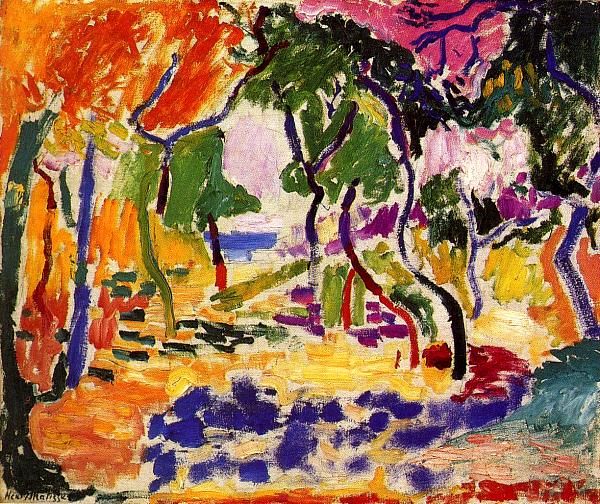
Henri Matisse painted “Countryside at Collioure” in 1905, during the Mediterranean summer that ignited the movement critics would soon nickname Fauvism. In the fishing town of Collioure, working shoulder to shoulder with André Derain, Matisse abandoned tonal modeling and descriptive browns in favor of high-key pigments set down with speed and conviction. This canvas condenses that revolution into a compact manifesto: trees writhe like living calligraphy, earth blazes in yellows and oranges, purples pool like concentrated shadow, and a blue wedge of sea glimmers through the foliage. Instead of imitating a view, Matisse stages the sensation of heat, glare, and movement—and he lets color lead every decision.
Subject, Setting, And The Motif Behind The Color
The motif is a palm-sized slice of the Collioure countryside: a path or clearing, a curved allée of trees, and beyond, a tiny window of sea and distant coast. The scene is commonplace, even humble. What elevates it is Matisse’s refusal to treat it as mere scenery. The trunks bend, leaning toward one another to form an organic proscenium. The sky, caught between leaves, becomes a set of hot pinks and lilacs. The ground is broken into thick blocks of lemon yellow, cadmium orange, and red-violet that register as both sunlit earth and the painter’s own heartbeat. The seaside opening stabilizes the composition and gives the chromatic storm a horizon to breathe against.
Composition As An Arching Canopy
The picture is built on a powerful armature: two flanks of trees lean inward to make an arch. The left side rises in a warm column of orange shot with blue and violet accents; the right side twists in black-edged trunks that torque toward the center. Across the top, interlaced branches stitch a canopy that presses downward in a shallow curve, while the narrow vista of water and headland pulls the eye into the distance. The ground is treated as a tilted plane—neither a conventional stage nor a perfectly flat décor—so we feel both the push of the surface and the invitation to step in. These opposing pressures—enclosure and opening, push and pull—generate the painting’s pulse.
Color As Architecture
In this canvas color does what drawing and modeling once did. Warm hues organize the front: cadmium orange, Indian yellow, and red build the trunks and soil. Cool greens and blue-greens wedge between them to articulate foliage. Purples and violets mark shadow not as negation but as complementary energy, their presence making the yellows flare brighter. The most saturated pinks are hoisted to the canopy where sky peeks through, turning air into a field of chromatic excitement. The sea’s small rectangle is a concise chord of cobalt and white; because the surrounding palette is hot, that small cool pocket reads with extraordinary depth. The entire landscape is thus constructed by temperature relationships—warm advancing, cool receding—rather than by measured perspective.
The Productive Power Of Black Contours
Matisse’s black lines are neither outlines in the academic sense nor shadows. They are structural beams that lock forms and make color resonate. The black that rims trunks and branches behaves like the lead of stained glass, tying saturated panes into a single organism. It also keeps the high key from drifting. Against ultrabright yellows and pinks, black provides ballast; its presence allows color to soar without becoming weightless. Few painters before 1905 used black with such confidence inside a brilliant palette. Here it is indispensable—design and emphasis rather than absence of light.
Brushwork, Impasto, And The Tempo Of Seeing
The surface is a mosaic of loaded, rectangular strokes. Some are dragged to leave ridges of impasto that catch the light; others are pressed and lifted to stamp quick notes across the ground. In the purple shadow at lower center, strokes cluster tightly, vibrating like a field of wildflowers caught in a gust. In the canopy, broader passes of pink and lilac sweep laterally, issuing a counter-tempo to the vertical trunks. The handling records the speed of perception in bright weather: when sunlight is harsh, the eye leaps from patch to patch, assembling the world from strong notes rather than continuous tone. Matisse translates that act of looking directly into paint.
Light And Atmosphere
Everything here speaks of Mediterranean noon. Shadows are short and colored, not gray. Air is dry, haze minimal. The hot palette reproduces the physiological effect of glare: details dissolve into zones; edges flare. Even the sea—coolest element in the picture—carries the density of high light rather than the somberness of late day. The atmosphere is an engine for simplification. Under such light, large forces matter more than small facts, and Matisse uses that truth to justify a language of planes and chords.
Space Without Illusionism
There is depth in the painting, but it is achieved by contrasts and overlaps rather than by converging lines. The curved trees overlap the bright ground; the ground overlaps the violet shadow; the opening to the sea overlies the horizon. Warm colors jump forward; cools slip back; darks anchor. This orchestration keeps the surface near the viewer even as it permits a journey into it. The picture plane does not disappear; it remains an active participant, reminding us that we look not through the canvas but at it.
Rhythm, Movement, And The Viewer’s Path
This is a landscape that moves. The trunks sway, their arcs reading like musical phrases. The purple shadow streaks diagonally, a bass note running under the bright ground. The small path that leads to the water is no architectural detail; it is a rhythm line that carries the eye to the blue chord beyond. Looking becomes a promenade: first across the sunlit foreground, then under the tilted canopy, then out to the cool sea, and finally back into the heat. The painting, like a walk, is experienced in time.
Trees As Characters
Matisse personifies the trees by giving each a profile. The left tree is a pillar of flame, built from oranges and shot through with violet; the right tree twists with a sinuous black spine; mid-ground trees are slimmer and lighter, their greens chipped with white to suggest glare. None is botanically specific; all are psychologically legible. They lean, greet, and converse, turning the clearing into a social space where forms interact like figures. This anthropomorphic charge adds warmth to the radical palette, ensuring that the painting’s boldness feels hospitable, not harsh.
Dialogues With Precedents And Peers
“Countryside at Collioure” gathers and transforms several influences. From Impressionism it inherits the high key and the refusal of black for shadow. From Neo-Impressionism it keeps the clarity of discrete strokes while abandoning the science of regular dots and optical mixtures. From Gauguin and the Nabis it borrows the authority of decorative contour and flat planes. Working contemporaneously with Derain, Matisse turns these sources into a simpler, louder instrument in which color is both subject and structure. The picture does not illustrate theory; it enacts conviction.
The Role Of Reserve And The White Ground
Even in such a saturated canvas, Matisse allows the primed ground to peep through in thin scrubs and along the edges of strokes. These small reserves function like breaths taken between phrases. They keep colors clean, prevent overmixing, and admit literal light into the painting. Particularly in the upper sky and along the path, flecks of ground make the whole surface feel sun-struck, as if brightness emanated from within the weave as much as from the pigment above it.
Emotional Register And Viewer Response
Matisse called for an art of balance and serenity, but serenity here does not mean quiet. It means coherence: despite the high volume of color, nothing clashes. The hot and cool zones interlock with the ease of a puzzle, so the viewer relaxes inside intensity. The emotional tone is one of charged ease—joy sharpened by the electricity of complementary pairs. The little wedge of blue sea works like a cool glass of water set down amid a feast of spices. Because the color relationships feel inevitable, the eye trusts them, and with trust comes calm.
Comparisons Within The 1905 Series
Seen beside “Promenade des Oliviers” or “Madame Matisse in the Olive Grove,” this canvas is more compressed and theatrical. Where those paintings open a central path flanked by trees, “Countryside at Collioure” brings the flanks almost together, letting the arching canopy dominate and the sea appear as a tantalizing keyhole. Compared with “Sun Street,” it is denser, replacing open reserve with saturated fields. Compared with “Landscape in Collioure,” it trades a single commanding dark trunk for a chorus of swaying forms. Across the set, the constant is Matisse’s reliance on color contrasts to engineer space.
Materiality And The Sense Of Place
The impasto in the trunks and purple shadow is not ornamental. It produces a tactile metaphor: the trees feel thick and resistant, the shadow dense and cool, the ground dry and friable. Counterposed to the thick paint are passages of scumbled, translucent color that let the canvas weave sparkle—especially in the sky and path—mimicking the optical grit of bright daylight. Place is therefore conveyed not just by hue but by the way paint sits on the surface.
Anticipations Of Later Matisse
Seeds planted here will bloom throughout Matisse’s career. The trust in color to build space leads to the saturated interiors of 1908–1911 and culminates in “The Red Studio,” where color becomes architecture itself. The black armatures around forms anticipate the clean contours of the Nice period and the decisive edges of the late cut-outs. The simplification of complex foliage into planes and chords foreshadows the dancers and bathers, figures that read as rhythms rather than anatomies. In this 1905 clearing, the future is already visible.
Why The Painting Still Feels New
The canvas remains fresh because it trades description for effect without sacrificing clarity. Photographs of the same place would tell us more about bark and leaf; they would not tell us more about light. Matisse insists that accuracy of sensation outranks accuracy of detail. He shows that the world can be rebuilt from temperature, interval, and rhythm—and that when those are right, the eye accepts bold liberties with hue. The lesson feels contemporary: in an image-saturated culture, the difference between looking and seeing is the courage to simplify.
A Walk Toward The Sea
At the center of the painting is a promise: a narrow path that slips between tree trunks toward the cobalt pane of water. It is a modest path, almost overwhelmed by the riot of color around it, yet it exerts steady pull. That small blue rectangle is both destination and compositional anchor. Follow it, and you recognize the painting’s generosity: the wildness of color is not chaos; it is a garden that leads somewhere quiet. The walk to the sea is a metaphor for the painting’s own structure—intense at the edges, lucid at the heart.
Conclusion: A Clearing Where Color Speaks First
“Countryside at Collioure” compresses Matisse’s discovery into a single, resonant scene. Trees curve like written phrases, a canopy of pink air vibrates above, a violet shadow cools the flaming ground, and a sliver of sea holds the composition together. Everything essential to the artist’s mature language is present: color as structure, black as armature, brushwork as tempo, space built by temperature instead of measured lines. What begins as a view becomes an invitation—to step under this charged canopy and let color, at last, speak first.