Image source: wikiart.org
The Fauvist Summer Distilled Into Hills and Sky
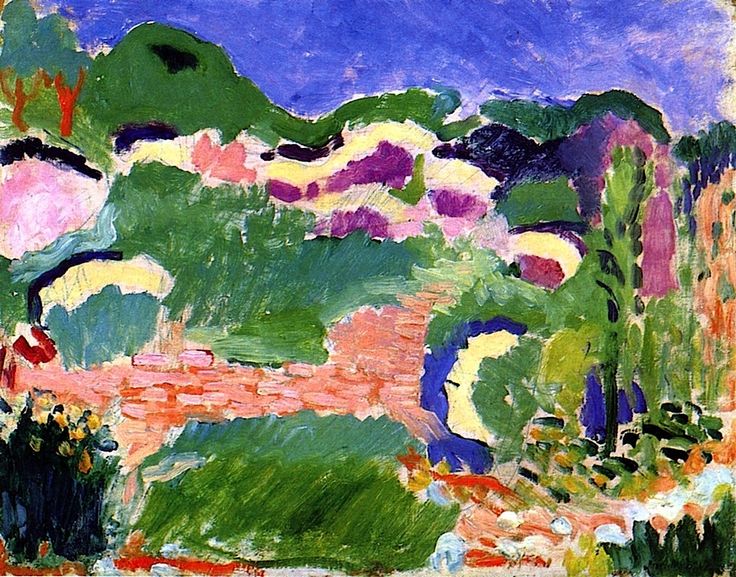
“Les Genêts” (1905) belongs to the incandescent summer in Collioure when Henri Matisse discovered how far color could carry a painting. The subject is a hillside cut by paths and dotted with shrubs, topped by a broad sky. The treatment is fearless. Patches of lavender, emerald, cobalt, and rose knit the surface into a single vibrating field. Matisse retains just enough description to anchor us in a place—low slopes, a sliver of track, the vertical accent of tall shrubs—while allowing color to become the true architecture. The title points to broom bushes, those hardy, yellow-flowering “genêts” that thrive in Mediterranean heat; their presence is not rendered botanically but as bursts of high key that ignite the greens around them. The result is a landscape that feels less reported than remembered, boiled down to its temperature, brightness, and rhythm.
A Landscape Built Like a Score
The first impression is musical. Across the bottom third, warm, brick-pink strokes step forward like a melody; above them, a large green field holds the middle register; in the upper band, lavender slopes swell toward a cobalt sky that resolves the chord. Matisse organizes the composition with horizontal tiers punctuated by verticals at the right edge—thin tree or shrub forms that act like bar lines. This stacking of zones gives the small scene a monumental calm while preserving movement. The pink path tilts obliquely, nudging the eye toward the center before it climbs into the band of hills. Rather than a measured perspective, the sense of depth arrives through intervals: wide strokes in the foreground, denser touches on the rises, a flat, simple sky that pushes them all forward. The land reads like a stage of color planes, each with its own tempo.
Color As Structure, Not Ornament
Every passage in “Les Genêts” proves Matisse’s conviction that hue can do the binding and building once done by line. Complementaries steer the image: cobalt against orange-pink, green against violet, lemon against purple shadow. The hottest notes are reserved for the broom shrubs, where creamy yellows flare beside darker greens to heighten contrast. Lavender swales lie between green ridges not because the earth is actually purple but because purple cools green and makes the field breathe. A small wedge of near-black tucked into the upper middle acts as a ballast, keeping the high key from floating away. Nowhere is color merely descriptive; each note is chosen for what it makes its neighbor become.
Brushwork That Leaves the Day’s Weather on the Canvas
Matisse lays on paint in quick, rectangular swatches, the sort of loaded strokes that still show the imprint of the bristle. In the pink path, they stack like bricks; in the green field, they turn broader and more lateral; in the hills and sky, they lift and curve, as if following the swell of wind. He rarely blends on the surface. Instead he lets the strokes butt against one another so the pale ground flashes between them, admitting more light. The technique registers both speed and certainty: the canvas feels executed in the open air, yet the distribution of weight—where the densest marks cluster, where the thinnest scrubs lighten the load—reveals calculation. The surface keeps the memory of a bright, dry afternoon when colors stayed crisp and shadows refused to go gray.
Title and Motif: What the Broom Shrubs Contribute
Naming the picture for genêts matters. Broom shrubs colonize poor soils in blazing sun, flowering a sharp yellow that catches the eye from far off. Matisse translates that sensation into small, bright eruptions—the lemon-cream dabs that punctuate the greens near the right edge and along the slopes. Their task is twofold. Visually, they spike the palette so the surrounding greens feel deeper and the violets cooler. Emotionally, they broadcast climate. One glance at these yellow ignitions and you sense the dry fragrance of warm hillsides, the rasp of insects, the sizzle of noon. Without painting the plant “correctly,” he conveys the plant’s presence with accuracy of feeling.
Drawing Without Contour
Look for outlines and you will find few. Where he needs separation, Matisse relies on a seam of contrast rather than a drawn edge: a sliver of blue between green and violet, a darker ribbon where pink meets field. At the far right, vertical shrubs are not encircled but asserted through stacked strokes that rise like flames. This method collapses the hierarchy between figure and ground. The hills, the path, the sky—all are equal participants in a single, woven fabric. Eliminating contour allows the eye to move uninterrupted, the way a walker’s attention flows across terrain without stopping to name every thing.
The Role of the Sky
The cobalt-violet sky at the top is crucial. Rather than painting a nuanced atmosphere, Matisse drops in a broad, nearly unmodulated plane—cool, saturated, and slightly darker at the edges. That flatness stabilizes the restless rhythms below. It acts like a lid keeping the color pressure inside the picture. The decision also inverts naturalistic expectation: the “deepest” space—the sky—reads as the flattest shape, while the foreground opens with texture and variation. Space becomes a negotiated experience rather than an illusion obeying lineal rules.
A Dialogue With Impressionism, Divisionism, and Gauguin
“Les Genêts” converses with several traditions at once. From Impressionism come the high key and the refusal of black for shadow; from the Neo-Impressionists, the idea that discrete touches can intensify one another when set side by side. Yet Matisse refuses the scientific regularity of divisionism. The marks change size, angle, and density as the motif requires; they are tools of emphasis, not system. From Gauguin and the Nabis he adopts the taste for decorative flattening and broad, assertive planes. The painting melds these sources into a language that feels both stripped and rich, as if the artist had boiled multiple recipes down to their most savory reductions.
Time of Day and Temperature
The painting’s high-key greens and blistered pink-oranges suggest a moment when the sun is not yet vertical but already hard—mid-morning, perhaps, or late afternoon when lateral light makes colors flare. The absence of long cast shadows adds to the sense of a bright, open field rather than a deeply raked evening. Air seems dry; nothing in the surface reads as haze. Matisse does not paint “weather” as cloud or wind; he paints it as temperature felt through color.
Space by Temperature and Interval
Depth arises from temperature shifts more than from drawing tricks. Warm pinks and oranges pull forward; cool violets slip back; mid-greens knit the middle ground. The eye steps into the picture by touching each field in turn, as if walking a path of color thresholds. The more one looks, the more one realizes that “distance” is not measured here but modulated. The near and the far are sensations of heat and cool, not places on a grid.
The Courage of Simplification
What might at first glance seem childlike is, in fact, rigorous simplification. Matisse excludes particular details—individual leaves, blades of grass, rocks—to reveal the structural pressures of the scene. He keeps only what carries the feeling: a path, a slope, a rise, a patch of bright shrub. One can imagine the discipline it took to stop early, to resist the instinct to “finish.” The economy pays dividends. Because nothing is fussy, the large forces—light, hue, mass—speak loudly. The painting models a way of seeing that privileges essentials over minutiae.
The Painting as a Manifesto in Disguise
Although it depicts a modest hillside, “Les Genêts” acts like a manifesto for Matisse’s new approach. It declares that a landscape can be constructed from a handful of colors and still convey specificity; that structural blacks can stabilize a brilliant range; that a sky may be a single plane; that a path may be a chord of pinks rather than a carved trench. In 1905 such liberties shocked viewers accustomed to tonal modeling and faithful description. Today they read as inevitabilities, partly because Matisse made them so.
Kinship Within the Collioure Cycle
Viewed alongside other Collioure works from 1905, this canvas occupies a distinctive slot. Compared with “Promenade des Oliviers,” it abandons the central axis of a path between trees and instead spreads energy horizontally. Compared with “Landscape in Collioure” with its commanding black trunk, this picture dials back the vertical anchor and lets color planes flank one another. Compared with “Madame Matisse in the Olive Grove,” it empties the scene of human figures, making the land itself the protagonist. Across these variations, one hears the same theme: color articulates space, light, and movement more directly than contour.
Material Presence: Pigment, Ground, and Pace
The paint is handled frankly, with areas of thin scrub where the ground participates and areas of impasto where color needs body. The canvas weave peeks through in the sky and some greens, granting a grain that feels like heat shimmering. Strokes move at different speeds: swift in the sky, slower and blockier in the fields, short and pecking in shrub patches. The variety ensures that no zone goes inert. Even the apparent “empty” spaces hum because the ground serves as active light rather than unpainted accident.
Psychological Space and the Viewer’s Walk
The painting invites a psychological walk. The pink path pulls you inward; the meadows open to your left and right; the darker ridges at the top offer a gentle stop against the sky. Because figures are absent, you occupy the scene without competition. The picture becomes less a view of someplace and more a practice of looking—how to move through a field with attention to temperature and contrast. This is one of Matisse’s gifts: to convert viewing into a bodily rhythm.
Why Broom, Why Now
The choice of broom shrubs carries symbolic weight beyond botany. Genêts are survivors—plants that bloom where soil is poor and light is severe. Their yellow blaze is less a flower than a flare. In post-Impressionist France, they also suggested the South: independence, resilience, a life close to the elements. To fix his 1905 experiment to these shrubs is to declare that his new language of color is hardy and sun-tested. The painting says, in effect, that modern color thrives in harsh light and thin soil; it doesn’t need the shelter of academic finish.
Anticipations of Later Matisse
This canvas seeds several future achievements. The reliance on color fields to organize space points forward to “The Red Studio,” where color becomes architecture outright. The courage to flatten the sky into a single band will recur in Nice interiors where windows are violet panes against green walls. The simplification of nature into bold masses anticipates the dancers and bathers—bodies turned into rhythms on open grounds. Even the hot-cold pairing and lean linear accents prepare the way for the paper cut-outs, where edge and color are literally one material.
How to Look at “Les Genêts” Today
For a contemporary viewer, trained by photography to expect meticulous detail, the painting offers a recalibration. Stand close and the world dissolves into patches; step back and a hillside reassembles. Notice how a small purple smudge can cool a whole acre of green; how a wedge of near-black anchors a sky; how a few lemon dabs conjure a flowering shrub. The longer you look, the less you “read” things and the more you register relations. That shift—from naming to sensing—is the experience Matisse built the canvas to deliver.
Conclusion: A Hillside That Teaches Vision
“Les Genêts” is a compact demonstration of a new way to see. With a handful of saturated hues and decisively placed strokes, Henri Matisse turns a simple Mediterranean hillside into a theater of color. The broom shrubs spark the field; the pink path breathes warmth through the middle; the sky’s broad cobalt lid steadies the restless land. In its economy and candor, the painting announces a belief that would guide Matisse for decades: color can be both structure and song, both measure and emotion. To walk this hillside with one’s eyes is to learn that painting does not merely depict light—it generates it.