Image source: wikiart.org
A Fauvist Morning Staged Between Two Trees
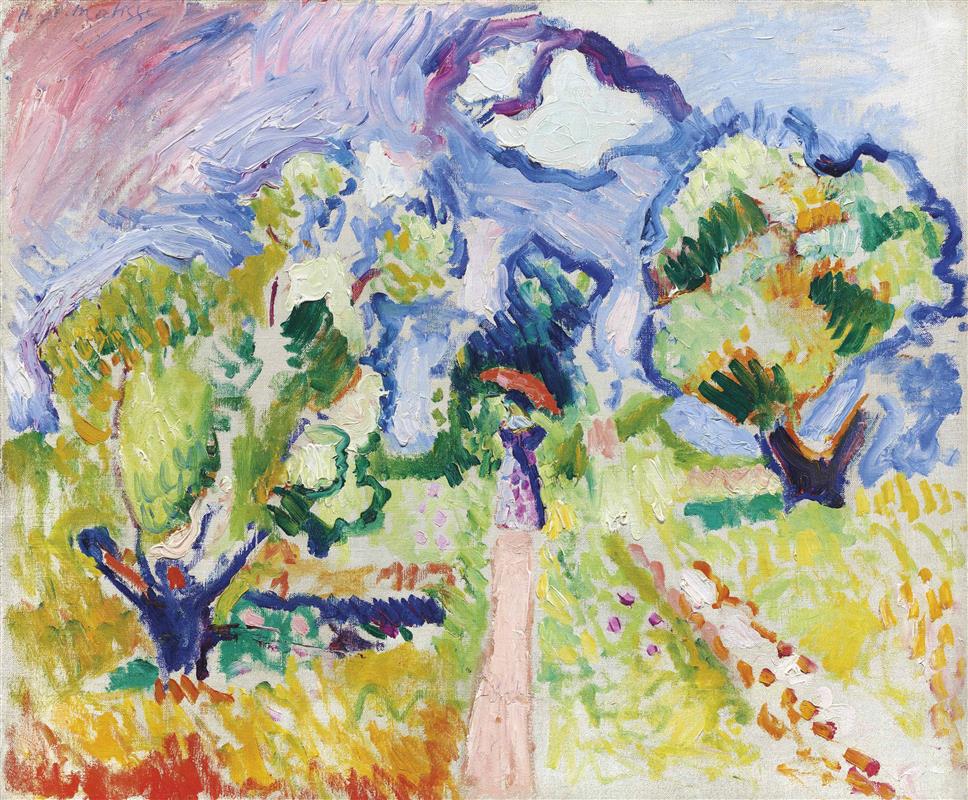
“Promenade Des Oliviers” (1905) greets the eye with an explosion of saturated color and vigorously loaded brushwork. A pink-beige path climbs straight up the center of the canvas, guiding us toward a tiny figure who shelters under a red-orange parasol. On either side, olive trees flare out in buoyant, irregular masses of lemon yellow, sap green, and viridian, ringed by assertive bands of ultramarine. Above them, a sky of lilac, periwinkle, and mauve heaves in long, quick strokes that read like gusts of wind made visible. What might, in another painter’s hands, become a tranquil pastoral turns here into a kinetic stage where color, not contour, sets the rhythm. The “promenade” of the title is not only the walker’s path; it is also the promenade of the viewer’s gaze as it travels through fields of hue.
The Summer Of 1905 And The Emergence Of Fauvism
The year 1905 marks the chemical spark that ignited Fauvism. That summer in the Mediterranean town of Collioure, Matisse—working alongside André Derain—rejected the measured blends of Impressionism and the optical rules of Neo-Impressionism. He chose instead to place pure, high-key pigments directly onto the canvas and to let their juxtapositions do the work of light and form. “Promenade Des Oliviers” embodies the freedom of that season. It is painting conceived as direct sensation: the heat of southern sunlight, the orchard’s resinous scent, the human pleasure of leisurely walking. Rather than calibrating tones to mimic nature faithfully, Matisse creates a parallel reality whose laws are chromatic and emotional.
Composition As A Proscenium
The compositional skeleton is simple and powerful. Two olive trees, one left and one right, behave like pillars that frame a proscenium. Between them runs the path—a vertical spine that divides yet unites the scene. The tiny parasol-bearing figure stands almost at the crossing of thirds, a fulcrum of scale and narrative that gives the landscape a human keynote without stealing the show from the color. Matisse strengthens the structure with diagonals: gridded strokes in the grasses angle inward, and a dotted ribbon of ochre footprints or stones arcs along the right-hand verge, echoing the path while complicating its authority. These lines give the picture a forward pull, as if the viewer has just taken the first step into the orchard.
Color As Architecture
The painting’s architecture is built from color contrasts rather than linear perspective. Matisse stacks complementary oppositions—blue/orange, red/green, purple/yellow—until the surface thrums. The tree on the right is a masterclass in this method: its foliage is a patchwork of citrus yellows and deep greens, but it is the cool blue contour that locks the form together and lifts it off the field. On the left, a cooler canopy leans into violets and blue-greens, counterbalancing the warmer right side and preventing the composition from tipping. The central figure’s violet dress harmonizes with the sky’s mauves, while the parasol’s warm accent ties her to the sunlit meadow. Color does not fill pre-drawn shapes; it is the very geometry of the picture.
Brushwork And The Physicality Of Paint
Matisse’s brushwork in 1905 is fast, decisive, and thick enough to catch the light. Strokes lie like tiles, often preserving the rectangular memory of the bristle tips. In the sky, broad, curving swathes of lilac and blue sweep in arcs, and cream-colored slivers of untouched ground flash between them, animating the air. In the grasses, short, angled dabs impersonate flickers of light without dissolving into optical tremor. Everywhere we feel the tempo of the artist’s hand: a quick notation rather than a labored transcription. Importantly, the paint does not aim for polish. The roughness is intentional, the better to represent the raw voltage of outdoor experience.
Space Without Illusionism
Although the path and diminishing trees suggest depth, the painting resists traditional illusionism. Planes tilt toward the picture surface. Blue contours outline masses like cloisonné, a device Matisse admired in Gauguin and in stained glass. The horizon is a pressure zone rather than a window. This flatness is not a defect but a principle. It reminds us that we are looking at pigment on canvas, and it places the viewer’s attention on relations among colors instead of the fictive recession of space. Yet paradoxically, the scene still breathes. The alternation of warm and cool zones, the scaling of the figure, and the diagonals of the grassy marks collectively produce a convincing sense of passage through air.
Olive Trees As Mediterranean Emblems
Olive trees are not neutral flora. In the southern French visual imagination, they signal longevity, resilience, and a particular bright dryness to the light. Their torsioned trunks and tufted crowns lend themselves to expressive deformation. Matisse’s olives appear elastic, sprung open by heat. He thickens their outlines in blue, as if the sky itself were clasping them. Their leaves are not rendered individually; instead their masses are pulsing color fields, a shorthand for the way sun atomizes foliage into flicker and glow. By choosing olives rather than, say, poplars or chestnuts, Matisse declares the painting’s geography and climate in a single stroke.
The Figure With The Parasol
The central figure—reduced to a few emphatic notes—gives the landscape a time signature and a human scale. The upright posture repeats the vertical of the path; the parasol makes a soft dome that rhymes with the round canopies of the trees. Clothing is suggested with violets and cool greens, not to define a portrait but to weld the person into the chromatic logic of the place. In a century that would soon make heroic subjects out of machines and factories, Matisse chooses a modest act—walking—as the vehicle of modern feeling. The parasol gestures toward leisure, but it is also a color device: its warm accent centers the eye and distributes the painting’s heat evenly.
The Sky As Weather Of Emotion
The sky is a theater of gesture. Thick, curving sweeps of mauve and ultramarine cut across one another, leaving cloud-shaped islands of bright white ground. These marks do not describe a meteorological event as much as an emotional one—the sense that the day is active, the air in motion, the sun blinding and then soft again as clouds sail by. The periwinkle band that drapes down from upper left into the orchard behaves almost like a curtain pulled open for the promenade to begin. This is the opposite of an invisible sky. It is a co-star.
Drawing Through Color And Edge
Matisse famously said he wanted his colors to be like “sticks of dynamite.” Here they are also his pencils. Outlines are made from pigment slabs rather than fine graphite. The blue edges around the trees are not shadows; they are assertions of boundary, bringing to mind the lead cames in stained glass that organize luminous panes. The effect permits extraordinary liberties within the forms: the greens and yellows can stay as raw as need be because the blue armature holds them. The technique allows drawing to be felt without subordinating the picture to contour.
The Role Of The White Ground
Where an academic painter would cover the support completely, Matisse often lets the primed ground shine through. In “Promenade Des Oliviers,” these flashes of white work like added light. They separate strokes so the colors do not blend into mud; they breathe air into dense passages; they create highlights with zero overpainting. This use of the ground is one reason the canvas looks sunstruck. The white is not emptiness but active luminosity. It behaves like the midday glare bouncing off dry earth.
Naturalism Reimagined
Nothing in the painting is “the right color” if one expects a photographic transcript, yet everything feels right if one expects a translation of sensation. Violets live in the sky because violet makes the yellow grass more electric. Trees wear blue halos because those halos put them in front of the purple cloud. The path blushing toward pink is not a failure of realism but an acknowledgment that heated light tints every pale surface. Matisse’s fidelity is to experience, not description. He has reinvented naturalism as a set of color relations that produce the same alertness one feels when stepping from shade into Mediterranean noon.
Rhythm, Footsteps, And The Act Of Looking
On the right edge, a rhythmic trail of orange patches runs along the path’s border, like footprints, stones, or dropped petals. Their function is musical as much as descriptive: they subdivide the space into beats, echoing the gentle cadence of walking. Matisse asks the viewer’s eye to travel with that same tempo, pausing on each patch before moving to the next, until the gaze meets the parasol and then glides upward into the sky. The painting thus choreographs looking. The promenade is enacted by the spectator.
Dialogues With Precedents And Peers
The canvas carries forward lessons from several sources while overcoming them. From the Impressionists, Matisse inherits the commitment to open-air light and the rejection of brown shadows. From Signac and the Neo-Impressionists he takes the idea that discrete, clean touches can vibrate when placed side by side—but he discards their strict optical science. From Gauguin and the Nabis he borrows the flat, decorative contour and the courage to let color lead. Working in real time with Derain in 1905, he pushes these elements toward something bolder: color patches so large and saturated that they stop imitating light and become light.
Leisure As A Modern Subject
A stroll through an olive grove is an unheroic theme, yet it matters that Matisse chooses it. Around 1900, modern painting repeatedly turns to scenes of leisure—beaches, cafés, gardens—not to escape modernity but to claim it. Leisure is modern because it is a choice about time. The petite walker with her parasol is not laboring; she is savoring. The orchard, far from being a nostalgic pastoral, is a contemporary public space, a place to move, to breathe, to take pleasure in sensory abundance. The painting proposes that modern life’s most radical promise might be the permission to feel fully.
Materiality, Speed, And Control
The apparent speed of execution does not imply carelessness. The strokes are placed with strategic economy. Saturated oranges appear at key pivots to accelerate the eye; cooler notes accumulate where a visual rest is needed. The left tree’s trunk, a dark flare rising into lighter foliage, counterposes the right tree’s paler core wrapped in a blue contour—a rotation that stabilizes the scene. The central path is slightly warmer than the surrounding yellows so it registers as a plane, while its edges bleed just enough to avoid stiff geometry. Such choices reveal a painter conducting an orchestra of hues with an ear for harmony and a love of syncopation.
The Picture Plane As A Lively Surface
Look closely and the surface reads like a relief map. Peaks of impasto catch raking light; troughs offer pockets of shadow. This tactility binds viewer and motif: the feel of thick paint plays against the imagined feel of thick air. Matisse does not wish the canvas to disappear. He wants it to be present as an object, a crafted thing that hosts a lived experience. That duality—object and experience—gives the painting its special charge.
The Ethics Of Joy
Matisse often spoke of wanting an art that offered balance, purity, and serenity. In “Promenade Des Oliviers,” joy is not naive; it is built. It arises from decisions: to choose high keys over browns, to keep marks open rather than sealed, to give the figure modest scale so the landscape can sing. The painting proposes an ethics of attention. By looking acutely at color, we practice a way of being in the world that welcomes intensity without anxiety. The work does not deny difficulty; it suspends it for the duration of our gaze, the way a walk can reset the mind.
Anticipations And Afterlives
This canvas anticipates several later Matisse signatures. The bold use of complementary chords foretells the portraits of 1905–1906 in which faces become green planes banded by red, and it prefigures the radical flattening of “The Red Studio” years later, where color itself constructs space. The thick outlines around forms point forward to the cut-outs, where color and edge will be one and the same. Even the motif of a path threading between trees recurs in variations, a durable armature on which Matisse tests different chromatic worlds.
Seeing The Orchard Today
Viewed now, “Promenade Des Oliviers” remains startlingly fresh because it models a way of looking that feels contemporary. The painting does not ask whether the trees are correctly drawn; it asks whether we can trust feeling as knowledge. It offers a toolkit—contrast, rhythm, interval—for turning sensation into form. It invites us to walk again, not to arrive anywhere but to keep noticing. In that sense the picture is less a window than a practice, a method for re-energizing perception when habit has dulled it.
Conclusion: A Path Through Color
Everything essential to Matisse’s mature art is here: color as structure, brushwork as tempo, drawing by edge and interval, the union of human presence and environment, the conviction that ordinary pleasure can carry the weight of art. “Promenade Des Oliviers” is not a document of a particular grove; it is the distilled experience of moving through light among living forms. The path up the center is a compositional axis, but it is also a promise: if we follow color, it will lead us somewhere vital. In 1905, that promise heralded a revolution; today it still leads us, step by step, into a brighter way of seeing.