Image source: wikiart.org
Historical Moment And Why This Subject Matters
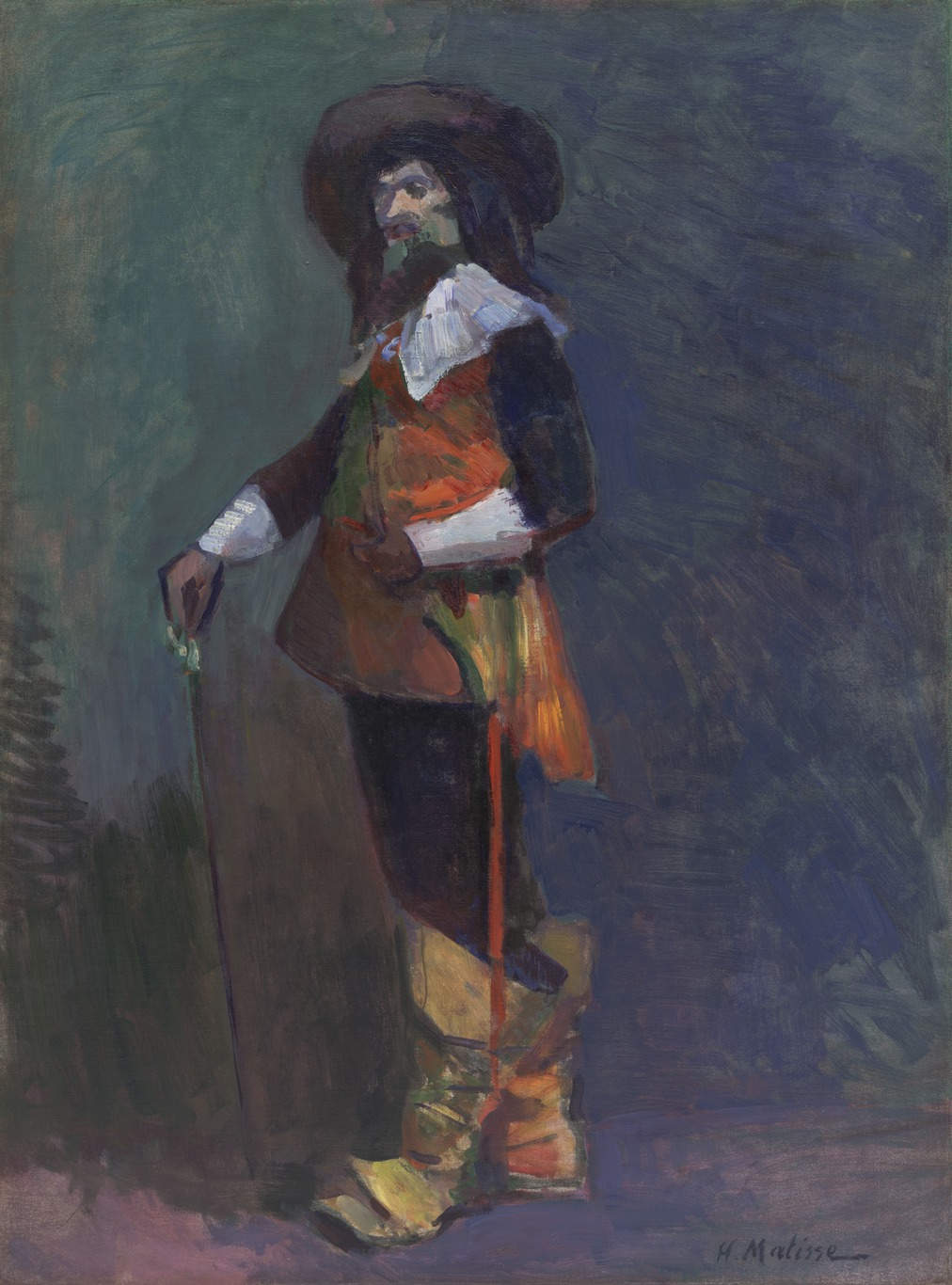
Painted in 1903, “The Musketeer” belongs to Henri Matisse’s crucial pre-Fauvist years, when he was paring down academic habits and discovering that color, plane, and rhythm could carry a picture more convincingly than meticulous description. The costume subject—half stage, half history—gave him license to experiment. A seventeenth-century figure invites theatrical gesture, saturated hues, and large, legible shapes; it also frees the artist from portrait likeness so he can concentrate on pictorial problems. In this work Matisse uses the musketeer as a pretext to test how a single figure can dominate a shallow field, how a few tuned colors can suggest light and material, and how brushwork can propose both air and drama without turning to academic modeling. The result is a compact manifesto for the language that, two years later in Collioure, would blossom into Fauvism.
First Impressions: Gravity, Poise, And A Quiet Flame
At first glance the painting feels poised and ceremonious. A bearded man in broad hat and high boots stands three-quarter view, cane lightly planted, head cocked toward the light. A crimson-orange doublet flares at the torso; cool blacks and midnight blues sink the sleeves and breeches; a crisp white collar and cuffs flash like quick chords struck across the composition. Surrounding everything is an atmospheric field of blue-greens and violets, brushed in long, curving sweeps that read as air more than architecture. The figure seems to step forward from that field—solid, dignified, and slightly theatrical—yet the surface never loses its painterly breath.
Composition: A Tall Triangle On A Shallow Stage
Matisse organizes the rectangle with classical clarity. The feet and cane establish a base; the torso rises in a gentle diagonal; the hat forms the apex of a stable triangle that locks the figure to the ground. The leftward cant of the cane sets a counter-diagonal, as does the jaunty brim of the hat, so the design never stiffens. Negative space is carefully metered: there is more breathing room on the figure’s right, where the background opens like a cool curtain, and a narrower margin on the left, where a darker vertical thicken the air. By pressing the musketeer close to the front plane and compressing depth, Matisse keeps the energy at the surface, where color relations do the storytelling.
The Background As Atmosphere Rather Than Setting
There is no documented interior, no period furniture, no horizon line. Instead, a bluish-green field sweeps behind the figure in broad, curvilinear strokes, punctuated by faint darker eddies along the lower left. This background functions like a stage scrim: it amplifies the warm notes of the costume, separates the figure from the floor, and provides a continuous climate in which the light can circulate. Because the ground is not neutral gray but an active, cool harmony, it plays against the orange and yellow of the tunic and boots, setting up complementary sparks that animate the whole.
Color Architecture: Warm Center, Cool Envelope, Exact Whites
The chromatic structure is economical and eloquent. At the center sits a hot red-orange doublet, edged by dull olive and darkened by the shadow of the beard; below it, high boots mix yellow ochre with strokes of sap green and violet shadow, catching the eye with their surprising citrus glow. The sleeves and breeches drop into a deep, blue-black register that tethers the lower half to the ground plane. The background, a mottled sea of blue-green, keeps the key cool and allows the warm center to radiate without screaming. White is rationed: the collar and cuffs flash like bright intervals, articulating angles of head and wrist and helping you read the pose instantly. There is very little pure black and no chalky white; Matisse prefers mixtures that carry temperature, because temperature—warm against cool—does the real work of turning form.
Light As Climate, Not Spotlight
Illumination in “The Musketeer” behaves like a stable weather system. No single window blast throws a theatrical spotlight; instead, the figure is washed by a consistent, diffused glow. The right cheek catches a pale, green-tinged light; the far side of the hat melts into a cooler violet; the boots gleam where ochre is dragged over darker underlayers. Because the value range is controlled, the light never rips holes in the surface. It clarifies volumes while protecting the integrity of the color chord. This steadiness is essential to Matisse’s picture-making in these years: it allows him to trade chiaroscuro for chroma.
Brushwork: From Notation To Dense Timbre
One of the painting’s pleasures is its variety of touch. In the background, long, flexible strokes sweep like wind, curving around the figure and implying space without delineating it. On the costume, paint grows denser and more directional. The doublet’s orange is laid in with short, meaty strokes that follow the turn of the torso; white on the collar is scumbled and then crisply struck to catch light; the boots are layered wet-into-wet so that yellow, olive, and violet mingle like worn leather catching a room’s glow. The beard is a compact mass of dark strokes that anchor the head and give the profile its bite. Everywhere the brush retains its handwriting, a reminder that description here is the outcome of touch and relation, not of detailed inventory.
Drawing By Adjacency And Selective Contour
Edges arise where colors meet. The right sleeve appears because a deep blue-black abuts the greenish ground; the hand exists as a pale, ochre wedge against the doublet; the hat brim is a thick dark arc laid over air. When Matisse wants to lock a form, he uses a firm contour—the seam along the tunic’s edge, a dark bevel at the top of the boot—but these outlines are not academic tracing. They function like binding on a textile: thin structural seams that keep colored planes from fraying into the atmosphere. Elsewhere he allows edges to soften and breathe, especially along the figure’s shadow side, so that the musketeer feels rooted in air rather than pasted on.
Costume As Structure And Icon
The attire carries historical resonance—cavalier hat, falling band collar, slashed sleeves, high boots—but Matisse resists antiquarian fuss. He abstracts the costume into functional shapes: a trapezoid of orange at the chest, two oblong boots, a white chevron at the throat, dark cylinders for sleeves. Those shapes build the composition even if you ignore their identity as clothing. At the same time, the iconography is suggestive. The cane, the high boots, and the swaggering brim hint at bravado, but the pose is composed and inward. He is more sentinel than swashbuckler. That contradiction—costume of dash, posture of calm—gives the figure its dignified modernity.
Psychology In The Tilt Of A Head
Without a descriptive face, Matisse finds psychology in structure. The head tilts and slightly withdraws into the hat’s shadow; the beard darkens the center; the eyes, implied by two quick planes, look past the viewer into the cool distance. The left hand rests on the cane with relaxed authority; the right hand, pressed to the hip, stops the tunic’s warm flare with a pale cuff. You sense focus, not theatricality; the musketeer stands as if waiting to be called, or listening to something beyond the frame. This mood of attentive calm matches the painting’s chromatic discipline.
Space Versus Surface: The Modern Tension
Depth is persuasive but shallow. A shadow puddles under the boots; the cane plants a vertical that seems to pierce an actual floor; yet the background never yields furniture, horizon, or corners. The canvas remains a field of colored sensations. That tension—credible stance within a fundamentally flat design—is the hinge of Matisse’s early modernism. He is not trying to resurrect a Baroque stage; he is exploring how far a picture can lean toward decorativeness while preserving presence.
Lineages And Conversations With The Past
“The Musketeer” converses with the Old Masters without imitating them. The Spanish inflection—wide hat, beard, dark sleeves—inevitably recalls Velázquez and the sober dignity of his court figures. The crisp white collar and cuffs flash like Manet’s accents, where a single light plane can command a composition. The occasional dark contour nods to Gauguin and the Nabis, for whom line is a structural seam. Yet the temperament is Matisse’s: the color is tuned rather than descriptive, the background is atmosphere rather than architecture, and the figure gains authority from simplification rather than detail.
Likely Palette And Material Decisions
Though only technical analysis can be definitive, the harmony points to a practical, early-twentieth-century kit. Lead white, perhaps moderated with zinc, builds the lights of collar and cuffs and keeps the stockings pearly rather than chalky. Yellow ochre and raw sienna sit under the boots and doublet; cadmium orange or vermilion pushes the tunic into its warm register; ultramarine and cobalt blues cool the background and sleeve shadows; viridian or terre verte, nudged warm with ochre, provides the greenish cast of the ground and boots; raw and burnt umber stabilize the deepest tones in beard, hat, and sleeve; a touch of ivory or bone black strengthens the darkest accents. Paint layers vary: thin, oily scumbles in the ground, thicker impasto for key lights, wet-into-wet mixing where materials need to feel alive.
The Cane: A Thin Vertical With Outsize Work
That slender cane does more than stage a prop. It anchors a line of force from hat brim to ground, calibrates scale, and gives the left hand a purpose that clarifies the outer contour. Chromatically it introduces a cool, dark accent that punctuates the warm torso. Spatially it confirms the figure’s contact with the floor while preventing the lower half from dissolving into the ground. This is Matisse’s economy at work: a minimal element performing multiple structural tasks.
Rhythm And Movement In A Still Pose
Although the musketeer stands, the picture is not static. The diagonal of the tunic’s hem, the oblique thrust of the cane, the curve of the hat, and the stepped highlights on the boots set up a subtle cadence. Background strokes flow around the silhouette like air moving past a body. The eye travels from the warm blaze at the torso down to the boot lights, bounces to the hand on the cane, and rises along the sleeve to the collar and beard—an elliptical orbit that keeps your attention within the figure before releasing it to the cool field.
How To Look Slowly And Profitably
Begin by letting the big triangle of the figure settle against the green-blue field. Then read the picture as a chord: orange and yellow at center, tempered by deep blues and violets, all bathed in a cool atmosphere. Move closer to watch edges form by contact—the pale cuff against the doublet, the dark hat against the green air, the boot lights dragged across shadow. Step back and notice how few marks deliver the head: a warm plane for cheek, a dark wedge for beard, a sliver of gray for eye. Finally, absorb the whole in one breath. The success lies not in any particular detail but in the tuned agreement of parts.
What The Picture Says About Matisse’s Direction
Seen alongside the studio views, still lifes, and musician subjects of 1903, “The Musketeer” clarifies Matisse’s agenda. He is practicing simplification without losing gravity, testing how decoration and figuration can share a surface, and trusting color temperatures to carry form. Within two years, in the sun of the Mediterranean, he would turn those lessons toward blazing oranges and blues. The serenity of those later Fauvist canvases depends on discipline learned in works like this—where a restrained palette, a stable structure, and a breathing surface already make a persuasive modern picture.
Enduring Significance
“The Musketeer” endures because it converts a potentially melodramatic subject into a lesson in pictorial measure. The figure has presence without bombast; the color glows without shouting; the brushwork is lively without fuss. Costume becomes structure, atmosphere becomes setting, and a handful of planes conjure a person who feels both historical and contemporary. The painting quietly insists that modern harmony does not require noise. It requires tuning—of edge to edge, warm to cool, mass to air—until the whole stands with the same alert composure as its subject.