Image source: wikiart.org
Historical Context And Why This Interior Matters
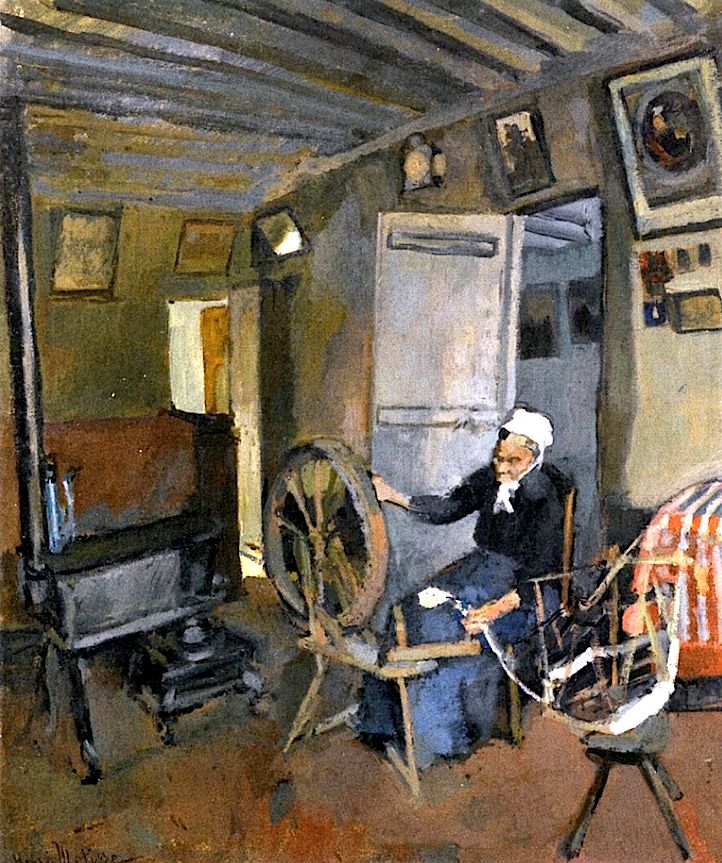
Henri Matisse painted “The Skein Winder from Picardy” in 1903, just before the blazing chromatic breakthroughs that would soon define his Fauvist period. In these early years he repeatedly returned to subjects drawn from northern France, where he was born and raised. This picture, set in a modest Picard interior, shows a woman working with a skein winder—a device used to wind spun yarn into neat hanks. The scene is both ethnographic and personal: Picardy’s textile crafts were part of local life, and Matisse’s sensitivity to fabric, pattern, and the textures of domestic labor echoes through his entire career. Rather than dramatize the figure with theatrical light, he builds a world out of measured planes, steady color, and the quiet cadences of work. The canvas is a crucial bridge between academic discipline and the decorative harmony that would become his signature.
First Impressions: A Room Built For Work And Warmth
At first glance we enter a long, low-ceilinged room crisscrossed by beams that pull our gaze toward the back wall. To the left sits a black iron stove, its legs planted on a protective plate; at center a large wheel tilts toward the viewer; to the right a separate swift for winding yarn stands on three legs and carries white strands; in the middle a woman in a dark dress and white coif leans forward, one hand steadying the wheel and the other guiding thread. The walls are a mosaic of grays, olive greens, and warm browns; pictures hang at angles above a pale door; a striped textile flares near the right edge like a small banner of color. The air is hushed, the light diffuse, the rhythms practical rather than poetic. The overall sensation is of an honest room rendered with structural clarity.
Composition: A Triad Of Circles And A Corridor Of Planes
The picture’s armature is elegant and legible. The ceiling beams act like rails that recess toward a vanishing point somewhere near the back door, which glows as a small aperture of light. On the ground plane, three major masses anchor the design: the stove’s dark box at left, the big wheel and seated woman at center, and the tripod swift at right. Matisse triangulates these forms so the eye moves in a loop—left to center to right and back again—while the corridor of the ceiling and floorboards quietly ushers us into depth. The figure’s body follows the room’s diagonals: torso angled forward, legs braced, hands set along diverging lines. Nothing is accidental; every angle contributes to a sense of purposeful motion within a stable frame.
Light As Working Atmosphere
Illumination is ambient rather than theatrical. It likely enters from a window behind the viewer and from openings at the back of the room. There are few hard shadows; instead, objects turn by temperature and value shifts that are gentle but decisive. The stove reflects cool light along its edges; the wheel’s rim warms where it faces the hearth and cools as it rolls away; the white coif and yarn act as small mirrors that catch and share the room’s pale light. This evenness serves the picture’s subject: steady work thrives under steady light.
Color Architecture: Earth Tones With Purposeful Flashes
The palette is grounded in earth pigments—ochres, umbers, deep olive greens—tempered by bluish grays and quiet creams. These low-key mixtures deliver the sensation of scrubbed surfaces, soot, and worn wood. Into this sober chord, Matisse inserts carefully rationed accents: a vertical seam of warm orange-brown on the stove, the pink and white stripes on the cloth at the right, a lemony glint on the skein winder’s pegs, and the tiny blue note of a kettle or jug near the stove. Because no passage is a dead neutral, each area leans warm or cool, and those temperature tilts carry the modeling. Color does structural work, not decorative chatter.
Drawing Through Adjacency Rather Than Outline
Edges in the painting are authored by the meeting of tones, not by reinforced contour lines. The wheel’s rim typically appears where a band of warm wood meets a slightly cooler wall; the chair legs read because their browns abut the floor’s gray-browns; the woman’s profile materializes as a seam between a creamy coif and the darker room behind. Where linear accents appear—the hinge and latch of the white door, a spoke of the wheel, the strut of the swift—they are sparse, calligraphic, and immediately reabsorbed by neighboring paint. The result is a unified surface in which forms feel discovered rather than traced.
Brushwork And The Feel Of Materials
Matisse calibrates touch to evoke substance. On the stove he uses thicker, tackier passages that look like cast iron absorbing soot and light. The wheel and furniture are made with broader pulls that emphasize planed wood. The walls and ceiling are scumbled thinly so the weave of the canvas breathes through, a perfect analogue for chalky plaster. The yarn on the swift is painted with swift, light touches that suggest softness and tension at once. This orchestration of speeds—heavier where objects are weighty, lighter where they are delicate—becomes the painting’s pulse.
Space: Compressed Depth With A Decorative Conscience
The room’s depth is persuasive, yet the surface never dissolves into deep illusion. The right-hand striped cloth presses against the picture plane like a decorative panel; the back wall’s door is rendered as a pale rectangle more concerned with its role in the composition than with literal perspective; the ceiling beams, while receding, also form a flat ladder that asserts the rectangle’s top edge. This tension between believable space and ornamental flatness is central to Matisse’s developing aesthetics. The painting must read as a balanced arrangement on a plane even while it invites us to walk inside.
The Woman At Work: Gesture, Rhythm, And Quiet Authority
The figure’s character is distilled through pose. Her torso leans slightly forward; one hand steadies the wheel while the other draws the thread; her feet are planted, skirt grounded, head bowed but intent. The white coif and collar frame a face built from a few decisive planes. Matisse refuses anecdote—no facial expression, no narrative aside—so that the type of action and the dignity of labor carry the emotional weight. The woman’s dark dress anchors the middle of the painting, a human counterweight to the stove’s mass and the swift’s tripod. She is not a portrait but a presence.
Motion Without Blur
Although nothing actually turns in a static image, Matisse suggests motion through structure. The large wheel is cropped so that we feel its circular path extend beyond the frame. The swift’s arms angle like a windmill caught mid-turn. The woman’s hands mark two points on an implied arc. Even the ceiling beams and floorboards, marching toward the rear, echo the regular rhythm of repetitive work. The composition choreographs our looking in loops and returns, mimicking the continuous motions of winding.
The Stove And The Door: Two Anchors Of Daily Life
At left, the squat stove speaks of heat, nourishment, and a winter solution; it is a domestic engine in visual counterpoint to the spinning apparatus on the right. At center back, the white door and narrow, light-filled passage provide a release valve for the compressed interior. The contrast between these two nodes—dark iron and bright exit—infuses the room with narrative potential without spelling a story. We feel the daily circuits of a rural household: heat, craft, passage.
Dialogues With Tradition And Peers
This canvas converses with several lineages. From Dutch and French genre painting it borrows the respect for everyday interior labor. From Courbet and the Barbizon painters it takes the authority of earthy color and frank touch. From Cézanne it absorbs the practice of constructing form through abutting patches rather than blended shadow. But the temperament is distinctly Matisse’s: he pursues serenity over ruggedness, harmony over drama, and decorative coherence alongside honest observation. The picture looks backward to tradition and forward to the modernity of simplified planes that will soon ignite under Fauvist color.
Materiality And Likely Pigments
The low-chroma harmony suggests a practical 1903 palette. Lead white, perhaps tempered with zinc, builds the pale door, the coif, and the highlights on walls. Yellow ochre and raw and burnt umbers construct the furniture, wheel, and floor. Ultramarine or cobalt mixed with white and touches of black quiets the gray ceiling and walls. A restrained vermilion or madder supplies muted reds in the striped textile; small notes of Prussian or cobalt blue appear in metalware near the stove. Ivory or bone black is sparingly added to deepen darks without killing chroma. Paint alternates between lean scumbles in the walls and thicker, pasted accents on wood and iron, allowing the surface to breathe.
The Ethics Of Omission
Matisse resists the temptation to over-describe. There is no meticulous rendering of knots in the wood, no granular mapping of soot on the stove, no counted spokes beyond what the structure needs. Pictures on the wall are indicated as tilting rectangles, sufficient to convey a life lived among images. Perspective is implied, not measured by ruler. These omissions protect the harmony of the whole, ensuring that each part contributes to a single, convincing climate.
How To Look Slowly And Profitably
Begin by stepping back to take in the room’s simple geometry: the ceiling’s linear march, the pale rear doorway, the triangle made by stove, wheel, and swift, and the dark human figure grounding the middle. Let that framework settle so the painting reads as one. Then approach the surface. Watch how the wheel’s rim is “drawn” not by a hard line but by the kiss of warm wood against a cooler wall. Notice the thin, chalky scumble that makes the plaster breathe; feel the tackier, heavier paint that gives the stove weight. Track temperature changes that model form: cool grays tipping warm near the hearth; creamy whites chilled where they recede. Finally, step back again and let the loop of your gaze mimic winding: left to center to right to back to left, a rhythm that becomes the work’s heartbeat.
Relationship To Matisse’s Broader 1903 Arc
In 1903 Matisse painted rural landscapes, studio scenes, and still lifes that share a common aim: simplify structure, compress depth, and let color relations do the descriptive work. “The Skein Winder from Picardy” translates those aims into narrative space. It shows him refining a language of calm planes and tuned temperatures that would allow his later, more saturated canvases to remain serene. In that sense, this picture is foundational; it teaches him how a room can be both lived-in and designed, how labor can be implied through rhythm rather than dramatized through detail, and how small accents of color can vivify a restrained field.
Social Resonances: Labor, Craft, And Value
Beyond composition, the subject carries quiet social meaning. The skein winder connects the picture to the economics of cloth—the very material that, in later years, Matisse would celebrate in patterned dresses and textiles. Here, before those exuberant motifs, he honors the labor that produces thread itself. The woman’s absorbed attention, the tools’ sturdy presence, and the room’s well-used surfaces all insist that making is dignified. The painting is not nostalgic; it is attentive. It offers modern painting as a counterpart to craft: a discipline of relations performed patiently in a room.
Why “The Skein Winder from Picardy” Endures
The canvas endures because it shows Matisse fusing observation with design. The space is believable, the labor intelligible, the mood humane; yet every inch of the rectangle is governed by balance, rhythm, and the ethics of omission. We witness a core insight taking shape: when relations are exact, a handful of planes and temperatures can carry both place and feeling. That insight will anchor the dazzling colors to come. In this quiet interior, you can sense the future—modern art emerging from the measured grace of a room at work.