Image source: artvee.com
Introduction
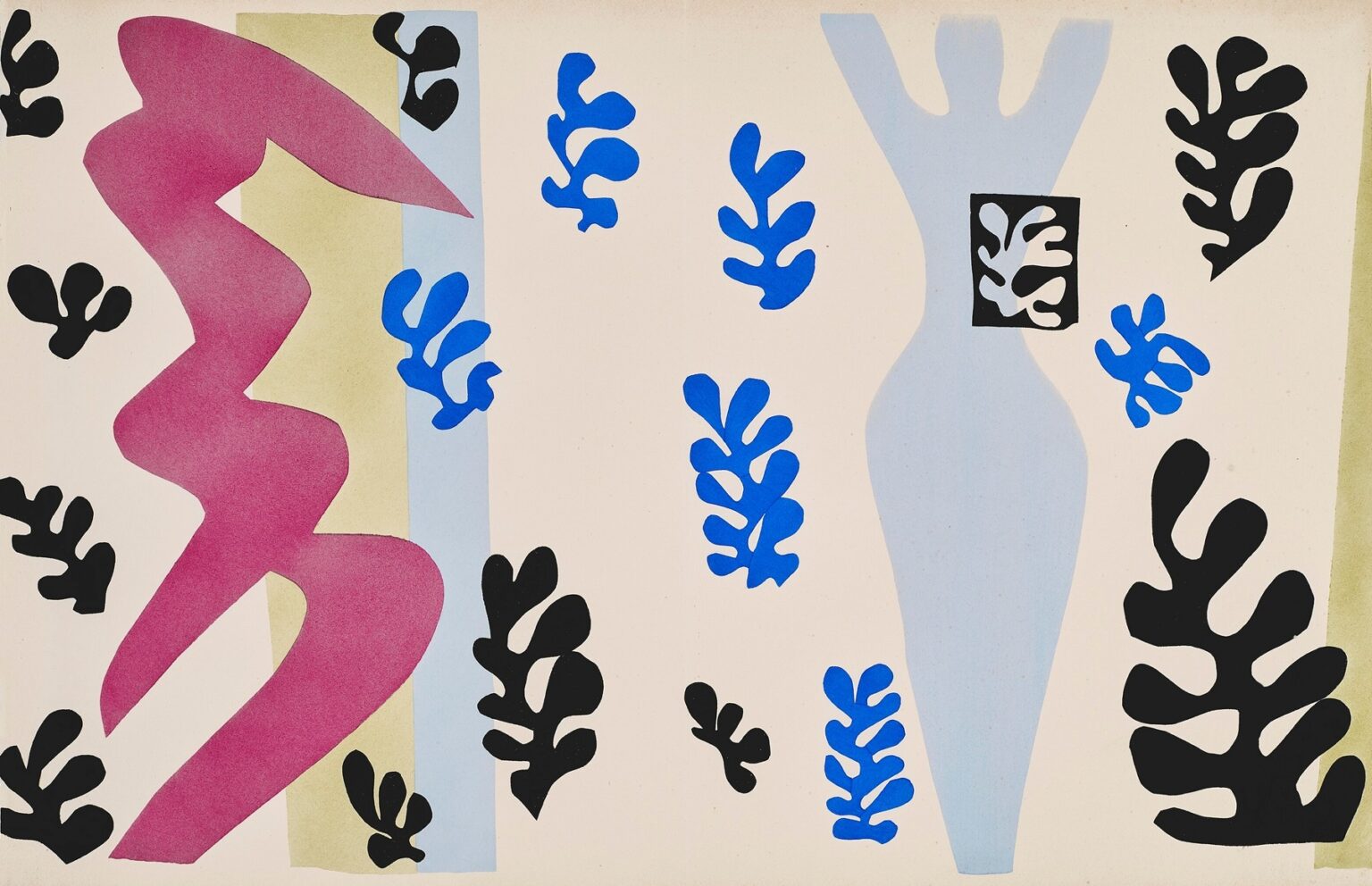
Henri Matisse’s “The Knife Thrower” (1947) captures the instant when precision meets peril. Within a luminous field of cream paper, a pale blue figure stands upright with arms lifted like a target, while a zig-zagging magenta shape surges from the left—the thrower’s coiled body crystallized into a single, lightning-shaped gesture. Between and around them, blue and black foliate forms—Matisse’s signature cut “leaves”—flit across the page like spinning blades. Two quiet vertical bands, one sandy and one mist-blue at left with a mossy-green echo at right, frame the arena as if we are watching a ritualized act in a tent of color. The page belongs to the Jazz portfolio, where Matisse reinvented performance subjects through the late technique he called “drawing with scissors.” Here he stages suspense without a drop of literal blood, using only gouache-painted paper, immaculate edges, and the rhythm of placement.
The Jazz Portfolio and Drawing With Scissors
During the 1940s, convalescing from illness, Matisse replaced the long exertions of oil painting with a method that united drawing and color in a single act. He brushed large sheets of paper with matte gouache and cut directly into the color, pinning fragments to the wall until a composition clicked. The cut edge was no longer a line containing paint; it was the shape of the color itself—the artist’s handwriting made structural. Jazz gathered these studio maquettes into a cohesive book, reproduced via pochoir so the printed plates preserved the gouache’s velvety surface and the crisp authority of the scissors. The portfolio’s theme is performance: acrobats, clowns, swimmers, cowboys, fables. “The Knife Thrower” folds danger into that theater and shows how an action can be told with emblematic clarity.
A First Reading of the Composition
The sheet divides into two charged halves. On the left, a tall, serrated magenta silhouette arcs like a bolt or a dancer snapped mid-turn. Its base plants on the cream ground, and its upper tip leans toward the center, visually thrusting into the picture. On the right, a cool, pale blue figure stands like a classical caryatid abstracted to a vessel—narrow waist, rounded hips, arms raised to make an aperture in the air. A small black square sits at the figure’s mid-torso, containing a white leaf shape; it functions as a ready-made target, a bullseye that carries the echo of a heart without slipping into illustration. Scattered across the field are black and ultramarine leaves that act like the knives themselves, seen not as shiny objects but as spinning signs. Two quiet verticals—the sandy-beige strip abutting a column of pale blue on the left, and a muted green slab on the far right—stage the act like flats in a theater.
Rendering the Thrower as Energy
Matisse refuses anecdote—no hat, costume, or facial features. Instead, the thrower becomes a zig-zag of magenta with soft airbrushed transitions inside its silhouette. The contour alone carries attitude. It pulses forward in three steps, tightening and releasing like a body winding into a throw. Sharp outer corners become elbows, hips, and the forward-leaning point of focus. That one piece of paper holds a choreography: gathering, coiling, and release. Because it is a single continuous cut, the form reads as a unified intention rather than a collage of body parts. It’s a masterclass in how to replace description with force.
The Target as Vase, Idol, and Body
Opposite the thrower, the pale blue figure stands with the calm of an altar image. Matisse has used this amphora-like silhouette elsewhere in the cut-outs, letting it toggle between body and vessel. Here, that ambiguity is especially potent: the target is human enough to make the act risky, yet object-like enough to keep the scene from theatrics. The raised arms widen the upper register, creating an invitation—an opening through which the knives seem to fly. The small black square on the torso punctuates the calm with a focus point. Inside it, a white leaf mirrors the surrounding “blades,” as if the performer wears the mark of the very thing that endangers them.
Knives as Arabesques
Matisse refuses the literal shine of steel. Instead, he uses the leaf motif that animates many of the Jazz plates to stand in for knives in flight. The decision is functional and poetic. The rounded lobes can read as the whir of a blade, a spinning silhouette caught at speed, while their repetition keeps rhythm across the field. In black they feel weighty and imminent; in ultramarine they cool the temperature and suspend panic. Scattered in varied scales and orientations, the motifs create the sense of a volley—some nearer, some farther, none fixed long enough to resolve into objecthood. Suspense becomes pattern.
Color Temperature and Emotional Weather
The palette is tuned like a stage plot. Magenta radiates heat and risk on the left; pale blue models breath and poise on the right. Black punctuates with authority, securing edges and focusing attention. Ultramarine floats as an intermediate pulse—cool but active—stabilizing the cream ground without dulling it. The sandy-beige and moss-green bars suggest tent fabric or wings, soft structural notes that turn the page from poster to place. The overall effect is a contained arena with a hot side and a cool side, their opposition measured not by perspective but by hue.
Figure–Ground Play and Visual Tension
One joy of the cut-outs is the way figure and ground constantly swap. The pale blue target is a body and also a void excavated from the cream. The black square is a solid mark and also an aperture that reintroduces the surrounding leaf motif inside the body. The knives read as positive forms on the cream but become negative events when they overlap the blue figure or the sandy strip. This play keeps the eye alert and mimics the verbal tension of the act: what is thrown and what is received? Which is object, which is space? The mind toggles and, in toggling, feels suspense.
Edges as Acting
Because line and color are one in the cut-outs, the edge does all the acting. The thrower’s contour swerves from tight angles to long glides—acceleration and deceleration you can feel with your eyes. The target’s profile remains serene and continuous, a single breath from head to toe. The black square’s edges are minutely imperfect, keeping the emblem human. Even the small knives show the touch of scissors; their lobes are similar but never identical. This edge vitality prevents the image from hardening into signage and gives it the quick of a performance witnessed rather than diagrammed.
Timing and the Held Moment
The scene is captured at the beat between release and arrival. No knife yet touches the target. The thrower leans forward; the target holds posture; the blades are mid-air. That held instant is central to Jazz: Matisse repeatedly chooses the point of maximum reach or suspension—before the acrobat lands, before the swimmer turns, before the sword is fully swallowed. Here, delay heightens empathy; we finish the act in imagination, which is why the page vibrates long after our first look.
Theater Without Anecdote
Matisse builds an arena with minimal means. Vertical bars imply architecture; the cream ground acts as stage. There are no spotlights or spectators, yet we feel the presence of a show because the elements adopt theatrical jobs—wings, backdrop, props—without pretending to be them. The composition trusts the viewer’s memory of performance to fill in the sound and bravado. It is sophisticated stagecraft: the essence of the trick presented without its trappings.
Gendered Readings and the Ethics of Risk
Because the target’s silhouette echoes classical goddess and vessel alike, many viewers read the figure as feminine, the thrower as masculine energy. Matisse does not stress that coding, but he allows the association by choosing a narrow-waisted target and a jagged, advancing counterpart. The plate thus touches the old circus paradox: danger staged as intimacy. Yet the image is not punitive or sensational. No blade pierces flesh; the target’s raised arms signal mastery, not victimhood. The black square can be read as armor as easily as bullseye. The ethics of the plate are clarity and respect: risk is acknowledged, skill is honored.
Relation to Other Jazz Plates
“The Knife Thrower” converses with neighboring pages in the suite. The ultramarine knives and cool target recall the poised swimmer cutting across black panes; the zig-zag thrower echoes the diagonal snap of the cowboy’s lariat and the lightning turns of acrobatic bodies in “The Codomas.” The black square with white leaf inside prefigures the way Matisse nests images within images elsewhere, as if reminding us that performance is a mirror of the world around it. Across Jazz, devices repeat while moods shift; this plate sits in the register of suspense, halfway between danger and dance.
Material Candor and Pochoir’s Role
The plate’s power depends on the material truth of cut paper. Pochoir reproduction preserved that truth—the matte glow of gouache; the exact, faintly beveled edges; the occasional minute overlap where colors touch. Up close, those facts keep the page human. You see where scissors paused before rounding a lobe, where a curve straightened for half an inch, where a corner softened. In a scene about bodily risk taken in public, the visibility of the artist’s hand becomes a quiet parallel: another kind of risk, a decision made without erasures, a cut that cannot be undone.
Space Without Perspective
There is no horizon line, no cast shadow, yet space is clear. Overlap arranges depth: knives over ground, ground over figure, figure beside the vertical bands. Color weight also carries distance. The cream breathes, the magenta pushes forward, the pale blue retreats, the black square projects. We feel the thrower in front of the sandy strip and the target in front of the green band. The fact that both verticals touch the page’s outer edges helps the arena read as continuous rather than a collage of islands.
Rhythm and Visual Music
The page swings. Blue knives repeat at varied intervals, syncopating against slower, heavier black shapes. The zig-zag thrower sets a treble; the amphora-like target anchors a bass. The black square is a drum hit in the middle of a sustained chord. Even the narrow verticals at the edges behave as measures, keeping time in a composition that otherwise could drift. Matisse’s late work proves that rhythm is not an import from music; it is native to seeing and can be scored through spacing alone.
Lessons for Design and Looking
“The Knife Thrower” models principles that remain fresh. Reduce subjects to relationships of force rather than to inventories of detail. Let color set temperature and orientation. Use borders not just to contain but to perform. Trust edges to carry character; when the edge is alive, a silhouette can do everything a modeled figure can do. Stage suspense by choosing a charged instant and leaving the next beat to the viewer. These are not period tricks; they are perennial tools.
Postwar Clarity and Late Serenity
Created in the first years after World War II, the Jazz plates often balance brightness with sobriety. The knife-throwing act could have been a page of anxiety; instead, it carries a strange serenity. The target is poised; the knives, though many, are also decorative signs; the thrower’s energy is concentrated, not frenzied. The work honors skill under pressure—a postwar value—while offering viewers an image ordered enough to soothe. Matisse’s stated aim, to provide balance and restful clarity, is met not by avoiding risk but by structuring it.
Conclusion
“The Knife Thrower” transforms a fairground thrill into a lucid grammar of shape and hue. A magenta bolt leans forward; a pale blue idol-body stands ready; a cloud of blue and black leaf-knives spins through the air. With these few elements, Matisse composes suspense, rhythm, and grace. The page reads instantly and then unfolds—edge by edge, color by color—into a meditation on how an image can hold danger without harm. It is theater without props, narrative without anecdote, a late work that shows how scissors and painted paper can still make a heart pause.