Image source: artvee.com
Introduction
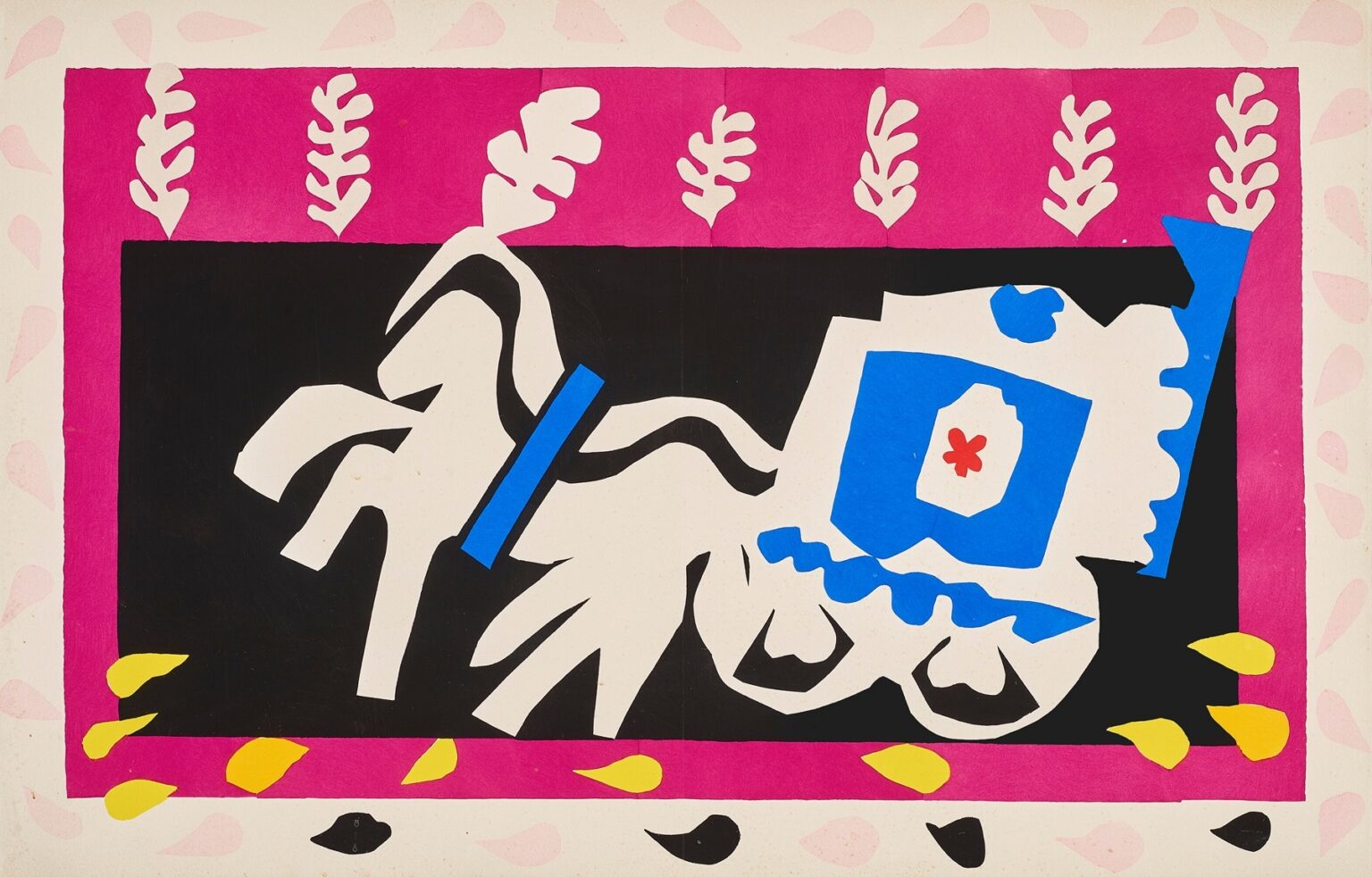
Henri Matisse’s “Pierrot’s Funeral” (1947) turns a subject that could have been solemn—the burial of the clown from commedia dell’arte—into a blazing, theatrical procession made of cut paper. A white horse pulls a stylized hearse across a black stage. Ceremonial blues punctuate harness and carriage, a small red emblem blooms at the center, and yellow petals scatter like falling light. The whole scene sits inside a hot magenta proscenium sprinkled with pale teardrop shapes, so the memory of carnival remains even as the page honors an ending. Made for the Jazz portfolio, the work shows how Matisse’s late method of “drawing with scissors” could compress narrative, music, and stagecraft into a handful of perfectly placed colors.
Jazz and the late invention of drawing with scissors
In the mid-1940s Matisse redirected his practice. After illness made long easel sessions difficult, he began painting sheets of paper with matte gouache and cutting directly into the color. Scissors replaced brush; contour and hue arrived at the same instant; compositions could be slid around the wall like musical phrases until they locked. These maquettes were reproduced in 1947 as the pochoir plates of Jazz, a book whose subject is performance—circus, acrobats, masks, swimmers—and whose pages pair images with the artist’s looping handwritten reflections. “Pierrot’s Funeral” is among the suite’s most narrative plates: it keeps the cut-out’s billboard clarity while staging a full scene, complete with frame, ground, actors, and props.
Pierrot and commedia dell’arte reframed
Pierrot, the pale, melancholy clown of Italian street theater, haunted European modernism. For painters and poets he stood for vulnerability in a noisy world, a figure who entertained and suffered in one breath. Matisse’s plate acknowledges that legacy while refusing sentimentality. There is no face, no limp body—just the brisk silhouette of a horse and a toy-bright hearse sliding through black. The decision is telling. Rather than dwell on Pierrot’s pathos, Matisse writes the rite: a procession, the social choreography of farewell. In a book obsessed with performance, the last performance belongs, fittingly, to a performer.
The composition at a glance
The image reads instantly and then deepens. A broad magenta border frames a black rectangle—the stage or street of the funeral. Inside, white cut shapes assemble into horse and carriage. Their edges are trimmed with a thin black contour that clarifies joints and wheels and keeps the white masses from dissolving into the ground. Ultramarine bars punctuate harness and vehicle; their coolness steadies the heat of the magenta. A small red star-shaped badge sits on the carriage panel like a flower, the plate’s tiniest yet most piercing accent. Across the top border, white leafy motifs parade like paper fronds; along the bottom, yellow teardrops—petals, confetti, candles’ flare—ride the procession’s wake.
Color as emotional temperature
Matisse orchestrates color as a bandleader handles sections. Magenta floods the edge with festive heat; it is theater curtain, carnival velvet, and ceremonial ribbon at once. The black interior is not despair; it is depth, a stage that makes pale forms read. White carries the narrative—horse, wheels, and carriage—so that the funeral is legible at distance. Blue acts like civic pomp, a crisp, near-official tone that suggests sash, crest, and cold air. Yellow supplies the touch of sunlight or the scattering of petals, flashes of warm light that keep the scene from hardening into silhouette. And the single red mark is heart, wound, flower, and stamp of identity—Pierrot’s color in a world otherwise stripped to signs.
The border as proscenium and procession route
Matisse’s frames are never neutral. Here the magenta border behaves like a tented proscenium, widening the spectacle and separating it from everyday space. The pale pink teardrops scattered across that border extend the story outward, as if the air itself carries sound and scent. At the bottom, the border thickens into a ground strip where yellow drops collect. They read as petals swept along by the wheels and as the rhythm line that a brass band might keep. The border thus becomes both architecture and time: it houses the act and measures its forward motion.
Rhythm, movement, and the carving of silhouette
The cut edges carry velocity. The horse is all diagonals—foreleg thrust, neck arched, mane shooting backward—so that we feel a sudden step. The carriage tilts, its wheels simplified to white discs with black wedges that imply rotation. Between horse and hearse, a wavy black line runs like a thread; it is rein and rhythm at once, the pulse that ties animal power to ceremonial vehicle. Even the blue strap across the horse’s chest leans in the direction of travel. Nothing in the plate is static, yet nothing is fussy: action comes from the way simple shapes are angled against the black field.
Symbols in plain sight
Because the vocabulary is so spare, every element bears symbolic weight. The small red rosette on the carriage panel is the plate’s semantic pivot: flower, badge of troupe or city, a spot of blood remembered. The white leafy repetitions across the magenta top border are laurel, palm, and paper frond in one—a frieze of honor fit for a performer. Yellow drops hover between petals and tears, between public festivity and private grief. Blue stands for dignity. Black names the threshold between worlds. By refusing anecdote, Matisse lets color and repetition carry meanings usually shouldered by faces and gestures.
The clarity of figure–ground
The Jazz plates depend on legibility, and “Pierrot’s Funeral” is a master class in figure–ground engineering. White shapes pop against black; where white touches magenta, a thin black rune of contour intervenes to prevent the forms from bleeding into the frame. The carriage’s negative spaces—wheel arches, window panels—are cropped decisively so that the vehicle reads despite its abstraction. Many artists would have added shading to model the wheels; Matisse relies on cut wedges that point like clock hands, an economical solution that suggests rotation without a single gradient.
Material presence and the truth of edges
The plate’s authority lives in its edges. Scissor cuts reveal tiny accelerations and pauses: a notch where the blade re-entered, a softened corner where it rounded a curve. These marks are the artist’s handwriting. They keep the image human even as it behaves like a poster. The pochoir process that transferred the collage to print preserves this edge truth—the matte body of gouache, the clean limits of a shape—so that the picture’s material candor remains intact: paper against paper, color against color, no disguise.
A narrative resting on timing
Matisse arrests the procession at an eloquent instant. The horse’s foreleg is lifted, the wheel wedges suggest the pre-roll of movement, and the yellow petals seem to be tumbling in slow arcs. We stand at the curb as the cortege passes. That timing matters because it converts spectatorship into participation: we supply the next step, the next bounce of the wheel, the fade of sound after the image moves on. The plate, though static, feels scored.
Comedy, elegy, and the paradox of a clown’s burial
The subject carries a gently paradoxical tone: how does one mourn a figure devoted to delight? Matisse answers by refusing gloom. The magenta frame glows; the petals scatter; the hearse is bright as a toy. The black rectangle is the sober ground on which this brightness makes sense, not a statement of despair. The plate suggests that for performers, death is folded back into spectacle, the last passage made not in silence but in the company of music, color, and community. Pierrot, who lived between laughter and loneliness, exits inside a picture that balances both.
Relation to other plates in Jazz
Within the portfolio, “Pierrot’s Funeral” converses with other theatrical images—“The Codomas,” “Icarus,” “The Clown”—each using emblem and field to build drama. Where “Icarus” isolates a single figure in cosmic blue, this plate runs a full procession past us, a community image rather than a solitary one. Where “The Codomas” saturates the page with diagonals and nets, this composition concentrates its energy into a central band of action anchored by a ceremonial frame. Across the suite, Matisse uses the same grammar—flat gouache, clean silhouette, small red punctum—but alters mood through density and pacing.
Postwar undercurrents and the will to brightness
Made just after World War II, Jazz crackles with a hunger for life. “Pierrot’s Funeral” acknowledges loss yet refuses pallor. The small red sign at the center, like a drop of blood or a medal, can’t help but recall recent wounds; the scattering petals feel like both confetti and fragments. Still, the plate’s overwhelming impression is forward motion and communal ceremony. It models a way to remember that does not abandon joy, a stance deeply characteristic of late Matisse.
Lessons in design and readability
Designers still mine the Jazz plates for first principles, and this one is especially instructive. Build a scene with a few decisive masses. Use a border to create architecture and time. Assign jobs to colors—depth, accent, dignity, warmth—and let them perform. Keep edges alive so clarity never becomes sterility. Replace literal description with emblems that read at distance. “Pierrot’s Funeral” could function as poster, book plate, stage drop, or mural because its grammar is so distilled and its relationships so exact.
Seeing at two distances
From across a room the plate is unmistakable: horse, hearse, petals, frame. Up close the scissor trail becomes a narrative of touch; small misalignments and overlaps reveal how the image was shaped. The viewer moves between these scales the way one hears a march both as block rhythm and as the trembling of reeds and skins. That dual legibility is one of the late cut-outs’ great achievements, and it is central to the lasting popularity of the Jazz suite.
Conclusion
“Pierrot’s Funeral” is a procession built from color. A white horse pulls a blue-trimmed carriage across a black ground, magenta curtains frame the route, petals fall, and a single red sign keeps the memory of a person at the heart of it all. With gouache-painted papers and scissors, Matisse conjures a scene that is both elegy and spectacle, balancing clarity and tenderness with the ease of a master who has trusted essentials. In a portfolio devoted to rhythm and performance, this plate offers the most generous kind of farewell: not a portrait of death, but an image of community moving together in bright, steady time.