Image source: artvee.com
Introduction
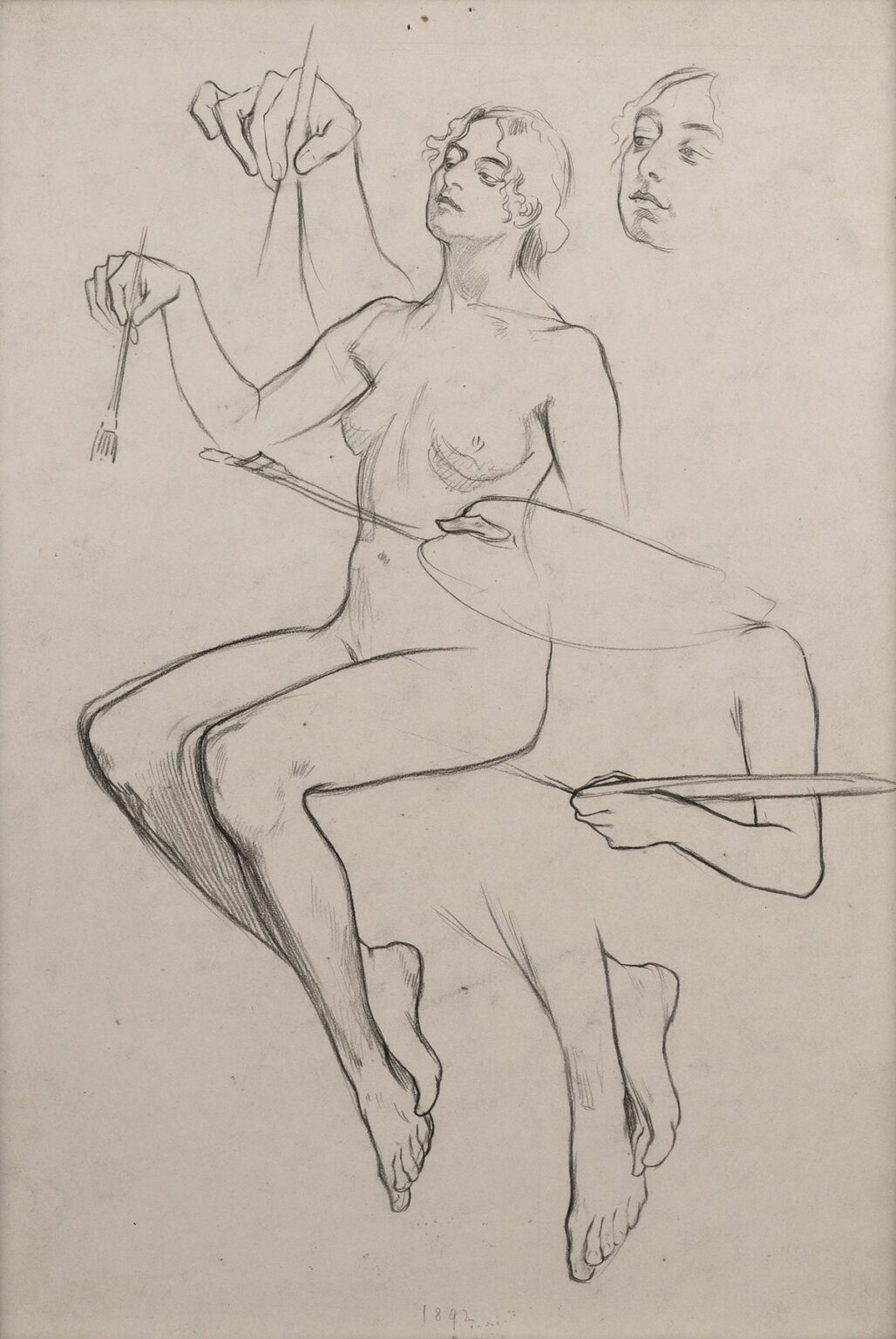
Alphonse Mucha’s “Female nude” is a window into the artist’s studio, a sheet where thought is recorded directly in line. Rather than present a single, finished figure, the drawing arrays multiple studies on one surface: a central seated nude, two carefully observed hands, a second head, and an auxiliary torso with a palette and brush. The result is both analytical and lyrical. It demonstrates how Mucha constructed one of his most celebrated powers—the persuasive contour—while testing pose, proportion, and the expressive capabilities of hands and face. Seen today, the sheet reads as an elegant anatomy of making, revealing a mind that builds form through rhythm and restraint.
A Study Sheet Rather Than a Finished Composition
The first fact the drawing declares is its status as a study sheet. The main figure occupies the center, seated in a floating pose, legs angled forward and downward, while the surrounding vignettes offer alternatives and clarifications. This is not a narrative scene with background, furniture, or setting; it is a page of thinking. Mucha treats the paper as a coordinate plane upon which fragments can migrate and be compared. The surrounding hands and head function like marginalia, enlarging the scale of problem areas so that decisions about pressure, angle, and character can be made with confidence before translating them back to the central figure.
The Central Figure and the Suspended Seat
The body sits without a visible chair, a standard device in academic studios to keep attention on anatomy and balance rather than on props. The left thigh carries most of the weight, while the right leg lowers slightly, toes dropped and relaxed. The pelvis turns subtly toward the viewer, and the torso counter-rotates, producing a gentle S-curve that animates the silhouette. The arms float outward as if poised to paint, one hand holding a brush and the other ready for a palette that, in one version, is only lightly sketched. This hovering posture emphasizes buoyancy and rhythm over gravitas, aligning the figure with Mucha’s lifelong interest in graceful, dance-like attitudes.
Face and Expression Across Two Studies
Two faces appear on the sheet. The primary head belongs to the central figure; the second, at the upper right, explores a variant angle with the chin slightly lifted and the gaze drifting sideways. Mucha resists heavy modeling, describing eyelids, nostrils, and lips with sparse strokes that leave the paper luminous. The expression is calm and self-contained, a hallmark of his allegorical women. Through minor adjustments in the corner of the mouth or the tilt of the eyes, he experiments with degrees of inwardness. The second head is not a separate person so much as a refinement of attitude, searching for the exact blend of poise and detachment that would later become iconic in his decorative panels.
Hands as Instruments of Character
Mucha isolates two hands in the upper left, each rendered with assertive clarity. One pinches a thin instrument, likely a brush or stylus, while the other opens and relaxes. The attention paid to knuckles, tendons, and the recessed curve between thumb and forefinger shows how seriously he regarded hands as vehicles of meaning. In the central figure, the hands perform, but here, separated from the body, they audition. Their scale is slightly enlarged compared to the figure’s own hands, a pedagogical trick that allows the artist to resolve the choreography of fingers before committing. This foregrounding of hands anticipates Mucha’s later posters, where the articulation of fingers—holding flowers, drapery, or instruments—adds grace and intention to his heroines.
Contour as the Primary Language
If one were to reduce Mucha’s art to a single principle, it would be the eloquent contour. In this drawing, contour is architecture. The outline of the thighs, calves, and ankles varies in thickness, pressing slightly where the form turns away and relaxing where the form turns toward the viewer. He refuses fussy crosshatching or tonal smudging; instead, he lets line alone determine volume. The resulting clarity makes the figure read instantly from a distance and rewards close study with subtle pressure changes. This economy, learned in the rigors of illustration and honed in life drawing rooms, undergirds the clean, whiplash curves of his mature Art Nouveau style.
The Palette, the Brush, and the Artist-Muse
A delicate irony runs through the sheet: the nude appears to be an artist herself. One hand lifts a brush; another coordinates with a sketched oval that suggests a palette. Even in the variant torso at lower right, a forearm steadies a long brush. Mucha thus fuses the roles of model and maker, a fusion that suits his interest in personified arts and seasons. The figure is not merely an object of study; she embodies the act of painting, holding the tools of her own depiction. This reflexivity adds a quiet allegorical charge, turning a classroom exercise into a meditation on authorship and agency.
Anatomy Without Pedantry
Many academic nudes aspire to anatomical exactitude at the expense of life. Mucha avoids that trap. He knows where bony landmarks sit—the iliac crest, the patella, the malleolus—and he marks them with the lightest of emphasis. He understands the envelope of muscle, but he refuses to freeze it into didactic shape. His aim is not to display knowledge but to transmit living proportion. The knees, for example, are indicated by a few crisp lines that switch direction precisely where planes change; the ankles taper convincingly not because every tendon is diagrammed but because the swelling and narrowing are paced correctly along the contour.
Rhythm and the S-Curve
The figure’s power comes from rhythm. From the left shoulder down through the torso and into the right thigh runs an S-curve that gives the body spring. Mucha’s line neither rushes nor hesitates; it flows with a musician’s timing. The rhythm continues into the wrists and fingers, which curl and extend with the grace of a conductor signaling tempo. Even the feet participate, toes flexed at slightly different angles that suggest micro-movements within a momentary pause. Rhythm, rather than shadow, holds the figure together.
The Intelligence of Omission
What Mucha declines to draw is as important as what he draws. The background remains entirely blank, refusing to anchor the body to any place or time. Hair is simplified to a few looping strands that frame the forehead and ear. The palette, in one iteration, dissolves into a contour that never quite closes. These omissions keep the sheet airy and prevent it from hardening into a tableau. They also respect the purpose of the page: to test proportions, rehearse hands and head, and evaluate how much information a figure needs in order to feel complete. The answer, for Mucha, is surprisingly little.
Multiple Attempts Without Confusion
Study sheets can devolve into chaos when overlapping attempts compete. Mucha maintains order by spacing his fragments and varying their scale. The large isolated hands inhabit one corner; the auxiliary head moves to another; the second torso stays low and right, its lines faint enough not to overwhelm the main figure. He orchestrates the page as carefully as a full composition. Even the blank spaces are deployed to let the eye rest between trials. The calm intelligence of this layout hints at the designer’s mind already at work, arranging not just form but the experience of viewing.
Light Through Line Rather Than Shade
Though the sheet contains minimal shading, light is nonetheless present. It arrives through the selective thickening and thinning of contour and through a few interior strokes at the ribcage, clavicle, and knees. Highlights exist as untouched paper, while the suggestion of shadow appears as lightly feathered lines that respect the direction of form. This choice keeps the body cool and luminous, allowing the white of the paper to read as light bathing the skin. The technique also anticipates print translation, where clear lines reproduce more faithfully than soft charcoal modeling.
The Academic Studio in the Age of Modernity
The drawing belongs to a moment when the academic studio coexisted with the temptations of modern illustration and advertising. Mucha navigated both worlds. The discipline visible here—measure before flourish, structure before ornament—would later support his decorative language. The rigor of life drawing gave him authority to stylize. In the Art Nouveau posters that made him famous, bodies are elongated, hair becomes arabesque, and drapery turns to music, yet everything remains believable because sheets like this taught him where anatomy truly sits.
The Feminine Ideal Reconsidered
Mucha is often associated with a particular feminine ideal: poised, serene, and gently self-possessed. This drawing reveals how that ideal was built. The figure is not coquettish or passive. Her chin sets with a hint of resolve, her shoulders square without stiffness, and her hands act with purpose. The lack of accoutrements—no jewelry, no fabric, no symbolic props—strips the image to poise itself. Even nude, she reads as agent rather than object, in part because she holds the tools of painting. The sheet thus complicates assumptions about the “Mucha woman,” showing the kernel of dignity from which his later allegories bloom.
Movement Paused at a Threshold
The pose captures a threshold between motion and stillness. The legs suggest she has just shifted or will shift; the hands hover, ready to act; the face lingers in reflection. Mucha often staged such thresholds, preferring the moment when energy gathers rather than explodes. In a drawing, that choice is practical, letting the artist study balance; in an image, it is poetic, proposing that grace consists in the promise of movement rather than its completion.
Material Presence of the Drawing Itself
Beyond subject, the sheet is an object with its own charm. Graphite skates across toned paper, leaving a metallic luster where pressure increases. Occasional corrections and light pentimenti near the wrists and ankles hum beneath the final line like afterimages of decisions. The paper’s faint specks and soft edges remind viewers of time’s passage without compromising freshness. Such material details carry intimacy, allowing us to feel the artist’s hand as a physical act rather than an abstract idea.
Relation to Later Allegorical Panels
Once Mucha’s decorative career accelerates, his figures appear framed by ornate halos, floral sprays, and architectural cartouches. Underneath those sumptuous environments lie bodies constructed exactly as here: with rhythmic contour, clarified anatomy, and disciplined omission. In panels where the Muse of Painting or Poetry presides, the instruments she holds and the angle of her head owe their conviction to studies like this. The “Female nude” is thus not a side road but a main artery feeding the grand boulevards of his mature work.
Comparisons with Contemporary Figure Studies
Compared with academic contemporaries, Mucha’s approach appears lighter and more melodic. Where others build tonal pyramids through laborious hatching, he sketches with a calligrapher’s confidence. Where some labor over muscular definition, he trusts proportion and flow. This decisiveness does not signal haste; it signifies clarity. The drawing therefore possesses a modernity that would translate seamlessly into lithographic lines, magazine illustrations, and posters that needed to be grasped instantly on a boulevard.
The Viewer’s Role in Completing the Image
Because Mucha withholds background and heavy tone, he recruits the viewer as collaborator. We supply the stool beneath the figure, the studio air, the diffuse light. We also complete the implied narrative of an artist preparing to work. That collaboration is part of the sheet’s pleasure. It teaches how little is necessary for the human brain to experience presence and how skillfully chosen lines can summon a body that feels tangible without ever being fully modeled.
An Exercise in Clarity and Grace
At every scale, the drawing pursues clarity. Large decisions—pose, tilt of head, spread of hands—read at a glance. Smaller decisions—wrinkle at the knee, pivot of the thumb—hold attention up close. The grace that results is not decorative frosting but the residue of correct choices. The line becomes beautiful because it is right. In that sense, the “Female nude” is a distilled manifesto: a belief that beauty is the visible surface of disciplined understanding.
Conclusion
“Female nude” presents Mucha before the fanfare of ornament, conversing with the body through line. The sheet demonstrates how he built figures that feel both ideal and human, how he made hands speak, how he coaxed expression from a few marks, and how he balanced omission with precision. It also hints at the allegorical turn his art would take, giving a brush and palette to the model so that she becomes an emblem of creation itself. In the quiet of this study, we watch Mucha’s future arrive: the lucid contour, the rhythmic pose, the serene face, and the conviction that a figure can be both structure and song.
