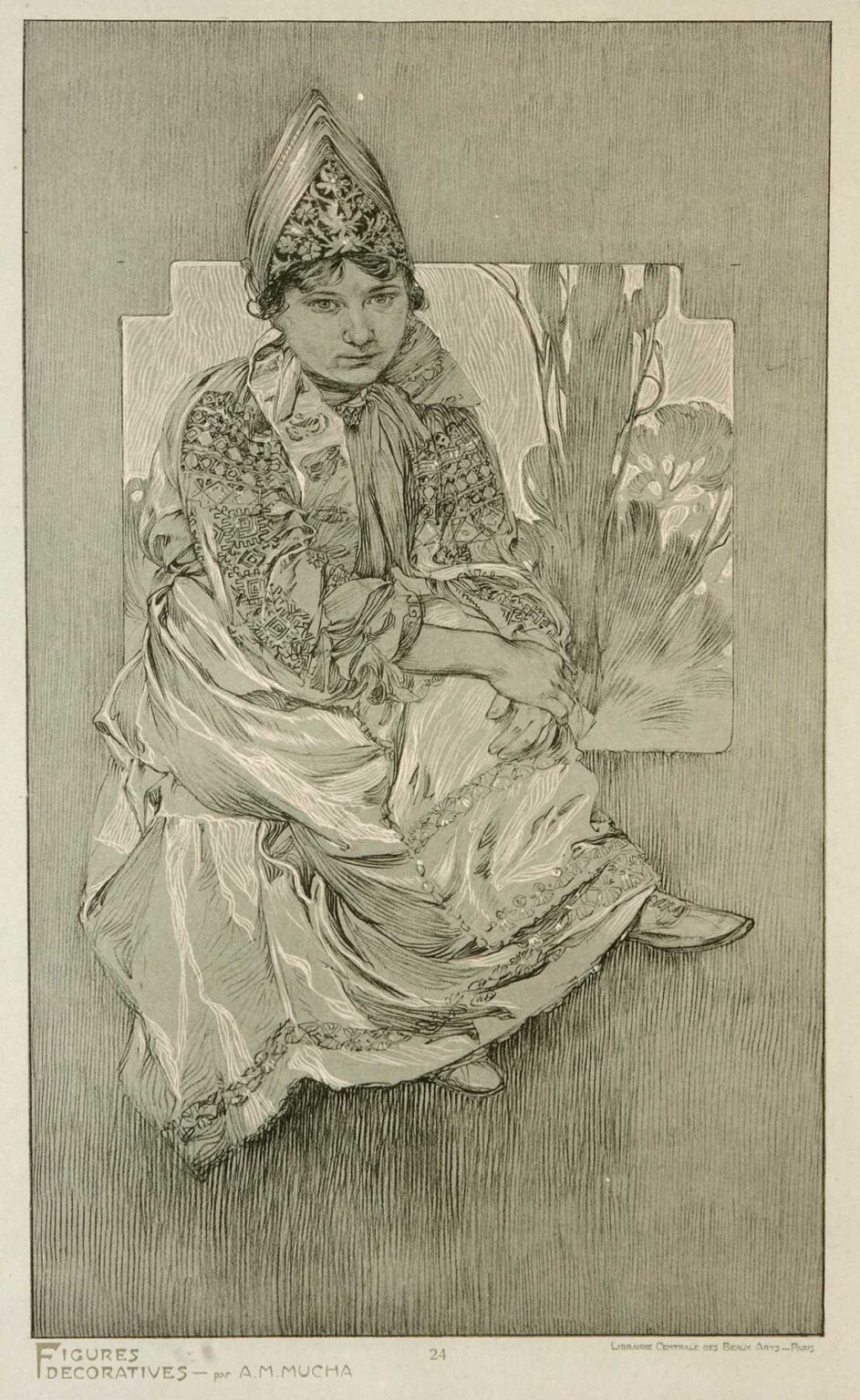
Image source: artvee.com
A first look at the plate
Alphonse Mucha’s “Decorative Figures” from 1905 captures a seated young woman in richly embroidered folk dress, rendered in a restrained monochrome that lets line do almost all the work of light, texture, and mood. The figure is tucked into a shallow stage set: a rectangular block trimmed with soft, floral silhouettes frames her head and shoulders, while a field of finely combed vertical hatching surrounds the entire vignette. Her pose—a compact spiral of crossed legs, folded arm, and tilted head—gathers the eye into a calm center. Even without color, the image reads as luminous, tactile, and unmistakably Mucha: the drapery flows in long arabesques, the face is modeled with tender realism, and every contour doubles as ornament.
Where the plate sits in Mucha’s career
By 1905, Mucha was not only the face of Parisian Art Nouveau posters but also a teacher of style. “Decorative Figures” belongs to a sequence of instructional portfolios in which he offered models, motifs, and compositional templates for designers, illustrators, and artisans. Earlier sets like “Documents Décoratifs” had codified his vocabulary of borders, floral scrolls, and lettering; the 1905 plates go further by treating the human figure itself as a repertory of usable forms. The result is not an advertisement or a narrative scene, but a poised specimen—an exemplary arrangement of line, fabric, and posture that students of applied arts could study and adapt. Mucha’s goal was never to keep his formula secret; it was to democratize beauty.
Composition as a quiet engine
The composition balances containment and motion. The solid rectangular window behind the sitter functions as an architectural bracket: it holds the head in a halo of light and establishes a horizon for the rest of the body to push against. Within that bracket, ornamental shapes—leafy tongues, petal bursts—echo the embroidered motifs on the costume, tying background and foreground into a single decorative organism. The figure itself is constructed as a gentle triangle: cap and face at the apex, knees and hem forming the broad base. That triangular stability allows Mucha to trace long, curling trajectories through the drapery without losing structural coherence. Every curve has a counter-curve; every soft fold meets a crisp seam.
The choreography of line
Mucha builds form with a choreography of lines that change speed, weight, and direction like dancers. Around the face the lines are short, feathery, and closely spaced, modeling cheek, nose, and lips with almost classical sensitivity. As the contours move into sleeves and skirts, they lengthen into supple ribbons that turn corners with barely a kink, creating the sumptuous feel of silk and satin. The background hatching is deliberately mechanical, its vertical sameness setting off the improvisatory music of the figure. This contrast—mechanical field versus musical subject—makes the woman seem to vibrate with life.
Light without white
Because the plate is printed in tones of a single ink, “light” is a function of density and direction rather than pigment. Mucha creates radiance by thinning lines until the paper glows through; he reinforces highlights by framing them with darker strokes. Notice how cuffs and hems sparkle not because they are filled with white but because their edges are so decisively drawn that the untouched paper reads as sheen. The headdress, richly patterned, is nonetheless topped by a rim of bare paper that to the eye becomes metal catching light. This is an old engraver’s trick—let absence do the shining—and Mucha uses it with quiet mastery.
The psychology of the pose
The sitter’s posture is not a stiff catalog display; it holds a private psychology. She leans forward slightly, arms folded over her knees in a gesture of guarded ease, as if pausing between duties. The head tilts, creating a conversational angle with the viewer; the gaze is direct but soft, neither coquettish nor imploring. This emotional moderation is one of Mucha’s signatures. He rarely pushes feeling to melodrama; instead he cultivates a poised inwardness that allows the spectator to project their own narrative into the scene. Here, that narrative might be a peasant girl at festival rest, or a studio model wearing borrowed finery—either way, dignity is the keynote.
Costume as cultural text
Mucha’s devotion to Slavic identity runs quietly through the plate. The cap, with its pointed crown and embroidered lattice, the dense sleeves, and the layered skirt banded with tiny vegetal motifs, all point to Central and Eastern European folk dress. For Mucha, such costume was never mere exotic garnish; it was a visual shorthand for rootedness, continuity, and communal beauty. By meticulously drafting the embroidery stitch by stitch, he acknowledges the anonymous hands that produced it. The figure becomes a meeting point of individual presence and collective tradition, precisely the synthesis Art Nouveau sought: the modern artist drawing sustenance from the well of craft.
The rectangular “window” and its meaning
That stepped rectangular window behind the head is more than compositional convenience. Its squared geometry contrasts with the rounded rhythms of the figure, a way of telling us that ornament needs an architecture to sing against. The tiny floral bursts within the window are a spatial link between the woman’s living world and the flat realm of pattern. In a design class, the plate would teach this lesson implicitly: give your figure a strong geometric backboard, and your curves will appear more lyrical by comparison. Mucha, the consummate teacher, embeds principles inside pictures.
Tactility and the sense of touch
Even in monochrome, the plate teems with tactile cues. The headdress feels brocaded and slightly rough; the sleeves are weighty with thread; the skirt reads as smooth, flexible, and cool. Mucha achieves this tactile variety by changing the grain of his marks. Short cross-hatching and stipple yield the matte tooth of fabric; longer parallel strokes glide into silk; heavy contour lines at the edges of folds give them firmness and spring. You can almost feel how the skirt would creak when she shifts, how the sleeve would resist being flattened by a palm. The senses, not just the eyes, are invited to study.
The arabesque and the living line
At the heart of Mucha’s style is the arabesque, a line that behaves like a plant: it grows, bends, bifurcates, and blooms. “Decorative Figures” is a primer in such growth. From the elbow down, the sleeve unspools in a sinuous S-curve that culminates in a sharp, glittering cuff. The skirt drops in plumb lines, then catches a breeze and swerves. Even the negative spaces—gaps between arm and body, between knees and hem—are carefully gardened arabesques. For Mucha, line is not merely descriptive; it is the life of the picture, the current that animates matter.
The face as still point
Within the orchestrated motion of drapery, the face is a still point. It is drawn with fewer overt arabesques and more restrained modeling, as if the mind housed there required quiet. The eyes are shaded with delicate curtains of hatch, the mouth small and unreadable, the nose marked by three or four decisive bends of line. Mucha’s women often carry a slight pensiveness—here it reads as self-possession. She isn’t selling a product or playing a myth; she is simply present, observed with respect.
Decorative intent and practical utility
Because the plate was made to be studied, not merely admired, it carries practical information for makers. The stepped border at bottom bears the caption “Figures décoratives—par A. M. Mucha,” and the publisher credit along the right margin roots the sheet in the commercial world of Paris print enterprises. It would have been handled by students, copied into sketchbooks, borrowed for bookplates and ceramic transfers, eyed by jewelers for sleeve patterns and by furniture makers for panel motifs. Mucha insisted that beauty should circulate. The sheet is a conduit.
Economy and generosity of means
One of the marvels of the plate is how much effect Mucha wrings from a narrow toolkit: contour, hatch, paper tone. There is no elaborate perspective, no deep space, no coloristic bravura. Yet the image feels complete because the economy is paired with generosity—of line, of detail, of attention. The embroidery is attended to as lovingly as the face; the humble shoe at the hem receives as careful a contour as the ceremonial cap. The cumulative effect is respect: for craft, for clothing, for the person wearing it.
Rhythm, proportion, and the body
Mucha subtly adjusts proportion to serve rhythm. The hands are slightly compact, and the feet small, so that the torso’s mass and the roiling drapery can command the page. The angle of the shoulders counters the diagonal of the legs, creating a torsion that keeps the pose alive. He keeps the figure’s silhouette tight to avoid the slackness that can afflict seated poses; every edge participates in the overall sweep. Even the fold that climbs from knee to waist is carefully metered—wide where it needs to show volume, narrow where it must pass behind a hand.
A tonal stage for the human actor
The gray field that surrounds figure and window is treated as stage and curtain in one. The vertical hatching is darker near the edges of the page, lighter around the window, guiding the eye gently to the center. Mucha avoids abrupt tonal jumps; instead he grades his hatch so that the viewer feels carried inward. The effect is theatrical and devotional at once. Like a proscenium arch or a church niche, the surround declares: pay attention, something worthy is set apart here.
Links to Mucha’s posters and panels
Even if you knew nothing of the portfolio context, you would recognize cousins to Mucha’s famous posters. The compact, frontal framing recalls the way he presents Sarah Bernhardt or the Four Seasons. The halo-like panel behind the head echoes his circular mandorlas. The meticulous hairline drawing of textiles foreshadows the jeweler’s precision in the stage costumes he designed. But there is also difference: the absence of color makes the underlying design legible, like seeing the skeleton beneath a dancer’s costume. This is Mucha, stripped to essentials and therefore instructive.
The mood of stillness and time
There is an intimate stillness in the plate, as if time slows to let the eye savor textures one by one. That stillness is not static; it is the calm of attention. The sitter’s folded hands, the quiet lap of fabric, the contemplative gaze—these all invite a viewer to linger. Mucha knew that decorative art lives with people in everyday spaces. By cultivating a tranquil mood, he makes the sheet restful to live with, even as it brims with intricacy.
Seeing the hand within the pattern
Part of the pleasure here is sensing the hand inside the pattern. Look closely at the embroidery on the sleeves: though symmetrical in gist, it is not mechanically mirrored. Tiny hesitations of the pen, small variations in motif size, and shifts in hatch angle keep the surface human. Mucha’s genius is to retain this human irregularity while offering the clarity and repeatability designers need. He models how to draw ornament that breathes.
Craft lessons encoded in the drawing
Several craft lessons are encoded for attentive students. First, the hierarchy of line weight: thick for outer contour, medium for significant fold edges, fine for interior modeling. Second, the value of a geometric armature: the rectangular window as foil to organic forms. Third, the principle of echo: motifs in background that rhyme with embroidery, establishing visual unity. Fourth, the use of negative space: careful gaps around hands and between layers of fabric prevent visual muddle. Without writing a single instruction, the plate teaches by example.
Cultural resonance and the ethics of beauty
Mucha believed beauty could be ethically formative—an idea born of his Slavic patriotism and his Catholic sensibility. By dignifying folk costume within an urbane decorative frame, he asserts that the graces of rural craft deserve metropolitan honor. The young woman is not an ethnographic specimen but a protagonist of beauty. In a cosmopolitan city that could fetishize or belittle provincial culture, this mattered. The plate is an argument, gently made, for a broader canon.
Why “Decorative Figures” still matters
For contemporary viewers, the plate offers two gifts. First, it is a toolkit for seeing: once you register how Mucha toggles between mechanical hatch and lyrical contour, your eyes sharpen for similar strategies in illustration, comics, and fashion drawing. Second, it is a reminder that decoration and depth are not enemies. The most decorative passage—the swelling skirt hem scored with sparkling hash-marks—also tells us about weight, fall, and light. Ornament here is a form of intelligence.
A closing look
Return to the face and you’ll notice a soft asymmetry: one brow slightly higher, the mouth’s corners unalike, a strand of hair peeking from under the cap. These minute deviations keep the image alive. Mucha never lets his formulas become wax figures. He builds a cathedral of line and then invites a person to sit inside. “Decorative Figures” is that invitation made visible—a seat prepared, the viewer welcomed, the everyday transfigured by attention.
