Image source: artvee.com
First Impressions and Subject
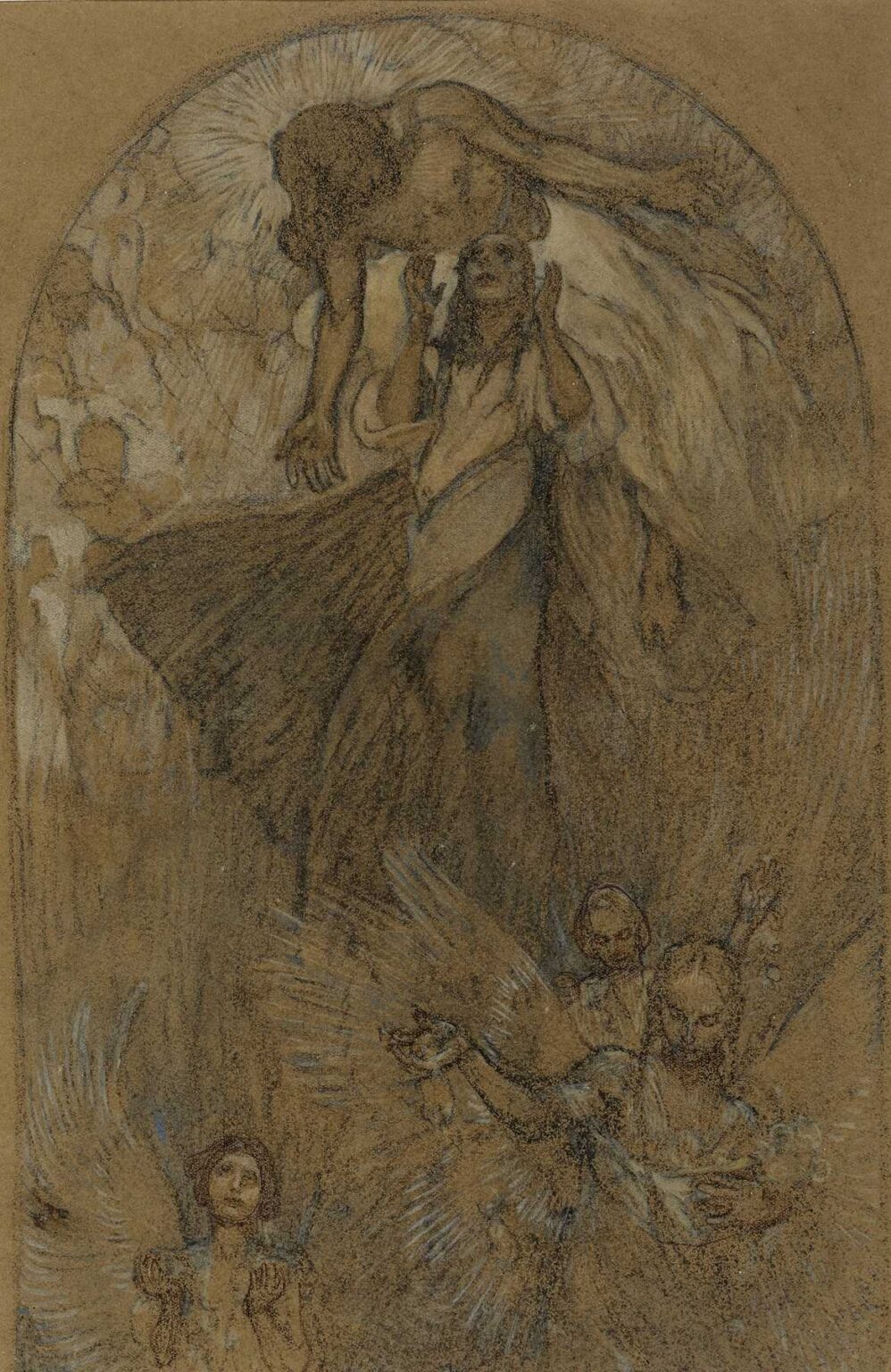
“Ascension” presents Alphonse Mucha in a quietly surprising register. Instead of the jewel-toned advertising posters that made him famous, we meet a devotional vision drawn on warm, toned paper. The composition is vertically arched like a chapel niche. At the top a radiant, horizontal figure rises into a field of light; below, a standing woman lifts her face and hands in rapt supplication; near the bottom, winged spirits surge upward in shimmering arcs. Even in this intimate sheet, the artist thinks like a stage director and architect, building a procession of forms that carry the eye—and the spirit—upward.
Composition and the Arched Format
Mucha adopts an arched format that instantly signals sacred art. The rounded top does more than recall altarpieces; it focuses the rising energy, narrowing the visual corridor so the ascent feels guided. Within this shape he places three strata. The lowest tier is populated by angels whose wings are splayed like fans, their gestures cupping small flames or blossoms that glow with chalky highlights. The middle tier is devoted to the intercessor, a woman whose elongated robe unfurls diagonally, creating a great wedge of shadow that pushes the eye toward the apex. The uppermost tier holds the culminating vision: a luminous body stretched horizontally, surrounded by a corona of radiating strokes. Each level is distinct yet linked by a continuous current of line, a spiraling draft of air that seems to lift fabric, hair, and wings together.
A Staircase of Figures and the Grammar of Movement
Mucha understands that movement on a static page must be designed, not merely suggested. He builds a staircase of figures that rises through gesture rather than architecture. The angels do not stand; they hover, their wings tilting like oars at different pitches, creating the sensation of an invisible updraft. The central woman’s robe billows as if caught by that same current. Her uplifted hands are critical punctuation marks: neither clenched nor theatrical, they are open, receiving. Finally, the horizontal body at the top breaks the vertical cadence, like a final chord that resolves the scale. The grammar is simple—rise, open, receive—yet the result is theatrically convincing, as if we have witnessed an entire sequence rather than a single moment.
Light as Theology
Light is the chief theological actor in “Ascension.” Toned paper becomes the twilight from which holiness emerges; graphite and charcoal supply the shadows of the earthly sphere; white chalk and pastel form a substance that is not simply lighter but different in kind, a visual equivalent to sanctity. Mucha places his brightest heightening along wings, edges of drapery, the uplifted face, and the radiance surrounding the upper body. That distribution is a sermon in drawing: grace descends to the seeker, catches material forms, and returns upward to its source. The glow does not flatten objects; it clings to them, describing contour and volume while affirming their transfiguration.
Materials and the Evidence of the Hand
The surface bears the hallmarks of Mucha’s practiced mixture of media: a tight, descriptive line in graphite or black chalk; broader smudges that establish atmospheric masses; transparent washes that cool the paper’s brown; and opaque white heightening that catches the divine glints. He modulates pressure so line weight alone communicates distance—faint for background congregants, dark and wiry for the angels nearest us. The paper’s tooth grips the chalk, allowing feathery strokes that become plumage and vapor in the same breath. The handling is fast but not careless; the drawing feels like a study executed while an inner image was vivid, and the urgency of that vision remains legible to us.
Decorative Line Meets Sacred Narrative
Mucha’s trademark is an arabesque line that can turn hair into tendrils and drapery into melody. In “Ascension” that decorative impulse is disciplined to serve narrative clarity. The swirl of the robe describes air currents. Halo rays are not merely ornaments but trajectories of motion. Wing-feather hatching is rhythmic enough to be decorative yet specific enough to read as feathers. The result is sacred storytelling that retains the Art Nouveau pleasure of flowing line without collapsing into pattern for its own sake.
Angels, Drapery, and the Mechanics of Motion
One of the drawing’s great pleasures lies in how fabric and feathers solve problems of motion. Mucha doesn’t have smoke or cloud machines; he has to make the ascent believable with marks. He clusters the angels in a spiral, their wings angled like overlapping fans. He sets the standing figure’s robe in a billow that looks caught by the same draft. He even allows the upper body’s drapery to stream backward, confirming the direction of travel. These mechanics convince the eye that an invisible force fills the arched niche, drawing everything toward the light, and they do so with the most economical means—curves that broaden, lines that taper, highlights that jump from fold to fold.
Iconography: Ascension, Assumption, or Vision?
The title “Ascension” invites Christian readings, yet the exact episode remains intriguingly open. The radiant figure above could be Christ at the Ascension or a saint borne heavenward. The intercessor below may be Mary Magdalene, the Virgin, or a visionary witness. Mucha often cultivated this productive ambiguity. By avoiding individual attributes and emphasizing archetypal gestures, he allows the image to expand from an illustration of a single verse into a more universal drama: the human gaze meeting the divine ascent, the earthly realm celebrating a passage into glory. The angels’ roles reinforce that universality; they are attendants of transition, not biographical actors.
Comparisons within Mucha’s Oeuvre
Placed beside the famous theatrical posters and calendar girls, “Ascension” at first looks like an outlier. Yet the continuities are striking. The layered composition, rising from base frieze to dominant central figure to crowned head, echoes his poster layouts. The round or arched framing device, so common behind Mucha’s heroines, becomes here a sacred architecture. Even the way highlights pick out hair, jewelry, and fabric in the posters finds a devotional counterpart in the way chalk catches halos and wings. What changes is intention. Advertising converts desire into attention; this drawing converts attention into contemplation.
Dialogue with Byzantine and Medieval Art
Mucha’s admiration for Byzantine mosaics and medieval reliquaries is well documented, and “Ascension” translates that love into a modern graphite liturgy. The arched field suggests an apse; the radiating halo recalls tesserae flashing in a dome. But where Byzantine art insists on frontal stillness, Mucha brings motion and tenderness. The bystanders at left are reduced to pale silhouettes, like a procession glimpsed in a memory. The angels’ faces are individualized just enough to make them feel near; their wings shimmer like gilded feathers in low church light. The sheet is a bridge between mosaic solemnity and Symbolist feeling.
The Role of Negative Space and Toned Ground
The brown of the paper is not a neutral substrate; it is atmospheric glue. It keeps the whites from shouting and the blacks from sinking. Mucha allows the ground to stand as mid-tone over large areas, letting only selective accents complete the forms. This restraint creates a hospitality of space around the figures. The abyss becomes breathable, and the shafts of light we infer between the marks feel more like presence than emptiness. Few artists use “nothing” as eloquently as Mucha does here.
Emotional Temperature and Gesture
Mucha is attentive to what bodies say without words. The witness below doesn’t pose like a model; she leans and beseeches, her hands open as if catching the first fall of grace. Her head tilts back, the throat exposed, a gesture of trust that unites vulnerability and exaltation. The angels at the lower right adopt varied tasks—offering, guiding, adoring—yet none strain or grimace. The emotional temperature is warm but not overheated, devout without theatrics. That moderation is exactly what lets the viewer project into the scene.
The Viewer’s Path Through the Image
Good compositions choreograph how we look. Here the eye enters at the bottom left where a small angel gazes upward. We follow that gaze to the cluster of wings, then ride the diagonal of the witness’s robe to the radiant arc above. Once there, the horizontal body sends our eye laterally, allowing us to notice the pale crowd along the left edge before circling back down the right side through fluttering wings and softer shadows. This path makes one pass of the ascent, then another, replicating contemplation itself: we look, we understand, we look again and perceive more.
From Poster to Altarpiece: Design Intelligence
Mucha’s training as a designer is everywhere. He knows how to arrange masses so a distant passerby—or, in this case, a congregant sitting nave-length away—can read the gist instantly. He knows how to deploy a few bright accents as hooks for the eye. He knows the economy of leaving secondary figures in silhouette so the principal actor can command. In “Ascension,” that design intelligence achieves a new purpose. Instead of selling a performance, the drawing stages a rite. The clarity rarely found in religious art of the period—often muddy with piety or cluttered with anecdote—here feels crisp, modern, and profoundly usable.
Color, Tone, and the Psychology of Browns and Blues
Though the palette is restrained, Mucha plays a refined game with temperature. The paper’s brown leans warm, evoking earth, bread, bodies. Over it he floats cool gray-blue washes that denote the realm of spirit and air. The white chalk sits at the meeting point of those two zones, a kind of consecrated temperature that glows because both warmth and coolness feed it. Psychologically the effect is consoling: humanity is not negated by divinity; it is clarified within it. The colors say what the figures enact.
The Drawing as Working Study
The speed and openness of the marks suggest a study rather than a finished exhibition piece, but that provisionality is a strength. We can see choices being made—where to concentrate detail, where to blur; where to lock line, where to let wash wander. The arched outline feels ruled in lightly before the figures flow into it, as if Mucha gauged the scale of his vision and only then allowed characters to enter. For scholars of process, this is a treasure: it captures the artist thinking in real time.
Reception and Modern Resonance
A contemporary viewer, even one with little attachment to Christian narratives, can enter “Ascension” through its structure of uplift and release. The angels’ labor resembles the communal work of art-making itself; the witness’s open hands model receptive attention; the ascending figure embodies the dream of transcendence that drives creative and spiritual lives alike. The drawing’s modernity lies not in style alone but in this accessible psychology of ascent.
Conservation Notes and What to Look For in Person
Seen in person, the delicate play between paper grain and chalk becomes a tactile experience. Look for the places where white heightening sits thickly, creating a luminous crust, and for areas where a graphite point has skated lightly, producing a silver line. Notice where the paper itself is the mid-tone of wings and faces, and how little is required to let the mind complete the form. If the sheet shows abrasion or discoloration, that, too, belongs to its devotional life; it was likely handled, pinned, or carried as part of a working cycle of designs.
Why “Ascension” Matters
“Ascension” condenses Mucha’s talents—decorative intelligence, narrative clarity, sensitivity to materials—into a single, quietly ambitious act of devotion. It shows how an artist renowned for posters could think just as effectively in sacred terms without abandoning the modern line that made him revolutionary. The drawing is both a private prayer and a public design, an object that teaches us how to look upward by arranging marks on a page. In a career that bridged theatre, advertising, national myth, and spiritual aspiration, this sheet is a hinge: it swings from earth toward heaven and invites us to move with it.