Image source: artvee.com
A first look at a dark interior
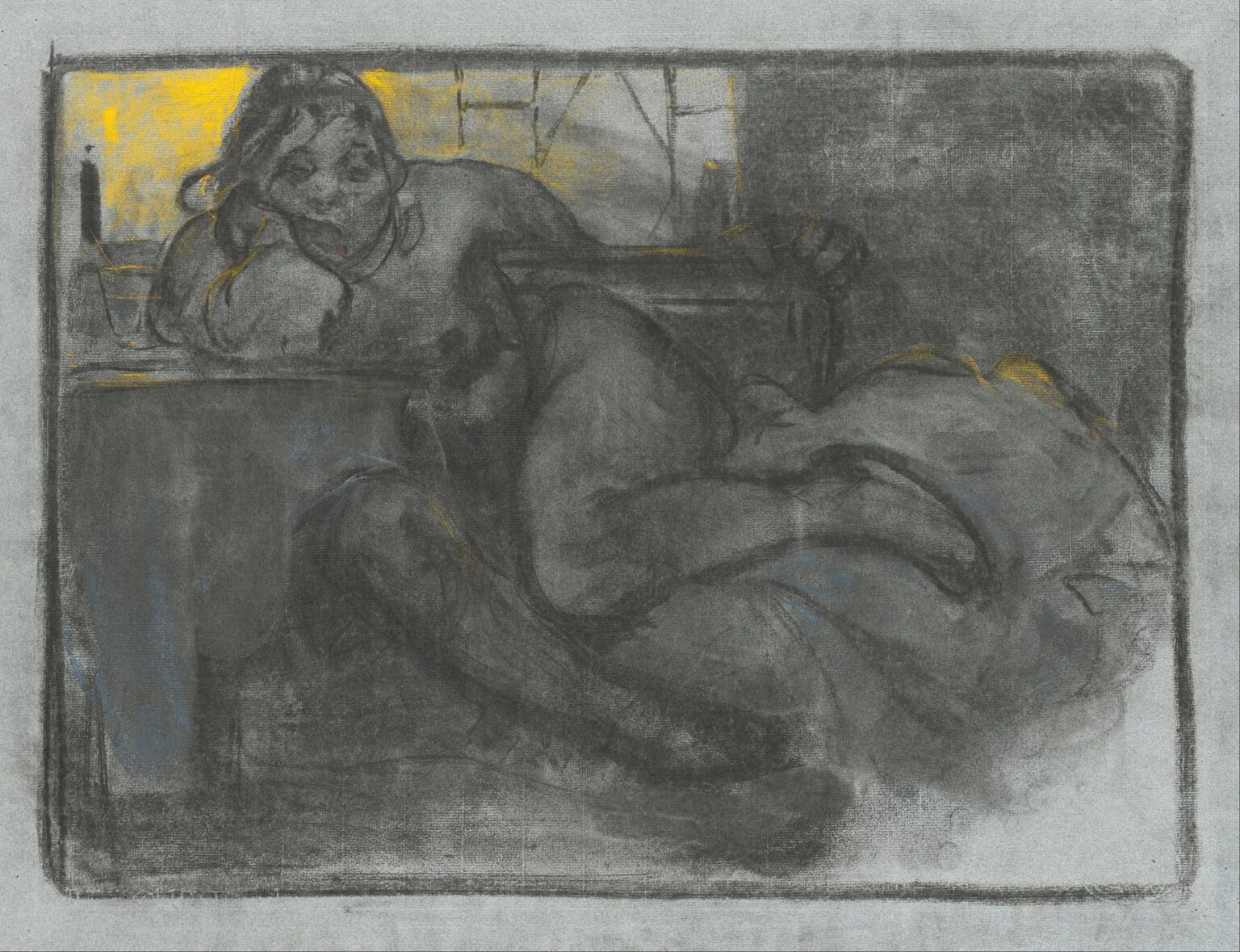
“Absinth” (1905) shows Alphonse Mucha far from his luminous theatre posters. The image is small, nearly monochrome, and claustrophobic. Within a hand-drawn rectangular vignette a figure lies curled across a low couch while, at left, another figure props the head on a hand beside a tabletop. The room is almost swallowed by charcoal blacks and foggy greys, relieved only by two accents: a mustard-yellow glow that leaks from the window or gaslight behind the seated figure, and faint cool blues brushed into shadowed passages. Nothing advertises; everything breathes. The intimacy is immediate, the mood heavy, and the title cues us to read the scene through the lens of absinthe—Paris’s notorious green spirit and the fin-de-siècle’s most charged social drink.
1905 and the culture around absinthe
By 1905 absinthe was both a bohemian muse and a public anxiety. Cafés served it ritualistically with water and sugar; critics blamed it for moral decline and nervous illness; painters used it to stage modern loneliness. Mucha, who had conquered Parisian walls with glamorous Art Nouveau allegories, understood the drink’s symbolic freight. Rather than show a glass in theatrical close-up, he registers its presence through atmosphere. The lethargy of bodies, the miasma of shadow, the sickly backlight, the way the picture’s edges seem to dim like a lamp running out of oil—all these describe a world tipped just off balance. The drawing arrives on the cusp of the campaigns that would soon outlaw the spirit in France (1915), so it reads as both observation and omen.
Mucha beyond the poster stereotype
The work disrupts the stereotype of Mucha as the prophet of prettiness. He was a trained illustrator and draughtsman with command of tone, characterization, and economy of means. “Absinth” uses none of his decorative borders, no floral arabesques, no ornamental lettering. Instead, he relies on figure, value and light to deliver meaning. That shift matters historically: it proves that the Art Nouveau master could pivot to a modern, almost journalistic realism when the subject required it, keeping his sensitivity to human presence while setting aside ornament.
Medium and touch
The surface reads as charcoal and black chalk with touches of colored pastel on a cool, slightly toothy paper. The drawing is rubbed, lifted, and reworked; Mucha pushes dense blacks into the couch and figure contours, then drags the medium to haze edges and unify masses. Highlights are not built with white so much as saved by leaving paper exposed, a strategy that keeps the image breathable despite its darkness. The yellow accents are scumbled in thinly, not to model forms but to suggest a source of light and the sour note of intoxication. Where small, icy blues are brushed into the shadows, they cool the palette and prevent the blacks from reading as dead.
Framing and composition
Mucha draws a dark border inside the sheet, as if the viewer peers through a sooty window. The frame tightens the scene, presses it inward, and establishes a cinema-like aspect ratio. The composition divides into two fields: a vertical block at left containing the tabletop, face and light, and a wide, low field at right dominated by the sprawling, sleeping or swooning body. A shallow diagonal—elbow to knee to pillow—carries the eye across. The most emphatic contour is the arc of the reclining figure’s back and thigh, a single sweep of tone that turns the person into a landscape of fatigue. The left figure’s bent arm forms a counter-curve, so the picture breathes by opposing crescents.
The two states of being
The standing-in for absinthe is psychological, not literal. The left figure—awake but dulled—leans into the hand in the classic pose of boredom or thought. The mouth slackens; the eyelids hang; the head’s weight is heavy enough to bend the wrist. The right figure retreats entirely into the body, limbs tucked, head turned away, one arm shielding the face. The pairing suggests stages of inebriation or two different responses to the same mood: rumination and escape. Mucha does not caricature; he refuses the grotesque distortions common in anti-absinthe pamphlets of the day. The bodies remain human, even tenderly observed.
Light as narrative
The only clear light arrives as a slab of yellow behind the sitter at left. It reads simultaneously as window, lamp glow, and moral sign. Because the light is behind the face, it silhouettes rather than reveals, turning the figure into a shadow-mask. The glow fails to reach the rest of the room, as if energy itself were exhausted. This is a story told by failed illumination. A secondary, smaller flash of yellow touches fabric and hair on the reclining figure, the last embers of wakefulness. Between these two notes the composition stages a line of diminishing light from attention to oblivion.
Color psychology in a nearly monochrome work
Mucha chooses ochre yellow rather than a cheerful lemon. It leans toward the color of nicotine, gaslight, and old varnish—urban rather than pastoral. The whispery blues cooled into the blacks lend a bruised cast to the shadows, complicating the palette so the darkness feels alive. Because absinthe’s mythic hue is green, the absence of green is striking. Instead of literalizing the drink, Mucha transposes its associations into the interplay of sickly yellow and nocturnal blue. The palette thus carries the theme without illustration.
Space, distance, and where we stand
The vantage point sits just a little above table height, close enough to make us accomplices. We are not spectators across a room; we are at the adjacent table or the end of the couch. The rectangle’s tightened corners mimic peripheral vision in a dim bar, where walls disappear and only near objects survive. The compressed space increases the drawing’s quiet sense of shame and proximity—this is too near for polite looking, exactly the sort of distance at which someone decides to avert their eyes.
The glass, the bottle, and other hints
Mucha keeps props ambiguous. A thin vertical near the far left could be a candle or bottle; a small cup-like silhouette sits below it. The horizontal bar near the center might be the back of a bench, a railing or even the arm of a machine; the vagueness is deliberate. He gives us just enough to summon the setting—a café, a small bar, a boarding-house room—without tying it to a single narrative. In this way the drawing functions as type rather than incident, a distilled mood more than a slice-of-life anecdote.
Body as landscape
One of the picture’s most beautiful ideas is the transformation of the reclining figure into terrain. The thigh rises like a hill; the back rolls like a ridge; the pillow becomes a crag of light. Mucha’s charcoal modeling fuses flesh and cushion into a single geology of rest. In his posters, drapery often turns into ornamental waves; here, flesh turns into charcoal topography. The effect is sympathetic rather than sensational. Sleep—induced or desired—overwhelms personality and returns the human form to pure form.
Drawing choices that steer emotion
The faces are intentionally underdefined. The left figure’s features blur into a mask; the right figure’s face hides almost entirely. This withholding prevents the scene from becoming a melodramatic portrait and keeps attention on the condition, not the individual. Where Mucha wants force, he asserts edges: the calf’s contour, the tabletop’s front, the border’s corners. Where he wants drift, he softens: the mid-tones fog into each other until forearm, cushion and air become one substance. The alternation of decision and haze is the drawing’s emotional engine.
Relationship to Mucha’s broader practice
Look at the border and you can still feel the poster designer at work. He frames the subject with a firm contour the way he would reserve a lithographic field for text. He organizes the page into legible blocks of tone that would read at a distance. Yet he avoids the seductions that made him famous—no halo of flowers, no bejeweled typography, no idealized profile. The discipline remains; the glamour is set aside. The result is a small masterpiece of restraint that expands our picture of his career.
Kinships and distinctions among contemporaries
“Absinth” inevitably invites comparison with works by Degas, Manet, or Toulouse-Lautrec depicting drinkers and café life. Mucha shares their interest in solitude within the crowd, but his image is more intimate and less descriptive. Where Degas often satirizes, Mucha empathizes. Where Lautrec caricatures with acidic line, Mucha collapses contours into velvety masses. The drawing also brushes against Symbolist darkness: the light has metaphysical overtones, the figures verge on allegory, and the room’s boundaries feel mental rather than architectural.
Gender, vulnerability, and the viewer
The reclining body appears feminine in contour, and the closeness of our viewpoint raises questions about vulnerability. Is the figure sleeping, sick, or merely sunk in drink? Does the companion watch, ignore, or keep half-hearted guard? Mucha avoids exploitation by softening anatomy and muffling exposure. He places a barrier—the tabletop and the couch back—between viewer and body. The effect is protective rather than prurient, acknowledging how intoxication can expose people to risk without turning that risk into spectacle.
Rhythm, contour, and the lull of repetition
Charcoal’s grain organizes the sheet into a lullaby of repetitions: horizontal tabletop and window bar; verticals in the sash; curved arcs of arm and leg; soft rectangles of cushion and wall. These patterns dull the scene pleasantly, like the regular clicking of café cutlery after midnight. Into that rhythm Mucha inserts two small disruptions: the yellow flare and a tiny red touch at the sitter’s lips. Those details pull the eye just enough to keep the composition awake without shattering the mood.
Time of night and the physics of fatigue
Everything here argues for late hours: the exhausted sprawl, the dimmed light, the way bodies surrender their alignment with furniture. Absinthe, with its ritual of dilution and its slowly intensifying effects, fits this internal clock. Mucha communicates the physics of fatigue—the way limbs curl to conserve warmth, how the head seeks a hollow for rest, how eyelids become too heavy to command—without resorting to caricature. The result is a drawing about time as much as about drink.
From study to finished intention
This sheet feels complete in its incompleteness. The drawn border suggests that Mucha considered it an image rather than a preparatory scribble; yet passages remain open, and the ambiguity of props implies that it was never aimed at literal illustration. It lives in the category of poetic study—the kind of work an artist makes to hold a feeling, test a palette, and reset the hand between large commissions. In 1905 Mucha was dividing energy among design, portraiture and star-client projects; a compact drawing like this could refresh his attention by replacing public dazzle with private observation.
Materiality and condition as part of meaning
The scuffs, rubbed edges and soft speckling you see across the paper are not defects; they bind content and medium. Alcohol fogs perception; charcoal fogs edges. The paper’s cool tone doubles the room’s air temperature. Even the way the yellow pastel sits slightly chalky on the surface echoes how gaslight skims rather than penetrates smoke-filled interiors. Material and theme rhyme line by line.
Why “Absinth” feels contemporary
Strip away the historical drink and you have a scene recognizable today: the fatigue of nightlife, the intimate melancholy of unguarded hours, the press of bodies within small city rooms. Mucha’s refusal to over-explain leaves space for present viewers to project their own stories—exhaustion after work, a late shift’s end, a private crisis, a quiet companionship. The drawing’s economy, ambiguity and empathy align with modern documentary photography and graphic novels more than with salon painting. It anticipates the aesthetics of dim interiors captured on phones and shared as fragments of mood.
What the picture says about looking
The drawing asks a small ethical question: how close should we come to someone else’s unraveling? Mucha keeps us near but not inside, intimate but not invasive. The border acts like conscience; it reminds us this is a frame, not a room, and that our gaze, however curious, has limits. Many of Mucha’s famous posters invited consumption—of plays, products, a glamorous lifestyle. “Absinth” invites consideration instead: of bodies, of night, of the way light fails and yet still tries to console.
Closing reflection
“Absinth” condenses a city’s complicated romance with a drink into a small theatre of light and shadow. It proves that Mucha could look past ornament to the human condition, using charcoal to whisper what his lithographs often sang. No glass is prominently displayed; no ritual is dramatized. Instead we receive the after-effect—the softened limbs, the bowed head, the yellowed window that cannot quite keep darkness out. A century later the drawing still carries its quiet charge, reminding us that the most persuasive images are sometimes the ones that stop performing and simply keep us company in the half-light.
