Image source: artvee.com
A First Look: Architecture Drawn Like Jewelry
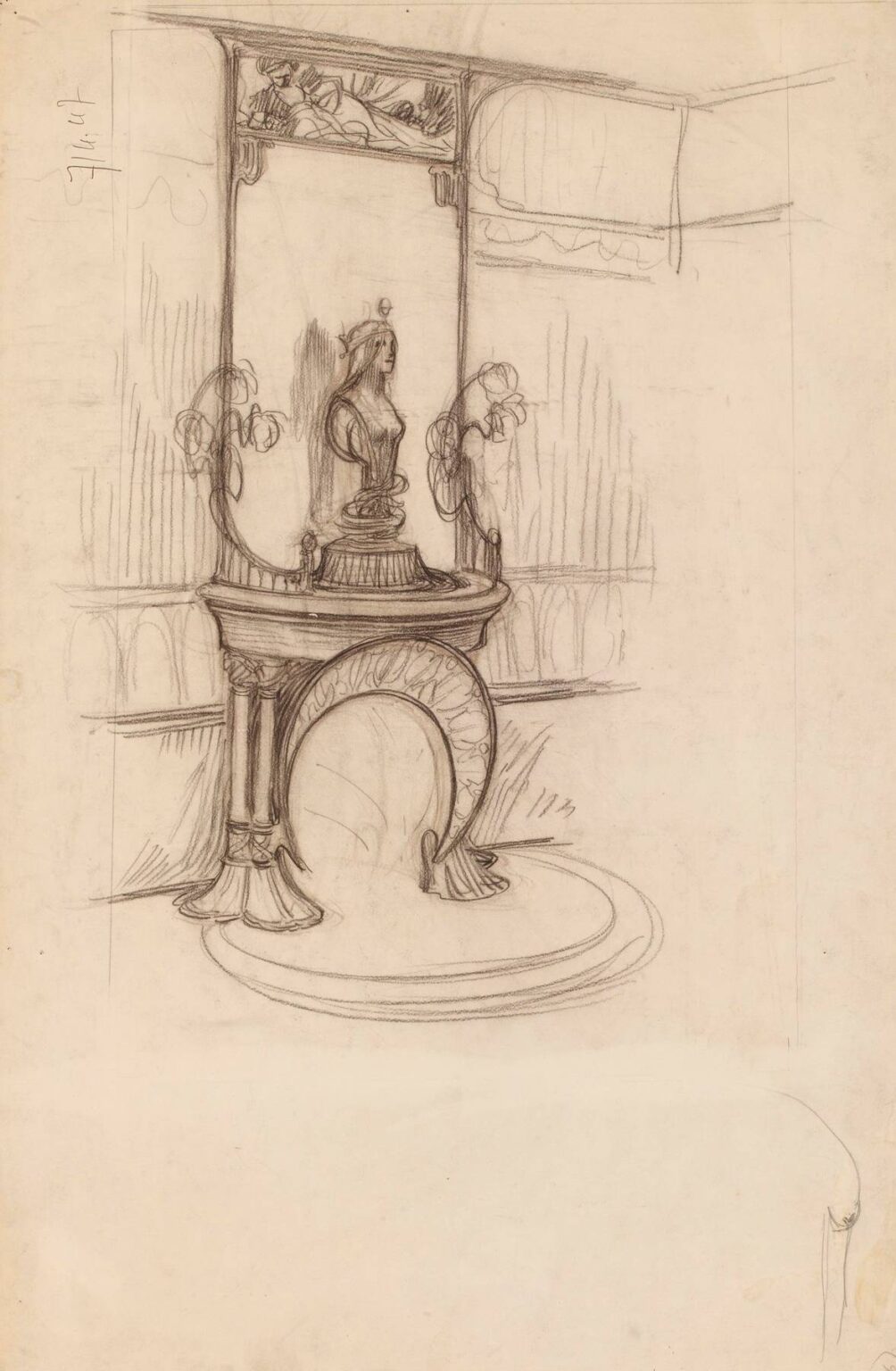
This 1900 sheet captures Alphonse Mucha in the act of designing, not posing. With a few supple pencil strokes he conjures a corner of an interior dominated by a curving fireplace, a mantel that behaves like a pedestal, and a female bust—“La Nature”—holding court at the center. The drawing is spare, exploratory and quick, yet nothing about it feels tentative. The line is confident, the geometry coherent, the symbolism unmistakable. It is an interior conceived as a piece of jewelry: ornamental, luminous in conception, and keyed to the human figure.
The Fouquet Connection and the Total Work of Art
Around 1900 Mucha collaborated intensely with the Parisian jeweler Georges Fouquet, creating exhibition settings and an extraordinary boutique in which furniture, vitrines, wall reliefs and lighting fused into a single environment. This fireplace design belongs to that spirit of a Gesamtkunstwerk—a total work of art in which architecture, sculpture, and applied arts share the same vocabulary. Even on paper the vocabulary is audible: whiplash curves, plant-borne supports, and a central feminine emblem that radiates calm power. The sheet functions as a thinking diagram for how a visitor would experience warmth, light and brand identity the moment they entered a room.
Composition: A Theater Built Around a Hearth
The fireplace sits like a small stage. Two slender uprights flare into “petal” feet that grip the floor, while a semicircular arch sweeps down to enfold the firebox. The mantel above projects forward as a dais for the bust. Curving lamp-stems—floral and tender—rise symmetrically to flank the sculpture like living candelabra. Behind, a paneled backdrop frames the scene; to the left a horizontal frieze panel contains reclining figures, and to the right a larger arch-like field suggests either a mirror or window. The layout is axial but not rigid. Mucha’s curves keep the eye circulating: from the petal feet to the arch, up the lamp stems to the bust, across the frieze and back again. It is a theater of loops.
Draftsmanship: Pressure, Breath, and the Speed of Thought
Mucha’s pencil carries a musician’s phrasing. He deepens line weight where structure needs emphasis—the front edge of the mantel, the inside of the arch, the base of the columns—and allows the rest to dissolve into whispers. The lamps are almost calligraphy; the backdrop dissolves into vertical hatching to suggest depth without insisting on detail. Even the elliptical hearth rug is a breath of tone, not an object. You can feel the speed at which he worked, yet the sheet never looks careless. It is clarity under pressure, the kind of drawing an architect makes to convince himself and a patron in the same moment.
La Nature: The House as Muse
At the center stands “La Nature,” a female bust wrapped in flowing hair and crowned with organic ornaments. Mucha personified ideas through women throughout his career—Seasons, Arts, Stars, Day and Night—and here Nature becomes the presiding spirit of a domestic ritual. The fireplace is civilization’s controlled flame; Nature is fire’s origin and floral growth; Fouquet’s jewelry, gleaming in nearby cases, would have echoed her vegetal motifs. By elevating the bust on the mantel, Mucha turns the hearth into an altar and the act of gathering around it into a secular ceremony.
Symmetry Tempered by Life
The design flirts with bilateral symmetry—the two lamp-stems, the twin uprights, the arch—but it avoids mirror stiffness. The lamps differ in droop and twist; the arch has a subtly uneven thickness; the bust’s pose offsets the central axis. This is classic Art Nouveau behavior: nature loves bilateral bodies but hates mechanical repetition. Mucha orchestrates a living symmetry, one that pleases without petrifying.
Curves That Mean Something
The drawing’s important curves are not decoration pasted onto frame; they are explanations of forces. The arch reads as compression and containment—the place where masonry would corral heat. The flared feet read as weight distribution, plant bulbs gripping earth. The lamp stems read as growth reaching toward light. The motif universe coheres because each line has a job: carry weight, guide heat, sprout and bloom. Ornament becomes a physics lesson.
Light and Fire: Technology in Organic Dress
Although the sheet is not technical, it reveals Mucha’s interest in modern illumination. The floral heads at the ends of the stems imply electric globes clothed as blossoms—a favorite Art Nouveau trope. The arrangement would have washed the bust in soft, lateral light while the fire below supplied a warmer, flickering glow. The effect is an ecosystem of light: electric “flowers” pollinating the figure while fire nourishes the body. In a boutique or upscale salon circa 1900, such layered lighting would have been both modern comfort and theatrical branding.
Materials Imagined Through Line
Mucha seldom labels materials in his quick studies, yet the pencil suggests them. The heavier contours of the arch and mantel hint at stone or enameled metal; the plant stems and petal feet feel like cast bronze or patinated iron; the backdrop might be carved wood or stucco with low relief. The bust itself could be plaster, bronze, or even a gilded composite—whatever would hold a soft sheen under the lamps. The point is not to guess with certainty but to notice how material possibilities are embedded in thickness of line, in how edges catch or release light.
Scale, Ergonomics, and the Human Experience
Notice the relation of pedestal height to the implied standing viewer. The bust sits at a level ideal for eye contact; the lamps hover near shoulder height; the firebox opens at a comfortable bend of the knees. Mucha understood interiors as choreographies of the body: where hands would warm, where eyes would rest, where feet would pause. The oval rug drawn on the floor is more than decoration; it is a stage mark telling us where to stand for the best mix of heat, light and sightline.
The Frieze Panel: Narrative Above Flame
Above the mantel a long horizontal field hosts reclining figures and swirling hair—perhaps a personification of Air or Dream. This band counterbalances the vertical impulse of the lamps and columns. It also situates the hearth within a mythic diagram: Fire below, Muse at center, Air above. Mucha often layers narratives like this, allowing allegory to flow through furniture and architecture so the room itself tells stories.
Negative Space and the Design Process
Large stretches of the sheet remain blank, especially to the right and lower portions. These voids are not failures; they are the room left for decision. He sketches the essentials—the heart of the idea—then leaves the periphery open for adjustments in scale, molding profiles, or finish. In this sense the drawing is a perfect teaching tool for designers: begin with the experience you want to stage, put your highest resolution where human bodies meet the object, and let secondary surfaces follow.
Ornament as Grammar, Not Accent
Every decorative choice here obeys a grammar. Capitals curl into tendrils because tendrils can grow and hold; lamp stems twine because twining controls direction; the arch lip unfurls because unfurling releases heat and catches light. None of these flourishes are arbitrary. They speak a visual language in which growth, containment and radiation are verbs enacted by line. This is why Mucha’s interiors never feel merely pretty; they are coherent arguments written in arabesque.
The Domestic Fire as Cultural Icon
Fireplaces in 1900 Paris were already half practical, half symbolic. Central heating was spreading; the hearth remained as an image of domesticity and as a focal niche for display. Mucha leverages that shift. He transforms a utilitarian opening into a brand altar: a place of warmth that also advertises a worldview—art wedded to nature, technology softened by organic form, the feminine as civilizing force. Visitors encountering such a fireplace in a showroom or private residence would have understood the owner’s tastes at a glance.
Echoes of Mucha’s Posters and Sculpture
Although this is interior design, echoes from Mucha’s more famous mediums abound. The bust recalls his self-designed sculptural personifications; the frieze above nods to his poster tympana, those semicircular panels filled with floating hair and allegory; the flaring bases repeat the rhythm of his poster borders that often blossom into floral knots at the corners. The transfer across media is not derivative; it is consistency of vision. Whether printed on a wall or built into a room, the language behaves the same.
Rhythm of Vertical and Horizontal
Two rhythms organize the sheet. A vertical rhythm—the columns, lamp stems, bust—creates lift and ceremonial focus. A horizontal rhythm—the frieze panel, mantel shelf, base ellipse—creates repose and stability. Where they cross, at the bust, the room’s energy concentrates. This is not a decorative accident. It is the same compositional logic painters use to place a figure at the crossing of strong axes. The fireplace becomes a portrait of a place with a clear center of gravity.
Cultural Roots and the Sacred Everyday
Art Nouveau loved the sacredness of everyday acts—reading, bathing, warming oneself—and Mucha was its poet. By installing “La Nature” above the flames, he sanctifies the ordinary. There is an implied liturgy: light the fire, switch on the floral lamps, approach the oval rug, feel warmth on the hands while the household’s emblem looks on. In an era fascinated by new rituals of modern living—department stores, cafés, exhibitions—this small domestic rite makes a counterclaim for intimate grandeur.
Practicality Hidden in Flourish
Beneath the lyrical line lurk practical features. The arch’s lip would deflect smoke; the flared feet would distribute weight on wooden floors; the upright elements leave space for tools or a screen; the mantel’s projection protects the bust from soot. Mucha’s flourish is never at odds with function; it camouflages it. That is why his interiors age gracefully: they are usable designs that also stage beauty.
The Paper’s Patina and the Survival of Ideas
The sheet bears light smudging, erasures, and margin marks. Those traces are not blemishes; they are the archaeology of an idea alive on paper. Designs like this survive as crucial evidence when original interiors are altered or dispersed. They tell us how the artist thought, how he prioritized, how he translated a vocabulary learned in posters into wood, metal and light. In conservation terms, the drawing is a portable room, carrying forward a space that may no longer exist in situ.
Relevance for Contemporary Designers
Contemporary interiors hungry for warmth and narrative can learn from this sheet. Begin with a human-scaled ritual; build architecture around a figure or emblem that holds meaning; let lighting be more than lumens—let it participate in the story; treat ornament as structural thought, not after-market appliqué. The drawing demonstrates how to achieve maximal presence with minimal means: a few lines that carry purpose, a center that gathers, a rhythm that guides.
Closing Reflection: A Hearth That Thinks
“Decorative fireplace with the bust of La Nature by Mucha Fouquet” is a thinking hearth. On a small page it reconciles opposing desires—function and fantasy, technology and botany, warmth and display. We can imagine the finished object in bronze, stone and glass, but we do not need it to feel the design’s intelligence. The pencil sings it already: nature presiding, flames contained, light blossoming, humans gathering. In 1900, at the height of a style that believed beauty could organize life, Mucha put that belief into a corner of a room—and even in sketch form, it still organizes ours.
