Image source: artvee.com
Introduction
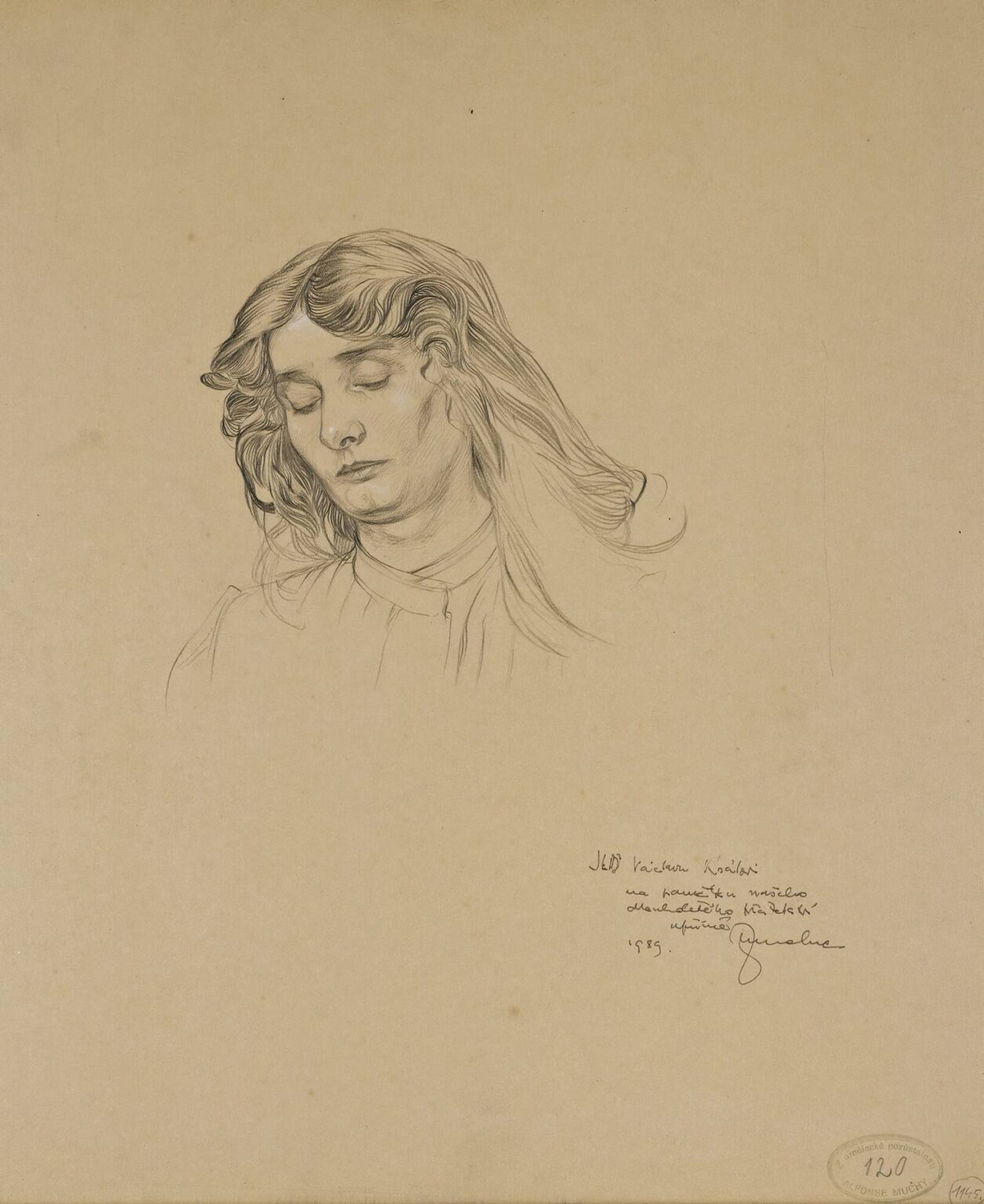
Alphonse Mucha is celebrated for radiant posters and lavish allegories, yet behind the ornament there is always a draughtsman of uncommon sensitivity. “Czech young woman” (1889) shows that foundation at its most intimate. On a sheet of warm paper, a head and the beginning of shoulders emerge from delicate graphite lines. The sitter’s eyes are downcast, her mouth closed in a faint, inward curve. Cascading hair is described with rippling strokes; the blouse is barely indicated. Vast margins of untouched paper surround the quiet head. Nothing distracts from the encounter between the artist’s hand and the young woman’s presence. Far from a slight sketch, the drawing is a meditation on character, national identity, and the expressive potential of a single line.
Where the Drawing Sits in Mucha’s Journey
In 1889 Mucha was in his late twenties, living between commissions, life classes, and illustration work. These were the Paris years before fame, when he honed a language that would later dazzle the boulevards. The drawing belongs to that formative period. It bears none of the decorative frames or swirling borders that would become his signatures, but it contains the seed of them in the rhythmic articulation of hair and the poised balance of contour and tone. It also predates his overtly nationalist projects while announcing their spirit through the title: “Czech young woman.” In the decades to follow, Mucha would place the destiny of the Slavs at the center of his art; here the subject is not yet an allegory of a people, but a person whose calm gravity makes the idea of a people thinkable.
An Economy of Means with Maximum Effect
The drawing is made with graphite, possibly touched with black chalk in key accents. Mucha exploits graphite’s full range: the line can be a whisper at the edge of the cheek, a firm stroke where locks overlap, or a soft cloud under the jaw. Shadows are built by feathered hatching that follows form. The simplest touches do the greatest work—the quick flare along the bridge of the nose, the careful dark of the pupils, the light break at the lower lip. With so little, the artist suggests a full volume in space. The technique demonstrates a mastery he would later conceal under color and pattern; here it is naked and irresistible.
Composition and the Courage of Empty Space
The portrait occupies a small island near the top left quadrant of the sheet, leaving a sea of untouched paper below and around it. That emptiness is not absence but design. It sharpens the viewer’s attention, making the drawn area feel precious and deliberate. It also creates a breathing field around the head; the quiet expands the sitter’s introspection outward until it fills the page. Mucha’s choice resists the period’s taste for fully modeled busts and decorated backgrounds. The drawing is modern in its negative space, anticipating design strategies he would later use in posters where a single figure floats against a plain ground to command a city street.
Pose and Psychological Weather
The young woman’s head tilts slightly to her right, eyes lowered. This is not the mechanical gaze of a studio model waiting for instructions; it is an inward turn. The expression balances gentleness and gravity. A hint of asymmetry livens the face: one eyelid sits a fraction lower than the other; the mouth inclines subtly, as if a thought is about to settle. The effect is humane and unsentimental. Mucha refuses to caricature beauty; he attends to personality. The tilt also creates a line of motion that guides the eye along the hair and back up to the forehead, forming a slow ellipse that keeps us looking.
Hair as the First Music of Art Nouveau
Even in this restrained sheet, hair becomes a stage for rhythm. Mucha maps wave after wave of locks with long, elastic strokes that thicken and thin according to turn and overlap. These accents anticipate the famous “whiplash” line that defines Art Nouveau. Yet here the pattern never turns decorative for its own sake. The artist observes how hair masses, clumps, and separates under gravity. He translates physics into music. This balance of observation and design will later allow him to impose elaborate frames and ornaments on his posters without losing the sense of living bodies inside them.
Light, Tone, and the Grace of Graphite
The illumination is even and soft, without theatrical contrast. Light rests on the forehead, the top of the nose, the cheekbone; shadow collects under the chin and within the ear. Because the paper itself supplies a mid-tone, Mucha can carve light out of the page rather than paint it on. The result is akin to sculpture: volumes are modeled by removing darkness rather than applying brightness. This gives the face a serene, almost marble stillness, while the floating strands of hair keep the image alive.
The Ethics of Likeness
To draw a person is to choose a truth among many possible truths. Mucha elects tenderness. He avoids hard edges that would dramatize bone or muscle. He also resists the sentimental sweetness popular in academic portraiture. The sitter is neither idealized into a type nor rendered with the flattery of genre prettiness. Instead, Mucha records the interior temperature of a moment—the thoughtfulness that lowers the eyes, the ease that lets the mouth rest. The page becomes a sanctuary where likeness and respect meet.
The National Word in the Title
Why mark the sheet “Czech young woman”? The phrase identifies more than nationality; it frames the portrait as a cultural emblem. In the late nineteenth century, Czech lands experienced a vigorous national revival—language, music, and visual culture asserted identity within a larger empire. Mucha participated in that revival throughout his life. Without draping the sitter in symbols, he offers the dignity of recognition: this face belongs to his people. Later, in the monumental cycle “The Slav Epic,” he would paint history writ large. The seed of that epic lies in portraits like this, where belonging is felt at the scale of a single thoughtful face.
The Unfinished as Intention
Only the head and a sliver of the blouse are worked; the shoulders vanish into the paper. This incompletion is not haste. It is a decision that concentrates meaning. By leaving the lower areas unresolved, Mucha allows the viewer’s imagination to complete the figure. The drawing becomes a collaboration: we finish the body in the mind, feeling the weight of hair on the back and the quiet rise of breath beneath the blouse. The unfinished edge also sharpens the sense of present tense. The portrait feels like an encounter that could resume at any moment, as if the model might lift her eyes and the artist, pencil hovering, would continue.
Relation to Symbolism and Naturalism
The 1880s straddled two major sensibilities. Naturalism prized observed truth; Symbolism chased inner states. Mucha navigates between them. The face obeys the laws of light, proportion, and anatomy; nothing in it is vague. Yet the lowered eyes and enveloping silence invite symbolic readings—reverie, modesty, listening, the hush before speech. Because no narrative props dictate interpretation, the drawing stays open, capable of holding many meanings without dissolving into ambiguity.
Draftsmanship Compared with the Posters
When fame arrived, Mucha’s posters for theatre and products featured fronts of text, floral halos, and luxurious color. The language of line remained the same. Compare the controlling curves in this hair with the curves that energize his later frames; the flexible pressure on this contour with the outlines that define poster silhouettes. The drawing shows that his public style rests on private discipline. It also helps explain why the posters feel alive rather than mechanical: the line comes from the same hand that could breathe a face into existence with a dozen strokes.
Materials, Scale, and Touch
The sheet’s size allows for broad spaces and minute control. Mucha’s touch is varied: in the hair, strokes fly longer and looser; in the features, pressure lightens to a whisper. He practices edge hierarchy—harder where a lock overlaps, softer where a cheek turns away—so that the viewer senses depth without heavy shading. A few micro-gestures reveal his sensitivity: the slight break in the line at the cheekbone to suggest light catching; the dot and dash inside the nostril to avoid blunt darkness; the tiny, nearly invisible crease at the corner of the mouth that grants the face repose rather than indifference. The more one looks, the more one sees decisions rather than habits.
The Humanist Quiet
Nothing in the drawing pleads for attention; it trusts the value of stillness. That quiet is humanist rather than decorative. The blank field frames not only a head but an act of attention—a person looked at long enough for the essential to surface. In an age, then and now, enamored of spectacle, such images remind us that dignity can be built from spare means. The drawing offers an ethic: look closely, with care, and reality will return the favor.
The Role of the Model
We cannot say who this young woman was, yet the drawing suggests partnership. The pose is sustainable, the tilt natural, the eyelids resting rather than forced shut. The sitter collaborates by maintaining a stable interior mood that lets the artist follow slow contours and delicate planes. That partnership echoes studio practices of the period while also anticipating Mucha’s long collaborations with models who would become icons in his work, including his daughter Jaroslava. In this calm portrait, the model is not a prop; she is co-author of the atmosphere.
Reading the Inscription
Near the lower right sits a handwritten note and signature. Even if one does not parse the Czech text, its placement signals a personal context—perhaps a dedication, a memory of the sitting, a gift. The inscription converts the drawing from anonymous study into an event anchored in time. Its distance from the head preserves the sanctity of the portrait space while securing provenance and voice. The script’s flowing rhythm mirrors the hair’s curves, linking word and image through the same hand.
Lessons for Painters, Designers, and Photographers
The sheet functions like a tutorial in seeing. It teaches restraint—how much can be said with little. It teaches edge control, the craft of letting lines breathe. It teaches the power of negative space, which designers know as a force equal to form. It teaches portrait photographers the value of an inward gaze: drama does not require shout; it can whisper. And it teaches that style without observation is decoration, while style plus observation becomes art.
How the Drawing Anticipates the Future
Look ahead from 1889 to Mucha’s great projects and one sees continuities. The flowing hair will become the current that moves through his posters; the soft, compassionate faces will blossom into his allegories; the pride embedded in the phrase “Czech young woman” will culminate in historical epics. Yet some things remain unique to the drawing: the vulnerable stillness, the open space, the nearness of breath. For that reason the sheet feels precious, as if we had been allowed into the studio before history arrived.
Why It Still Matters
Viewers today often meet Mucha through coffee-table reproductions of glamorous prints. This drawing complicates that introduction. It shows the private seriousness that underlies the public dazzle. It also offers a counter-image of national identity: not flags or battles, but a contemplative face that claims worth without spectacle. In a time saturated with images, the drawing’s restraint reads as radical. It proposes that attention is a form of love and that art’s first task is to pay it.
Conclusion
“Czech young woman” is a small miracle of graphite and air. With disciplined line and patient tone, Alphonse Mucha makes a personality appear. The sheet’s spacious margins amplify the quiet, its limited modeling guards the mystery, and its title honors origin without turning the sitter into a cliché. Everything essential in Mucha’s later triumphs is latent here: rhythmic line, empathy for the feminine figure, and devotion to the idea that beauty grows from attentive looking. Standing before this drawing, one feels less the weight of style than the presence of a person—someone who has paused, eyes lowered, as if listening to her own thoughts, while an artist, equally attentive, listens alongside her with a pencil.
