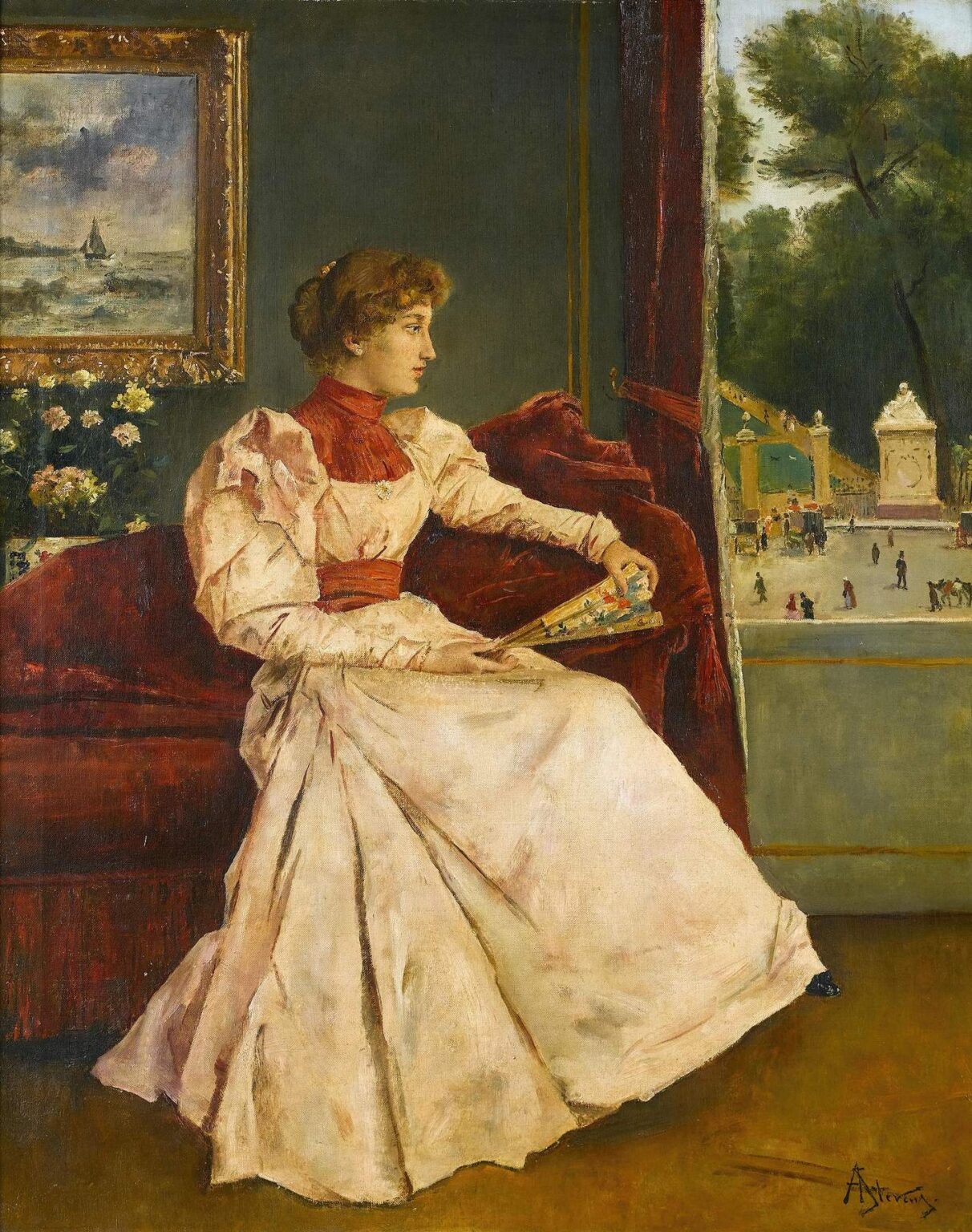
Image source: artvee.com
Historical and Biographical Context
Alfred Stevens (1823–1906) painted At Home during the height of his career in the 1860s, a period when Parisian high society and domestic elegance provided fertile ground for his artistic imagination. Born in Brussels, Stevens initially trained at the Royal Academy before moving to Paris in 1847, where he developed a close friendship with Gustave Courbet and became associated with the realist movement. Yet unlike Courbet’s often gritty portrayals of rural life, Stevens found his muse within the urban interiors and salons of the Second Empire. His nuanced depictions of fashionable women, sumptuous fabrics, and refined settings earned him widespread acclaim. At Home, with its elegant portrayal of a young woman seated before a large window and a framed seascape, exemplifies Stevens’s unique synthesis of Realism’s fidelity to detail and the emerging taste for modern life’s aesthetic pleasures.
The Social Milieu of Mid‑19th‑Century Parisian Interiors
In the mid‑19th century, Paris was a nexus of decorative arts, haute couture, and bourgeois comfort. Under Napoleon III, the city underwent massive renovation—grandeur mingled with bourgeois intimacy, and private salons became stages for the display of wealth and taste. Paintings of interior life were not mere genre scenes but commentary on contemporary ideals of femininity, leisure, and sociability. Women of the upper middle class were both subject and arbiter of fashion, occupying spaces that reflected their social standing. Within this context, Stevens elevated the everyday act of repose into a celebration of modern life. At Home invites viewers to contemplate not just a single figure but an entire culture of refinement, where the selection of furnishings, artworks, and attire performed silent yet eloquent social discourse.
Composition and Spatial Structure
Stevens composes At Home with deliberate clarity and balance. The painting is divided vertically into three zones: on the left, a framed seascape painting and a vase of flowers; in the center, the richly upholstered sofa upon which the sitter reclines; and on the right, a tall window that opens onto a verdant exterior. This tripartite arrangement creates both visual harmony and narrative tension. The framed seascape within the painting acts as a mirror to the window beyond, drawing a parallel between art and nature, interior and exterior. Horizontals—the sofa’s back, the window sill—ground the composition, while the sitter’s diagonally placed legs and the fan in her hand introduce gentle dynamic flow. Stevens’s careful spatial organization underscores his mastery of interior design as pictorial architecture.
Light, Atmosphere, and Psychological Tone
Light in At Home is both natural and subtly theatrical. Sunlight filters through the large window on the right, casting a warm glow on the woman’s pale skin, her fine dress, and the sofa’s plush velvet. Yet Stevens tempers brightness with indoor shadows, preserving the intimacy of the salon. The juxtaposition of illuminated and shaded areas reveals textures with painterly precision: the sheen of silk, the soft nap of velvet, the cool smoothness of porcelain. Psychologically, the light enfolds the sitter in a gentle spotlight, inviting viewers into a private moment of repose. Her contemplative gaze—neither directly at the viewer nor entirely turned away—conveys a sense of reflection or mild wistfulness, imbuing the domestic scene with emotional depth beyond mere decorative appeal.
Color Palette and Harmonious Contrasts
Stevens employs a refined palette that modulates warm and cool tones to articulate space and mood. The dominant reds and pinks of the woman’s gown and the sofa’s upholstery are balanced by the pale greens of the wallpaper and the cool blues of the seascape painting. Subtle accents—a jade vase, the soft yellow of fresh flowers—provide chromatic punctuation without disrupting overall cohesion. The sitter’s ivory skin and the gauzy fabric of her sleeves act as neutral zones that unify these contrasting hues. Stevens’s color harmony eschews bold discord in favor of nuanced interplay, reflecting the salon’s cultivated elegance. This chromatic subtlety also underscores his background in decorative arts, where color coordination was paramount.
Brushwork and Surface Texture
Although Stevens’s surfaces are polished and lifelike, close inspection reveals a sophisticated handling of brushwork. Fabrics are rendered through fluid, overlapping strokes that convey drapery’s weight and fall. The seascape within the painting receives looser, more impressionistic touches—broad, swift sweeps of gray and white—hinting at waves and cloud‑scudded sky. Floral details in the vase emerge from dabs of pigment that suggest petals rather than delineate each bloom. In contrast, the sitter’s face and hands are painted with meticulous care, each contour and shadow softly modeled to capture the subtleties of flesh. Stevens thus varies his touch to differentiate material qualities and focal points, guiding the viewer’s eye across textures both sumptuous and delicate.
The Seated Figure: Fashion, Gesture, and Identity
The young woman in At Home epitomizes Second Empire fashion: a high‑waisted bodice with puffed sleeves, delicate lace trim, and a full skirt of fine fabric. Her coiffure—hair tousled yet restrained by a jeweled comb—was the height of contemporary taste. Seated with one elbow resting on the sofa’s armrest, she holds a decorative fan with light grip, a gesture that conveys both leisure and refined restraint. Her posture—elegant yet relaxed—suggests familiarity with this domestic setting. Stevens’s interest in the sitter extends beyond mere portraiture; he captures her as an archetype of cultured femininity, an active participant in the era’s aesthetic dialogues. Though we do not know her name, she represents the modern woman as both spectator and curator of her surroundings.
Interaction of Artworks and Interior Elements
Within At Home, the internal painting of a seascape and the lush floral arrangement engage in silent conversation with the wider room. The seascape—a small painting of sailboats on choppy waters—echoes the sitter’s own contemplative gaze, hinting at faraway horizons beyond the salon. The fresh flowers, rendered in gentle pastels, celebrate domestic cultivation and the intersection of still life and portraiture. The sofa’s deep red velvet ties these elements together, while the gilded frame of the seascape painting introduces a formal reference to public museum display. Through these juxtapositions, Stevens reflects on art’s varied contexts—private, public, and natural—and invites viewers to consider how interiors shape and reflect personal identity.
Symbolism and Social Commentary
While at first glance At Home may appear purely decorative, it carries undercurrents of social commentary. The private salon—filled with fashionable dress, imported furnishings, and collected artworks—functioned as a stage for bourgeois legitimacy. Stevens’s depiction showcases the intersection of wealth, taste, and gender roles within the domestic sphere. The woman, though elegantly attired, occupies a space that privileges leisure over labor, reflecting prescribed societal norms. Yet her introspective demeanor suggests inner life beyond these conventions, hinting at the burgeoning sense of female self-awareness that would gather momentum in subsequent decades. In this way, Stevens captures both the allure and the limitations of mid‑Victorian domesticity.
Technical Execution and Conservation
Painted in oil on canvas, At Home demonstrates Stevens’s consummate technical skill. The canvas was likely prepared with a smooth ground, facilitating the application of thin, even layers of paint. His palette included lead and titanium whites for opacities, earth pigments like siennas and umbers for warm shadows, and ultramarine and cobalt blues for cool accents. Stevens’s underpainting—visible in subtle greenish undercurrents in flesh areas—adds depth and lifelikeness. Conservation records indicate a stable surface with minimal varnish discoloration, suggesting that the work has been well-cared for since its acquisition by European and later American collections in the early 20th century. The clarity of color and the retention of delicate glazes affirm the painting’s enduring visual impact.
Provenance, Exhibition, and Reception
At Home was first shown at the Paris Salon of 1867 to favorable reviews, where critics praised Stevens’s fidelity to detail and the painting’s harmonious mood. It was acquired by a prominent Parisian collector before entering the collection of a British aristocrat in the 1880s, reflecting Stevens’s international appeal. By the early 20th century, the work had crossed to American museums as part of exhibitions showcasing 19th‑century European art. Art historians have often cited At Home as emblematic of Stevens’s ability to elevate genre painting to high art, lauding its formal elegance and its subtle interrogation of social norms. Today it remains a highlight in major museum collections, drawing admiration for its technical mastery and nuanced narrative.
Comparative Artistic Influences and Legacy
Stevens’s interiors stand in conversation with contemporaries such as Jean‑Honoré Fragonard and François Boucher—18th‑century masters whose Rococo sensibilities he updated for a modern audience. Yet his restraint and emphasis on naturalistic detail align him more closely with the Realists, including Gustave Courbet. The quiet drama of a single figure amid reflective surroundings foreshadows later Impressionist interior scenes by artists like Édouard Vuillard and Pierre Bonnard. Stevens’s legacy endures in the 20th century through his influence on artists who sought to reconcile genre tradition with modern life: his interiors calmly assert that everyday beauty and psychological complexity need not be mutually exclusive.
Contemporary Relevance and Appreciation
In a 21st‑century world of rapid change and virtual connectivity, At Home offers a timeless reminder of the power of physical surroundings and contemplative repose. Its portrayal of domestic elegance—down to the soft fall of fabric and the painted brushstrokes of a small seascape—reminds viewers of art’s capacity to elevate the ordinary. As modern audiences revisit 19th‑century urban life through historical exhibitions and digital archives, Stevens’s painting invites reflection on how private spaces shape identity and how art within art can deepen our understanding of human experience. At Home continues to resonate as both a masterful work of genre painting and a subtle social document.
Conclusion
Alfred Stevens’s “At Home” stands as a paragon of 19th‑century interior painting, fusing meticulous Realist technique with a modern sensibility for color, light, and psychological nuance. Through its harmonious composition, refined palette, and richly textured surfaces, the work captures a singular moment of feminine repose that reflects broader themes of leisure, taste, and identity in Second Empire Paris. Over a century since its creation, At Home endures as a testament to Stevens’s transnational vision and his ability to transform the private salon into a universal stage for contemplation, beauty, and the quiet poetry of everyday life.