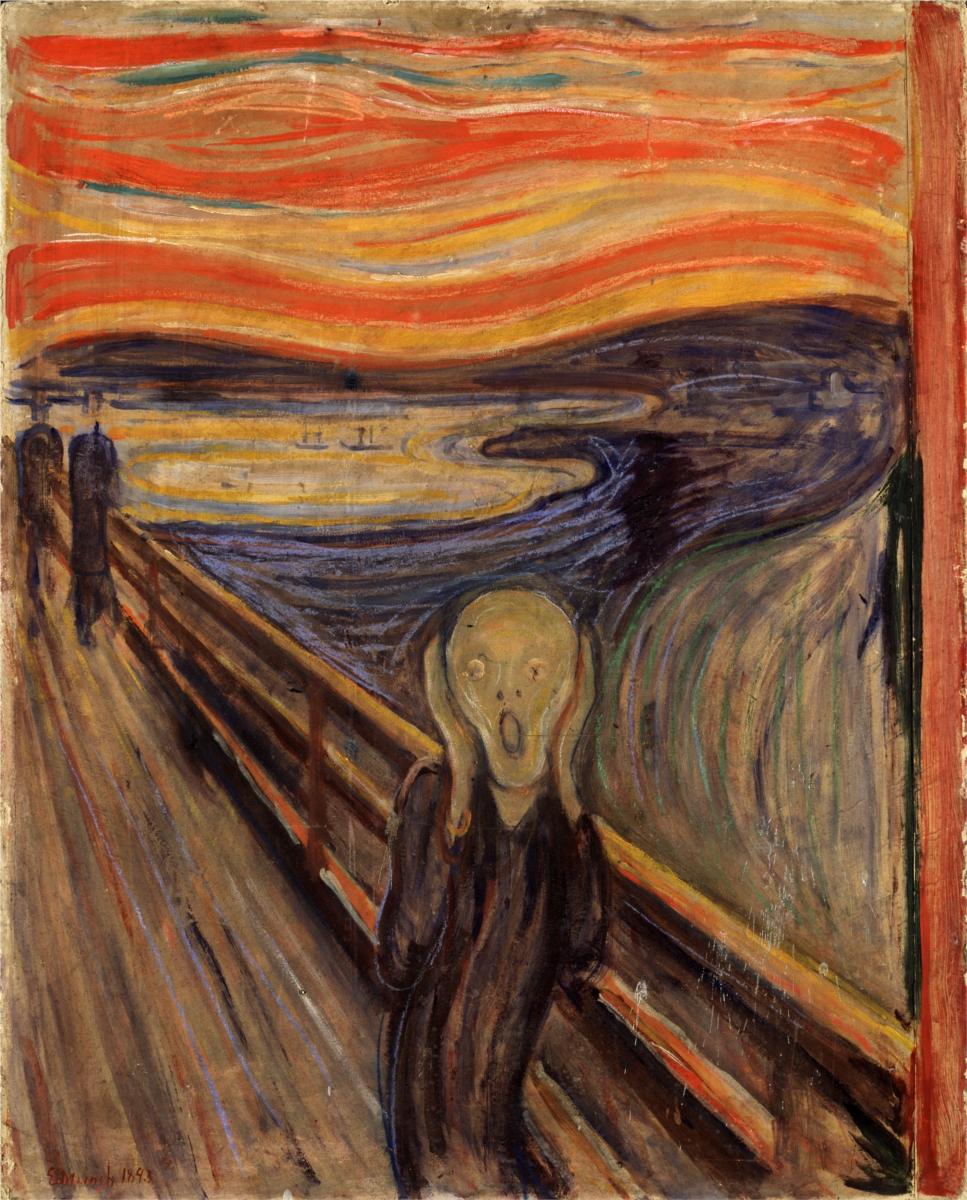
Image source: wikiart.org
Introduction
Edvard Munch’s The Scream from 1893 is one of the most recognizable images in the history of art. Even people who know very little about painting usually know this face, this bridge, and this burning sky. The picture has entered popular culture so completely that it can sometimes seem too familiar, yet that familiarity should not hide how radical and unsettling the work really is. Munch created an image that feels immediate, unstable, and emotionally raw. Rather than presenting the world as calm, ordered, and visible, he transformed it into a vibrating field of fear, isolation, and psychic pressure.
What makes The Scream so enduring is that it does not simply show a person who is afraid. It makes the entire world appear to participate in that fear. The sky writhes in bands of red and orange, the water curves into the same flowing rhythms, and even the landscape seems to lose its solidity. The figure in the foreground is no longer a secure individual standing apart from nature. Instead, the person seems to dissolve into the same waves of force that move through the sky and the land. The result is a painting that feels less like a scene observed from life and more like an inner state made visible.
This is one of the great achievements of Munch’s art. He did not want painting to remain limited to surfaces, likenesses, or social appearances. He wanted it to enter the emotional and psychological life of modern human beings. In The Scream, he found a visual language capable of doing exactly that. The picture condenses anxiety, alienation, memory, and dread into one unforgettable image. It is at once deeply personal and strangely universal, which is why it continues to speak to viewers more than a century after it was made.
Historical Context and Munch’s Artistic Vision
To understand The Scream, it helps to place it within the larger direction of Munch’s career. Born in Norway in 1863, Munch developed as an artist at a time when European painting was changing rapidly. Academic traditions still carried great authority, but many artists were turning away from polished realism and toward more subjective, experimental forms of expression. Impressionism had already loosened the old rules of representation, and Symbolism encouraged artists to suggest states of mind, dreams, and spiritual unease rather than merely recording visible reality.
Munch absorbed these changes, but he took them in a uniquely intense direction. He was less interested in fleeting light effects than in the emotional life of human beings. Love, jealousy, illness, desire, loneliness, and death became recurring themes in his work. His art often emerged from painful personal experience, including early family losses and a lifelong sense of psychological vulnerability. Yet he did not present these themes as private confessions alone. He transformed them into images that seem to touch universal experiences of fear and longing.
The Scream belongs to a broader group of works in which Munch explored the emotional crises of modern life. He was trying to create an art stripped of comforting illusion. Instead of balanced compositions and idealized forms, he embraced distortion, simplification, and expressive color. These choices were not technical accidents. They were part of a deliberate effort to show what feelings look like when they overwhelm ordinary perception.
In this sense, The Scream anticipates later Expressionism. The painting rejects the idea that art should calmly mirror the world. It insists that the world is filtered through emotion, memory, and anxiety. Munch was not painting the bridge and the sky as neutral objects. He was painting the terror of consciousness itself, and he did so in a way that opened new possibilities for modern art.
The Scene and Its Immediate Impact
At first glance, the painting appears simple. A figure stands on a bridge or walkway, hands pressed against the sides of the face, mouth open in what seems like a cry. Two other figures walk farther back along the bridge. Beyond them lies water, distant land, and a sky streaked with intense red and orange. Yet this apparent simplicity is deceptive, because almost every element in the painting contributes to a feeling of emotional dislocation.
The bridge creates a strong diagonal that pulls the viewer into the image. It begins near the lower edge and recedes sharply into the distance. This perspective device should create order and stability, but Munch uses it in a disturbing way. The bridge channels the viewer toward the background, while the foreground figure interrupts that movement with an overwhelming emotional presence. There is a tension between the straight structural lines of the bridge and the swirling curves of the landscape and sky. The human-made element seems rigid and narrow, while nature appears fluid, alive, and unstable.
The central figure is what viewers remember most. The face is skull-like, simplified to a pale mask with hollow eyes and an open oval mouth. The body is reduced to a dark, narrow form. Individual features have been stripped away. This person is not presented as a fully described portrait. Instead, the figure becomes a sign of raw human vulnerability. Because the features are generalized, viewers can project themselves into the image more easily. The figure becomes not just one individual, but an emblem of existential terror.
The two background figures intensify this effect. They continue walking, apparently untouched by the emotional crisis in the foreground. Their distance suggests separation and isolation. Whether they are companions who fail to understand, or simply other people moving through the same world without sharing the same emotional state, their presence makes the central figure’s experience feel lonelier. The scream does not bring connection. It marks a rupture between the self and others.
Composition and the Language of Distortion
One of the most powerful aspects of The Scream is its composition. Munch carefully organized the painting to create tension between structure and collapse. The bridge, with its railing and receding lines, provides a strong geometric framework. It is one of the few stable elements in the image. Against this controlled structure, almost everything else seems to undulate and tremble.
The sky is the most dramatic example. Instead of a naturalistic atmosphere, Munch paints broad bands of red, orange, yellow, and blue that sweep horizontally across the surface. These lines do not sit quietly in the background. They vibrate with force, as though sound waves or emotional currents have taken possession of the air itself. The water and land echo this same curving movement. Nature does not appear fixed. It appears transformed by sensation.
This distortion is essential to the meaning of the painting. Munch was not trying to render topographical accuracy. He was turning the visible world into an extension of inner experience. The curves in the sky and landscape suggest that the figure’s terror is not confined within the body. It radiates outward, infecting everything around it. The entire composition feels like a resonance chamber for anxiety.
The placement of the central figure is equally important. Positioned near the front of the picture, the figure confronts the viewer directly. Yet the figure is also visually fragile, almost swallowed by the surrounding lines and colors. This balance between confrontation and dissolution gives the work much of its power. The scream is immediate, but the self that utters it seems to be losing coherence.
Munch’s distortions also produce a sense of instability in the viewer. The eye cannot settle comfortably. It moves along the bridge, then is pulled back by the face, then swept upward into the flaming sky. The result is a deeply unsettling viewing experience. The painting does not invite calm contemplation. It creates a visual rhythm of tension, disruption, and emotional exposure.
Color and Atmosphere
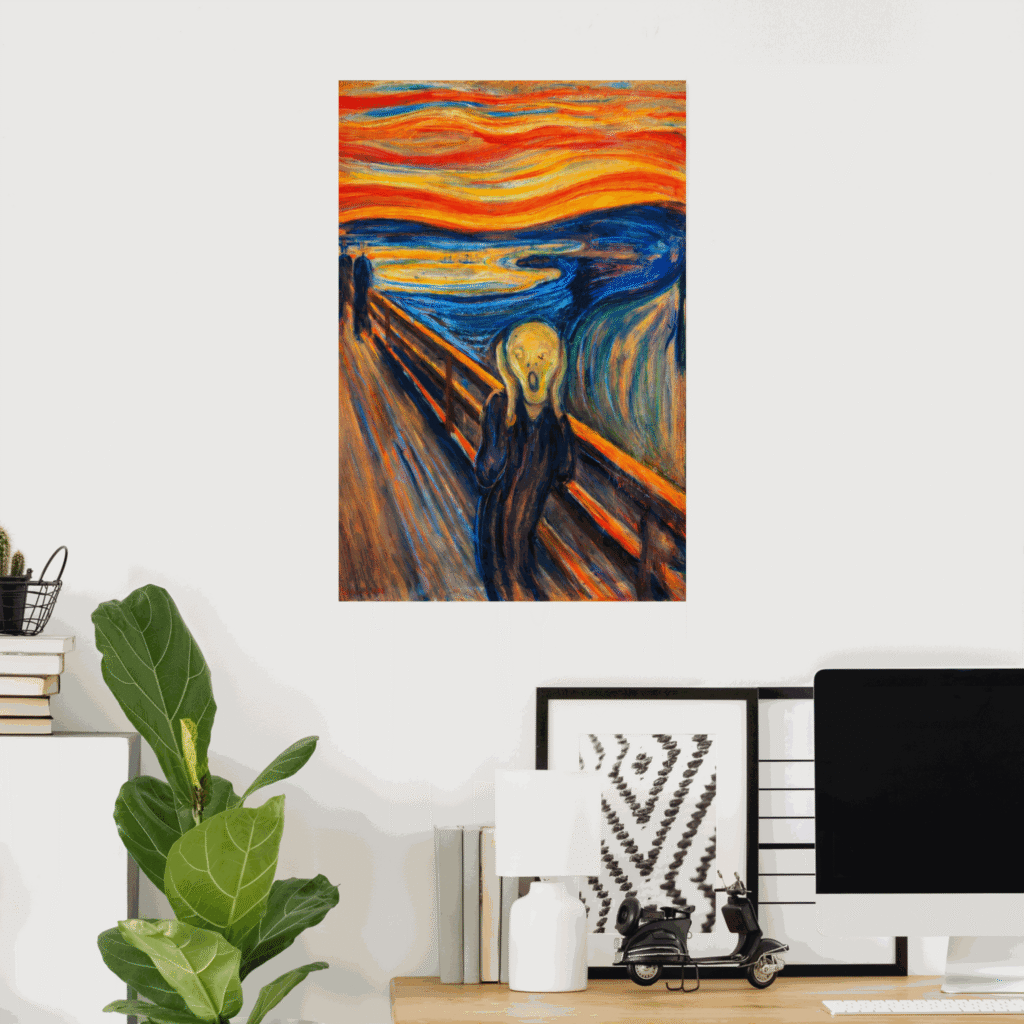
Color is one of the keys to the emotional force of The Scream. Munch did not use color descriptively in a conventional sense. He used it expressively, shaping the emotional weather of the painting. The sky is the most obvious example. Its intense reds and oranges create a sense of heat, danger, and alarm. These are not peaceful sunset colors. They feel almost violent, as though the sky itself has become wounded or inflamed.
The contrast between the warm sky and the darker blues and blacks of the water and land heightens the drama. The dark forms below seem heavy and suffocating, while the glowing sky above pulses with agitation. This opposition gives the picture a strange, feverish intensity. The world feels divided between burning energy and oppressive shadow.
The pale face of the central figure stands out sharply against these surrounding colors. It has a ghostly, almost sickly quality, as though drained of life. This pallor makes the figure look exposed and defenseless. It also creates a strong focal point, drawing the eye immediately to the face and mouth. The scream is not only heard in imagination. It is staged chromatically through contrast.
Munch’s brushwork adds to this atmosphere. The paint is handled in a way that emphasizes movement and instability. Lines ripple and flow rather than resting in clean edges. This gives the whole surface a trembling quality. The painting seems to be in motion, as though reality itself is shuddering. That visual vibration is crucial to the emotional content. The world of The Scream is not just seen. It is felt as a nervous disturbance.
The overall atmosphere is one of sensory overload. Light, color, and line refuse serenity. Everything seems charged with emotion. This is why the painting can feel so contemporary even now. It conveys a kind of psychic intensity that many viewers recognize immediately, whether they interpret it as anxiety, panic, dread, or alienation.
The Figure as a Universal Symbol
The central figure in The Scream has become one of the most iconic forms in all of art because it is both specific and anonymous. Munch gives enough detail to make the figure intensely memorable, but not enough to anchor it to a distinct identity. We do not know exactly who this person is. We do not even know with certainty whether the figure is screaming or hearing a scream passing through nature. That ambiguity gives the image its remarkable breadth of meaning.
The face resembles a mask or a skull. It is stripped of conventional beauty, gendered detail, and individualized personality. The body, too, is simplified into a dark vertical shape. This reduction makes the figure seem almost posthuman, as though intense emotion has melted away ordinary identity. The person becomes a vessel for sensation rather than a character in a narrative.
This abstraction is one reason the figure has had such broad cultural afterlife. It can stand for panic, despair, alienation, or existential fear in general. Yet in the painting itself, the figure is not merely a symbol in an abstract sense. It is also a deeply embodied presence. The hands press against the head, suggesting pressure, vulnerability, and an attempt either to contain or to defend against overwhelming sensation. The open mouth indicates a threshold where interior pain becomes external sound.
There is also a haunting contradiction in the figure’s pose. It seems both active and passive. On one hand, the open mouth suggests expression, a cry released into the world. On the other hand, the hands over the ears suggest that the figure may be recoiling from a scream already present in the environment. This uncertainty is central to the painting’s meaning. Fear is not neatly located either inside or outside the self. It passes between person and world, dissolving the boundary between them.
Because of this, the figure has endured as a universal sign of psychological distress. Munch did not create an image of heroic suffering or dramatic action. He created an image of exposed consciousness, a person suddenly unable to hold the world together in stable form. That experience remains painfully recognizable.
Alienation, Modernity, and Existential Anxiety
Although The Scream can be read in personal and emotional terms, it also belongs to a broader modern experience. The late nineteenth century was a period of social and intellectual change, marked by urbanization, secularization, scientific upheaval, and shifting ideas about the self. Traditional certainties were weakening, and many artists and writers became increasingly concerned with inner instability, loneliness, and the fragility of meaning.
Munch’s painting captures this atmosphere with extraordinary force. The central figure is isolated not only from the surrounding people but from the world itself. The bridge, which should function as a path or connection, becomes instead a stage for disconnection. The two distant figures remain self-contained and unreachable. The landscape no longer offers comfort or harmony. Nature appears disturbed, even menacing.
This sense of alienation is one reason The Scream has often been linked to existential anxiety. The painting presents a moment in which the self confronts a universe that no longer feels stable, comforting, or intelligible. The scream becomes an answer to that confrontation, though it is an answer without resolution. Nothing is solved. The image remains suspended in the intensity of the moment.
What makes the work especially modern is that it does not depend on a traditional religious or mythological framework to explain suffering. There is no divine drama, no clear moral narrative, and no heroic redemption. The terror in the painting is immediate and psychological. It arises in ordinary space, on a bridge, in the presence of other people, under an open sky. That ordinary setting makes the emotional event even more unsettling, because it suggests that overwhelming dread can erupt within everyday life.
The painting therefore speaks not only to Munch’s personal experience but to a broader condition of modern consciousness. It visualizes what it feels like when the world becomes too intense to bear, when perception itself turns unstable, and when the self is left radically alone within that experience.
Why The Scream Still Feels So Powerful Today
One reason The Scream remains so compelling is that it addresses emotions that have not disappeared with time. Viewers continue to recognize in it a powerful image of panic, dread, and mental strain. The painting seems to understand something fundamental about human vulnerability. It conveys the sensation of being overwhelmed in a way that is immediate even for contemporary audiences.
Its continued power also comes from its formal daring. Many images of suffering rely on narrative detail, dramatic action, or realistic description. Munch achieves something more concentrated. He reduces the scene to essential elements and lets color, line, and distortion carry the emotional charge. Because the image is so stripped down and direct, it remains legible across cultures and generations.
At the same time, the painting is not exhausted by instant recognition. The more one studies it, the more complex it becomes. It can be read psychologically, symbolically, socially, and formally. It is at once a landscape, a figure study, and a meditation on consciousness. That layered quality helps explain why it remains central to art history rather than merely popular culture.
Another reason for its endurance is that it captures a paradox many people still feel. We live among others, yet often experience intense emotions in isolation. We move through familiar environments that can suddenly become uncanny. We seek control, yet perception itself can seem unstable under pressure. The Scream gives visual form to these contradictions with startling clarity.
Munch created more than an image of fear. He created an image of what it means for fear to transform reality. That is why the painting continues to feel alive. It is not simply looked at. It acts upon the viewer, stirring unease and recognition at the same time.
Conclusion
The Scream is one of the defining masterpieces of modern art because it transforms emotion into form with extraordinary directness. Edvard Munch took a relatively simple scene and turned it into a vision of psychological and existential crisis. Through distortion, expressive color, unstable movement, and radical simplification, he created an image in which the self and the world seem to tremble together.
The painting’s greatness lies in its refusal to separate outer reality from inner experience. The bridge, the sky, the water, the distant figures, and the central face all participate in a single emotional event. Anxiety is not shown as a hidden feeling locked inside a private mind. It becomes atmospheric, environmental, and universal. The entire world seems to cry out.
That fusion of personal anguish and universal meaning is what gives The Scream its lasting force. It speaks to fear, alienation, and vulnerability in a language that remains instantly understandable, yet it does so with enough ambiguity and formal richness to support endless interpretation. The image is unforgettable not only because it is dramatic, but because it feels true to experiences that are difficult to explain in words.
More than a century after it was painted, The Scream still confronts viewers with the fragile edge between self and world, perception and emotion, silence and sound. It remains a haunting reminder that art can do more than represent appearances. It can reveal the deepest tremors of human consciousness.
